

166
M. N. Yahya et al.
d
+
i =
⎛
⎝
n
j=1
v i j − v
+
j
p
⎞
⎠
1/ p
, . . . i = 1, 2, . . . , m.
(16.7)
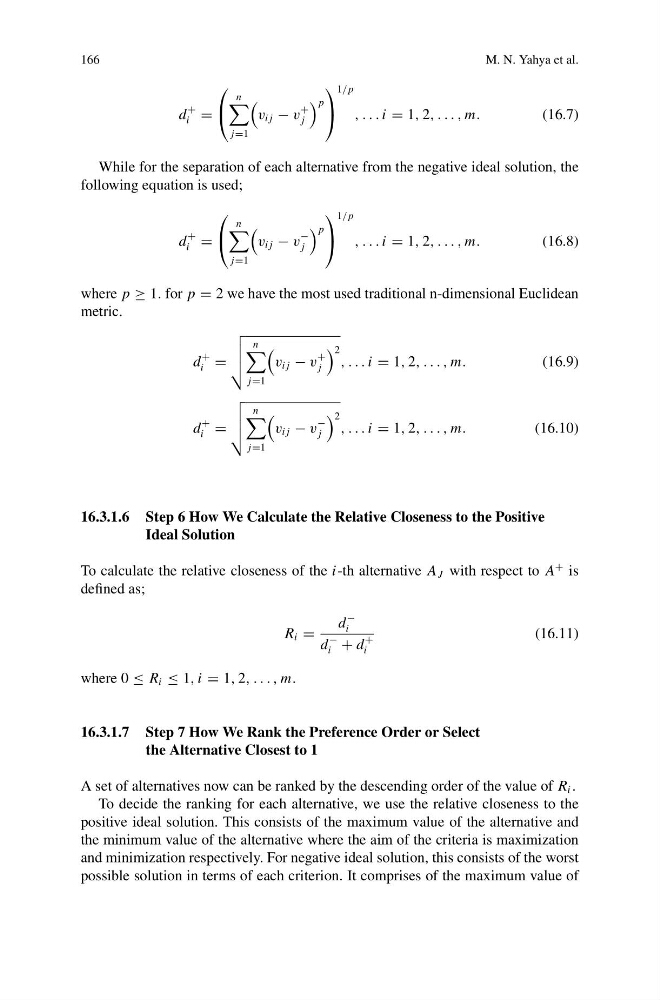
While for the separation of each alternative from the negative ideal solution, the
following equation is used;
d
+
i =
⎛
⎝
n
j=1
v i j − v
−
j
p
⎞
⎠
1/ p
, . . . i = 1, 2, . . . , m.
(16.8)
where p ≥ 1. for p = 2 we have the most used traditional n-dimensional Euclidean
metric.
d
+
i =
n
j=1
v i j − v
+
j
2 , . . . i = 1, 2, . . . , m.
(16.9)
d
+
i =
n
j=1
v i j − v
−
j
2 , . . . i = 1, 2, . . . , m.
(16.10)
16.3.1.6 Step 6 How We Calculate the Relative Closeness to the Positive
Ideal Solution
To calculate the relative closeness of the i-th alternative A J with respect to A
+ is
defined as;
R i =
d
−
i
d
−
i + d
+
i
(16.11)
where 0 ≤ R i ≤ 1, i = 1, 2, . . . , m.
16.3.1.7 Step 7 How We Rank the Preference Order or Select
the Alternative Closest to 1
A set of alternatives now can be ranked by the descending order of the value of R i .
To decide the ranking for each alternative, we use the relative closeness to the
positive ideal solution. This consists of the maximum value of the alternative and
the minimum value of the alternative where the aim of the criteria is maximization
and minimization respectively. For negative ideal solution, this consists of the worst
possible solution in terms of each criterion. It comprises of the maximum value of
M. N. Yahya et al.
d
+
i =
⎛
⎝
n
j=1
v i j − v
+
j
p
⎞
⎠
1/ p
, . . . i = 1, 2, . . . , m.
(16.7)
While for the separation of each alternative from the negative ideal solution, the
following equation is used;
d
+
i =
⎛
⎝
n
j=1
v i j − v
−
j
p
⎞
⎠
1/ p
, . . . i = 1, 2, . . . , m.
(16.8)
where p ≥ 1. for p = 2 we have the most used traditional n-dimensional Euclidean
metric.
d
+
i =
n
j=1
v i j − v
+
j
2 , . . . i = 1, 2, . . . , m.
(16.9)
d
+
i =
n
j=1
v i j − v
−
j
2 , . . . i = 1, 2, . . . , m.
(16.10)
16.3.1.6 Step 6 How We Calculate the Relative Closeness to the Positive
Ideal Solution
To calculate the relative closeness of the i-th alternative A J with respect to A
+ is
defined as;
R i =
d
−
i
d
−
i + d
+
i
(16.11)
where 0 ≤ R i ≤ 1, i = 1, 2, . . . , m.
16.3.1.7 Step 7 How We Rank the Preference Order or Select
the Alternative Closest to 1
A set of alternatives now can be ranked by the descending order of the value of R i .
To decide the ranking for each alternative, we use the relative closeness to the
positive ideal solution. This consists of the maximum value of the alternative and
the minimum value of the alternative where the aim of the criteria is maximization
and minimization respectively. For negative ideal solution, this consists of the worst
possible solution in terms of each criterion. It comprises of the maximum value of