

16 Comparative Analysis for Irrigation Water Application Methods …
165
if C i is a benefit criterion and if C i is a cost criterion
For i = 1, . . . , m; j = 1, . . . , n.
16.3.1.3 Step 3 How to Calculate the Weighted Normalized Decision
Matrix
To calculate the weighted normalized value v i j , this is done in the following way:
v i j = w j n i j
(16.4)
For i = 1, . . . , m; j = 1, . . . , n.
Where w j is the weight of the j-th criterion,
n
j=1
w j = 1.
16.3.1.4 Step 4 Determination of the Positive Ideal and Negative Ideal
Solutions
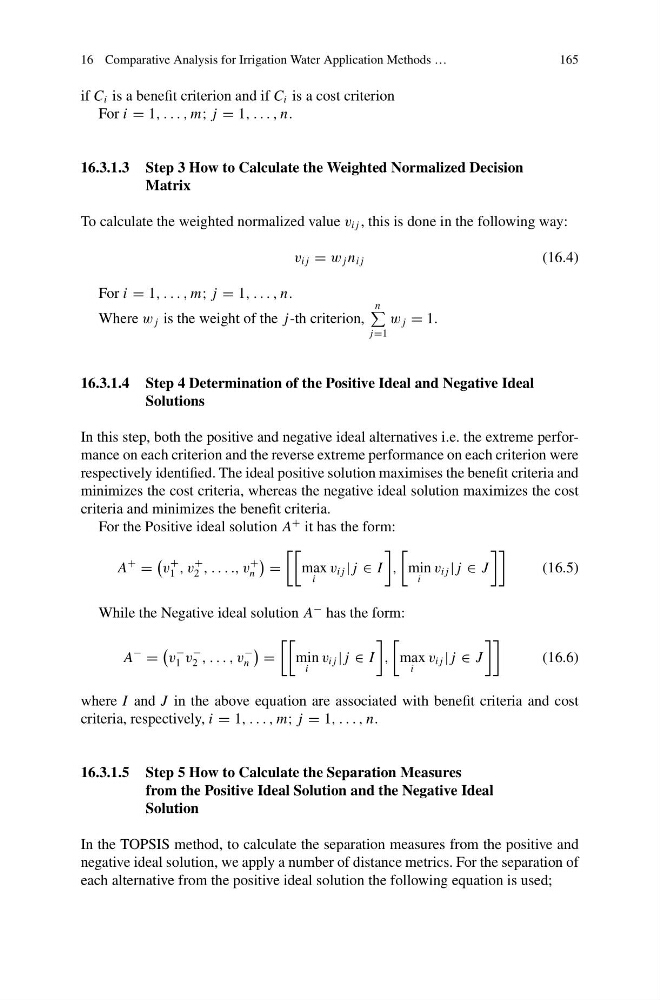
In this step, both the positive and negative ideal alternatives i.e. the extreme performance on each criterion and the reverse extreme performance on each criterion were
respectively identified. The ideal positive solution maximises the benefit criteria and
minimizes the cost criteria, whereas the negative ideal solution maximizes the cost
criteria and minimizes the benefit criteria.
For the Positive ideal solution A
+ it has the form:
A
+
=
v
+
1 , v
+
2 , . . . ., v
+
n
=
max
i
v i j | j ∈ I
,
min
i
v i j | j ∈ J
(16.5)
While the Negative ideal solution A
− has the form:
A
−
=
v
−
1 v
−
2 , . . . , v
−
n
=
min
i
v i j | j ∈ I
,
max
i
v i j | j ∈ J
(16.6)
where I and J in the above equation are associated with benefit criteria and cost
criteria, respectively, i = 1, . . . , m; j = 1, . . . , n.
16.3.1.5 Step 5 How to Calculate the Separation Measures
from the Positive Ideal Solution and the Negative Ideal
Solution
In the TOPSIS method, to calculate the separation measures from the positive and
negative ideal solution, we apply a number of distance metrics. For the separation of
each alternative from the positive ideal solution the following equation is used;
165
if C i is a benefit criterion and if C i is a cost criterion
For i = 1, . . . , m; j = 1, . . . , n.
16.3.1.3 Step 3 How to Calculate the Weighted Normalized Decision
Matrix
To calculate the weighted normalized value v i j , this is done in the following way:
v i j = w j n i j
(16.4)
For i = 1, . . . , m; j = 1, . . . , n.
Where w j is the weight of the j-th criterion,
n
j=1
w j = 1.
16.3.1.4 Step 4 Determination of the Positive Ideal and Negative Ideal
Solutions
In this step, both the positive and negative ideal alternatives i.e. the extreme performance on each criterion and the reverse extreme performance on each criterion were
respectively identified. The ideal positive solution maximises the benefit criteria and
minimizes the cost criteria, whereas the negative ideal solution maximizes the cost
criteria and minimizes the benefit criteria.
For the Positive ideal solution A
+ it has the form:
A
+
=
v
+
1 , v
+
2 , . . . ., v
+
n
=
max
i
v i j | j ∈ I
,
min
i
v i j | j ∈ J
(16.5)
While the Negative ideal solution A
− has the form:
A
−
=
v
−
1 v
−
2 , . . . , v
−
n
=
min
i
v i j | j ∈ I
,
max
i
v i j | j ∈ J
(16.6)
where I and J in the above equation are associated with benefit criteria and cost
criteria, respectively, i = 1, . . . , m; j = 1, . . . , n.
16.3.1.5 Step 5 How to Calculate the Separation Measures
from the Positive Ideal Solution and the Negative Ideal
Solution
In the TOPSIS method, to calculate the separation measures from the positive and
negative ideal solution, we apply a number of distance metrics. For the separation of
each alternative from the positive ideal solution the following equation is used;