

164
M. N. Yahya et al.
16.3 Methodology
16.3.1 Technique for Order of Preference by Similarity
to Ideal Solution (TOPSIS)
This study will use a fuzzy TOPSIS technique to analyse different irrigation water
application methods or systems. In the TOPSIS method, we usually assume some
rating and weights which are normally represented numerically for any problem
solution to be made by a single decision-maker. But for a multiple decision making,
complexity do arise due to the fact that preferred solution in this case need to be
agreed by different interest groups or people with different goals and opinion. This
is systematically described below at different steps.
16.3.1.1 Step 1: Construction of the Decision Matrix
and the Determination of the Weight of Each Criteria
In step 1, a decision matrix X = X ij and a weighing vector W = [w 1 , w 2 , . . . w n ] are
chosen. Where X ij ∈ ∈, W j ∈ ∈ and w 1 + w 2 + ….w n = 1.
The criteria of the function can be either a cost function (less cost better result)
or a benefit function (more criteria better results).
16.3.1.2 Step 2 Calculation of the Normalized Decision Matrix
In this step, comparison is made across all criteria to be used; this is done by transforming all attribute dimensions into non-dimensional attributes. To make all scores
into normalize form, a transformation is been made for each evaluation matrix X,
because the majority of the criteria are usually measured in various units. One of the
several known standards formulas out of many is used for the normalisation of these
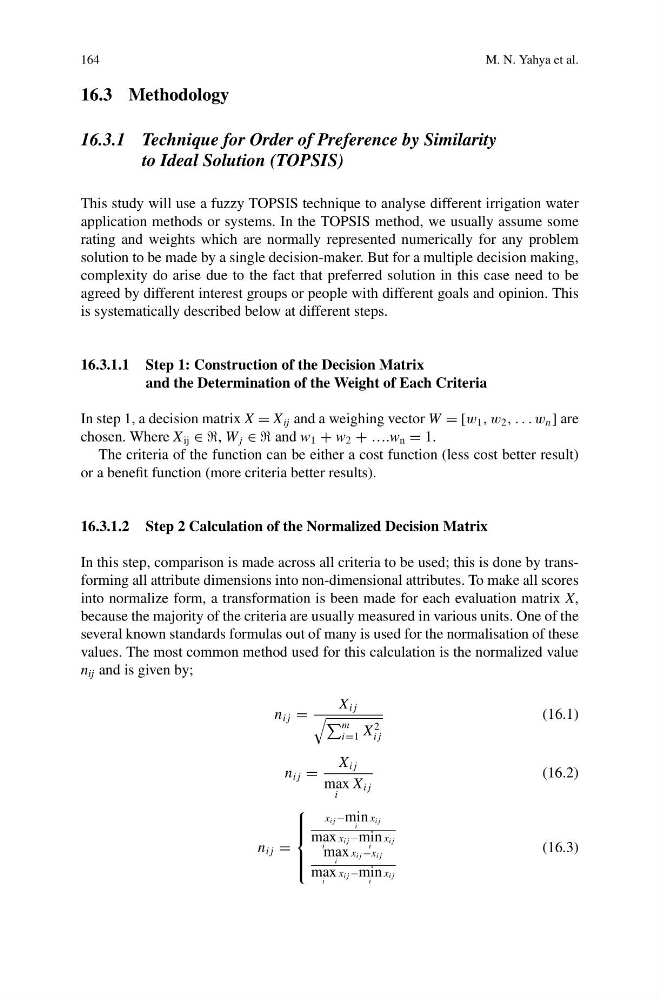
values. The most common method used for this calculation is the normalized value
n ij and is given by;
n i j =
X i j
m
i=1 X
2
i j
(16.1)
n i j =
X i j
max
i
X i j
(16.2)
n i j =
⎧
⎪ ⎪ ⎨
⎪ ⎪ ⎩
x i j −min
i
x i j
max
i
x i j −min
i
x i j
max
i
x i j −x i j
max
i
x i j −min
i
x i j
(16.3)
M. N. Yahya et al.
16.3 Methodology
16.3.1 Technique for Order of Preference by Similarity
to Ideal Solution (TOPSIS)
This study will use a fuzzy TOPSIS technique to analyse different irrigation water
application methods or systems. In the TOPSIS method, we usually assume some
rating and weights which are normally represented numerically for any problem
solution to be made by a single decision-maker. But for a multiple decision making,
complexity do arise due to the fact that preferred solution in this case need to be
agreed by different interest groups or people with different goals and opinion. This
is systematically described below at different steps.
16.3.1.1 Step 1: Construction of the Decision Matrix
and the Determination of the Weight of Each Criteria
In step 1, a decision matrix X = X ij and a weighing vector W = [w 1 , w 2 , . . . w n ] are
chosen. Where X ij ∈ ∈, W j ∈ ∈ and w 1 + w 2 + ….w n = 1.
The criteria of the function can be either a cost function (less cost better result)
or a benefit function (more criteria better results).
16.3.1.2 Step 2 Calculation of the Normalized Decision Matrix
In this step, comparison is made across all criteria to be used; this is done by transforming all attribute dimensions into non-dimensional attributes. To make all scores
into normalize form, a transformation is been made for each evaluation matrix X,
because the majority of the criteria are usually measured in various units. One of the
several known standards formulas out of many is used for the normalisation of these
values. The most common method used for this calculation is the normalized value
n ij and is given by;
n i j =
X i j
m
i=1 X
2
i j
(16.1)
n i j =
X i j
max
i
X i j
(16.2)
n i j =
⎧
⎪ ⎪ ⎨
⎪ ⎪ ⎩
x i j −min
i
x i j
max
i
x i j −min
i
x i j
max
i
x i j −x i j
max
i
x i j −min
i
x i j
(16.3)