

1 3
Topics in Current Chemistry (2019) 377:2
reactor [86]. However, results indicated that the rate of O 2 supply may not be suf‑
ficient for fast reactions not to be mass transfer limited [87].
7.2 Tube‑in‑Shell Reactor
Stahl and co‑workers reported a tube‑in‑shell reactor (also referred to as tube‑in‑
flask reactor) as an alternative membrane strategy for the safe introduction of O 2
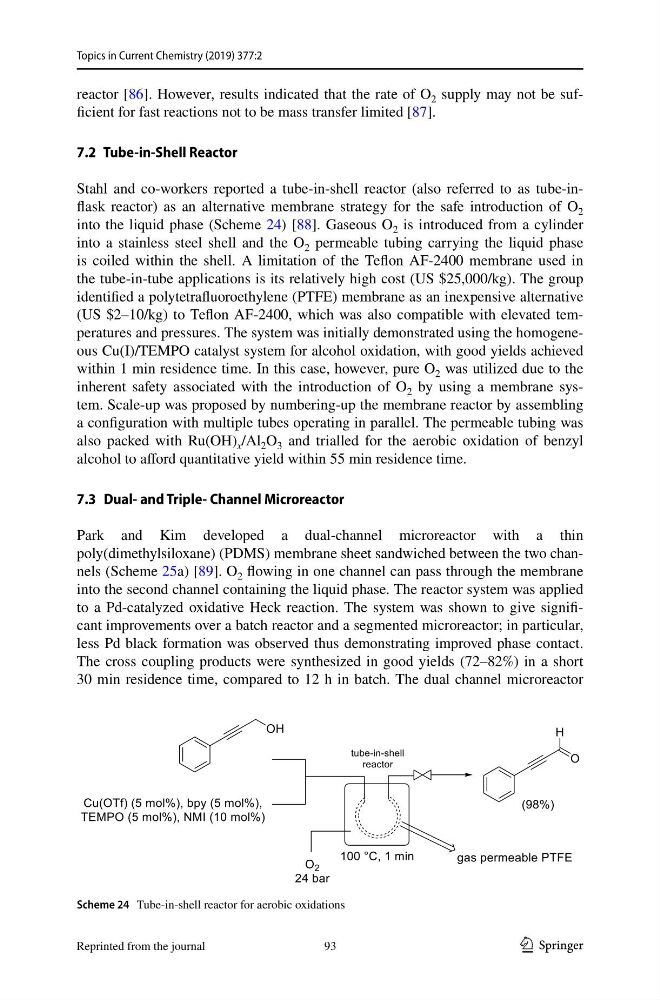
into the liquid phase (Scheme 24) [88]. Gaseous O 2 is introduced from a cylinder
into a stainless steel shell and the O 2 permeable tubing carrying the liquid phase
is coiled within the shell. A limitation of the Teflon AF‑2400 membrane used in
the tube‑in‑tube applications is its relatively high cost (US $25,000/kg). The group
identified a polytetrafluoroethylene (PTFE) membrane as an inexpensive alternative
(US $2–10/kg) to Teflon AF‑2400, which was also compatible with elevated tem‑
peratures and pressures. The system was initially demonstrated using the homogene‑
ous Cu(I)/TEMPO catalyst system for alcohol oxidation, with good yields achieved
within 1 min residence time. In this case, however, pure O 2 was utilized due to the
inherent safety associated with the introduction of O 2 by using a membrane sys‑
tem. Scale‑up was proposed by numbering‑up the membrane reactor by assembling
a configuration with multiple tubes operating in parallel. The permeable tubing was
also packed with Ru(OH) x /Al 2 O 3 and trialled for the aerobic oxidation of benzyl
alcohol to afford quantitative yield within 55 min residence time.
7.3 Dual‑ and Triple‑ Channel Microreactor
Park and Kim developed a dual‑channel microreactor with a thin
poly(dimethylsiloxane) (PDMS) membrane sheet sandwiched between the two chan‑
nels (Scheme 25a) [89]. O 2 flowing in one channel can pass through the membrane
into the second channel containing the liquid phase. The reactor system was applied
to a Pd‑catalyzed oxidative Heck reaction. The system was shown to give signifi‑
cant improvements over a batch reactor and a segmented microreactor; in particular,
less Pd black formation was observed thus demonstrating improved phase contact.
The cross coupling products were synthesized in good yields (72–82%) in a short
30 min residence time, compared to 12 h in batch. The dual channel microreactor
Scheme 24 Tube‑in‑shell reactor for aerobic oxidations
93
Reprinted from the journal
Topics in Current Chemistry (2019) 377:2
reactor [86]. However, results indicated that the rate of O 2 supply may not be suf‑
ficient for fast reactions not to be mass transfer limited [87].
7.2 Tube‑in‑Shell Reactor
Stahl and co‑workers reported a tube‑in‑shell reactor (also referred to as tube‑in‑
flask reactor) as an alternative membrane strategy for the safe introduction of O 2
into the liquid phase (Scheme 24) [88]. Gaseous O 2 is introduced from a cylinder
into a stainless steel shell and the O 2 permeable tubing carrying the liquid phase
is coiled within the shell. A limitation of the Teflon AF‑2400 membrane used in
the tube‑in‑tube applications is its relatively high cost (US $25,000/kg). The group
identified a polytetrafluoroethylene (PTFE) membrane as an inexpensive alternative
(US $2–10/kg) to Teflon AF‑2400, which was also compatible with elevated tem‑
peratures and pressures. The system was initially demonstrated using the homogene‑
ous Cu(I)/TEMPO catalyst system for alcohol oxidation, with good yields achieved
within 1 min residence time. In this case, however, pure O 2 was utilized due to the
inherent safety associated with the introduction of O 2 by using a membrane sys‑
tem. Scale‑up was proposed by numbering‑up the membrane reactor by assembling
a configuration with multiple tubes operating in parallel. The permeable tubing was
also packed with Ru(OH) x /Al 2 O 3 and trialled for the aerobic oxidation of benzyl
alcohol to afford quantitative yield within 55 min residence time.
7.3 Dual‑ and Triple‑ Channel Microreactor
Park and Kim developed a dual‑channel microreactor with a thin
poly(dimethylsiloxane) (PDMS) membrane sheet sandwiched between the two chan‑
nels (Scheme 25a) [89]. O 2 flowing in one channel can pass through the membrane
into the second channel containing the liquid phase. The reactor system was applied
to a Pd‑catalyzed oxidative Heck reaction. The system was shown to give signifi‑
cant improvements over a batch reactor and a segmented microreactor; in particular,
less Pd black formation was observed thus demonstrating improved phase contact.
The cross coupling products were synthesized in good yields (72–82%) in a short
30 min residence time, compared to 12 h in batch. The dual channel microreactor
Scheme 24 Tube‑in‑shell reactor for aerobic oxidations
93
Reprinted from the journal