

Topics in Current Chemistry (2019) 377:2
1 3
of 4‑methoxyphenylboronic acid and cyclohex‑2‑enone conducted within a seg‑
mented flow regime and tube‑in‑tube reactor were comparable, 85% and 84%,
respectively.
The performance of reactions can be improved by the continuous supply of O 2
through the membrane during the reaction, thus replenishing O 2 as it is consumed,
rather than pre‑saturating the liquid feed prior to the reaction. Continuous penentra‑
tion of gas ensures that the liquid phase is saturated with O 2 throughout the reaction.
Enzyme‑mediated oxidation chemistry is an emerging topic in organic synthesis
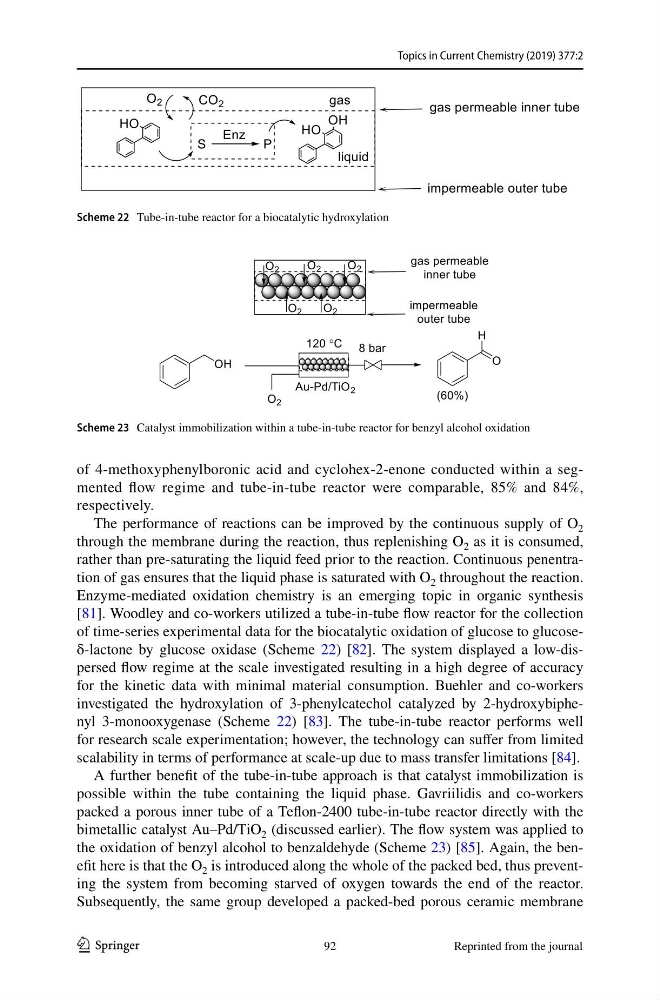
[81]. Woodley and co‑workers utilized a tube‑in‑tube flow reactor for the collection
of time‑series experimental data for the biocatalytic oxidation of glucose to glucose‑
δ‑lactone by glucose oxidase (Scheme 22) [82]. The system displayed a low‑dis‑
persed flow regime at the scale investigated resulting in a high degree of accuracy
for the kinetic data with minimal material consumption. Buehler and co‑workers
investigated the hydroxylation of 3‑phenylcatechol catalyzed by 2‑hydroxybiphe‑
nyl 3‑monooxygenase (Scheme 22) [83]. The tube‑in‑tube reactor performs well
for research scale experimentation; however, the technology can suffer from limited
scalability in terms of performance at scale‑up due to mass transfer limitations [84].
A further benefit of the tube‑in‑tube approach is that catalyst immobilization is
possible within the tube containing the liquid phase. Gavriilidis and co‑workers
packed a porous inner tube of a Teflon‑2400 tube‑in‑tube reactor directly with the
bimetallic catalyst Au–Pd/TiO 2 (discussed earlier). The flow system was applied to
the oxidation of benzyl alcohol to benzaldehyde (Scheme 23) [85]. Again, the ben‑
efit here is that the O 2 is introduced along the whole of the packed bed, thus prevent‑
ing the system from becoming starved of oxygen towards the end of the reactor.
Subsequently, the same group developed a packed‑bed porous ceramic membrane
Scheme 22 Tube‑in‑tube reactor for a biocatalytic hydroxylation
Scheme 23 Catalyst immobilization within a tube‑in‑tube reactor for benzyl alcohol oxidation
92
Reprinted from the journal
1 3
of 4‑methoxyphenylboronic acid and cyclohex‑2‑enone conducted within a seg‑
mented flow regime and tube‑in‑tube reactor were comparable, 85% and 84%,
respectively.
The performance of reactions can be improved by the continuous supply of O 2
through the membrane during the reaction, thus replenishing O 2 as it is consumed,
rather than pre‑saturating the liquid feed prior to the reaction. Continuous penentra‑
tion of gas ensures that the liquid phase is saturated with O 2 throughout the reaction.
Enzyme‑mediated oxidation chemistry is an emerging topic in organic synthesis
[81]. Woodley and co‑workers utilized a tube‑in‑tube flow reactor for the collection
of time‑series experimental data for the biocatalytic oxidation of glucose to glucose‑
δ‑lactone by glucose oxidase (Scheme 22) [82]. The system displayed a low‑dis‑
persed flow regime at the scale investigated resulting in a high degree of accuracy
for the kinetic data with minimal material consumption. Buehler and co‑workers
investigated the hydroxylation of 3‑phenylcatechol catalyzed by 2‑hydroxybiphe‑
nyl 3‑monooxygenase (Scheme 22) [83]. The tube‑in‑tube reactor performs well
for research scale experimentation; however, the technology can suffer from limited
scalability in terms of performance at scale‑up due to mass transfer limitations [84].
A further benefit of the tube‑in‑tube approach is that catalyst immobilization is
possible within the tube containing the liquid phase. Gavriilidis and co‑workers
packed a porous inner tube of a Teflon‑2400 tube‑in‑tube reactor directly with the
bimetallic catalyst Au–Pd/TiO 2 (discussed earlier). The flow system was applied to
the oxidation of benzyl alcohol to benzaldehyde (Scheme 23) [85]. Again, the ben‑
efit here is that the O 2 is introduced along the whole of the packed bed, thus prevent‑
ing the system from becoming starved of oxygen towards the end of the reactor.
Subsequently, the same group developed a packed‑bed porous ceramic membrane
Scheme 22 Tube‑in‑tube reactor for a biocatalytic hydroxylation
Scheme 23 Catalyst immobilization within a tube‑in‑tube reactor for benzyl alcohol oxidation
92
Reprinted from the journal