

1 3
Topics in Current Chemistry (2019) 377:2
into the reaction mixture using the tube‑in‑tube gas‑loading tool, and the gas‑sat‑
urated solution then passed through a tubular reactor at 60 °C for 60 min. A cop‑
per‑catalyzed Glaser–Hay acetylene homocoupling reaction was also demonstrated
by the same group (Scheme 20b) [77]. The reaction mixture was loaded with the
tube‑in‑tube gas‑loading tool, and the gas‑saturated solution then passed through
a tubular reactor at 100 °C. The copper and the amine base were then removed
from the flow stream by passing it through a cartridge of polymer‑supported thio‑
urea and polymer‑supported sulfonic acid. The 1,3‑butadiynes were isolated in up
to quantitative yields, generally without the need for chromatography. Polyzos and
co‑workers translated the nitro‑Mannich α‑C(sp
3
)–H functionalization of N‑aryl
tetrahydroisoquinolines mediated by iron salts to flow by using the tube‑in‑tube
reactor for the introduction of O 2 (Scheme 20c) [78]. Kirschning and co‑workers
used a Teflon AF‑2400 tube‑in‑tube reactor to pre‑saturate the liquid feed with O 2
before the feed entered a packed‑bed reactor containing immobilized gold‑doped
nanoparticles (Scheme 20d) [79]. Au‑NPs were immobilized on a nanostructured
Fe 3 O 4 ‑containing core and a silica shell that was heated in an external oscillating
electromagnetic field to catalyze benzylic and allylic alcohol oxidation in the pres‑
ence of pure O 2 or air.
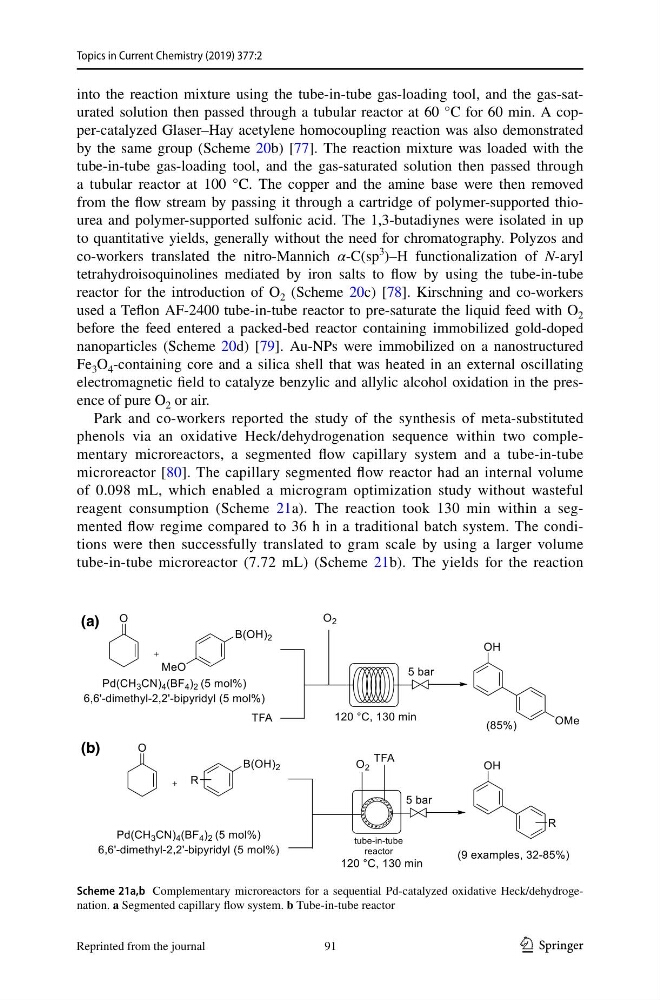
Park and co‑workers reported the study of the synthesis of meta‑substituted
phenols via an oxidative Heck/dehydrogenation sequence within two comple‑
mentary microreactors, a segmented flow capillary system and a tube‑in‑tube
microreactor [80]. The capillary segmented flow reactor had an internal volume
of 0.098 mL, which enabled a microgram optimization study without wasteful
reagent consumption (Scheme 21a). The reaction took 130 min within a seg‑
mented flow regime compared to 36 h in a traditional batch system. The condi‑
tions were then successfully translated to gram scale by using a larger volume
tube‑in‑tube microreactor (7.72 mL) (Scheme 21b). The yields for the reaction
(a)
(b)
Scheme 21a,b Complementary microreactors for a sequential Pd‑catalyzed oxidative Heck/dehydroge‑
nation. a Segmented capillary flow system. b Tube‑in‑tube reactor
91
Reprinted from the journal
Topics in Current Chemistry (2019) 377:2
into the reaction mixture using the tube‑in‑tube gas‑loading tool, and the gas‑sat‑
urated solution then passed through a tubular reactor at 60 °C for 60 min. A cop‑
per‑catalyzed Glaser–Hay acetylene homocoupling reaction was also demonstrated
by the same group (Scheme 20b) [77]. The reaction mixture was loaded with the
tube‑in‑tube gas‑loading tool, and the gas‑saturated solution then passed through
a tubular reactor at 100 °C. The copper and the amine base were then removed
from the flow stream by passing it through a cartridge of polymer‑supported thio‑
urea and polymer‑supported sulfonic acid. The 1,3‑butadiynes were isolated in up
to quantitative yields, generally without the need for chromatography. Polyzos and
co‑workers translated the nitro‑Mannich α‑C(sp
3
)–H functionalization of N‑aryl
tetrahydroisoquinolines mediated by iron salts to flow by using the tube‑in‑tube
reactor for the introduction of O 2 (Scheme 20c) [78]. Kirschning and co‑workers
used a Teflon AF‑2400 tube‑in‑tube reactor to pre‑saturate the liquid feed with O 2
before the feed entered a packed‑bed reactor containing immobilized gold‑doped
nanoparticles (Scheme 20d) [79]. Au‑NPs were immobilized on a nanostructured
Fe 3 O 4 ‑containing core and a silica shell that was heated in an external oscillating
electromagnetic field to catalyze benzylic and allylic alcohol oxidation in the pres‑
ence of pure O 2 or air.
Park and co‑workers reported the study of the synthesis of meta‑substituted
phenols via an oxidative Heck/dehydrogenation sequence within two comple‑
mentary microreactors, a segmented flow capillary system and a tube‑in‑tube
microreactor [80]. The capillary segmented flow reactor had an internal volume
of 0.098 mL, which enabled a microgram optimization study without wasteful
reagent consumption (Scheme 21a). The reaction took 130 min within a seg‑
mented flow regime compared to 36 h in a traditional batch system. The condi‑
tions were then successfully translated to gram scale by using a larger volume
tube‑in‑tube microreactor (7.72 mL) (Scheme 21b). The yields for the reaction
(a)
(b)
Scheme 21a,b Complementary microreactors for a sequential Pd‑catalyzed oxidative Heck/dehydroge‑
nation. a Segmented capillary flow system. b Tube‑in‑tube reactor
91
Reprinted from the journal