

Topics in Current Chemistry (2019) 377:2
1 3
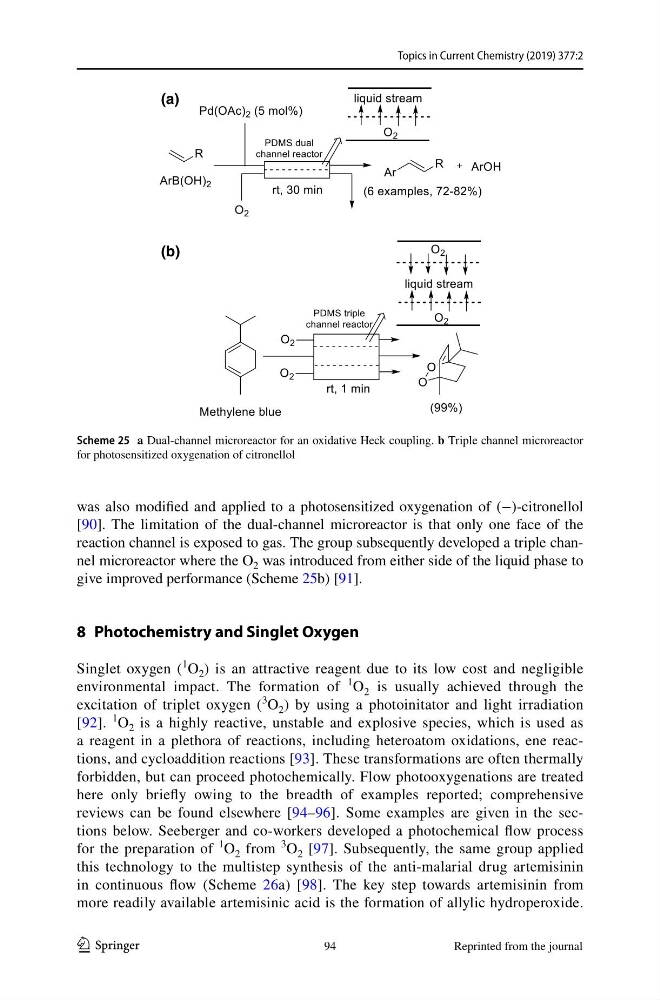
was also modified and applied to a photosensitized oxygenation of (−)‑citronellol
[90]. The limitation of the dual‑channel microreactor is that only one face of the
reaction channel is exposed to gas. The group subsequently developed a triple chan‑
nel microreactor where the O 2 was introduced from either side of the liquid phase to
give improved performance (Scheme 25b) [91].
8 Photochemistry and Singlet Oxygen
Singlet oxygen (
1
O 2 ) is an attractive reagent due to its low cost and negligible
environmental impact. The formation of
1
O 2 is usually achieved through the
excitation of triplet oxygen (
3
O 2 ) by using a photoinitator and light irradiation
[92].
1
O 2 is a highly reactive, unstable and explosive species, which is used as
a reagent in a plethora of reactions, including heteroatom oxidations, ene reac‑
tions, and cycloaddition reactions [93]. These transformations are often thermally
forbidden, but can proceed photochemically. Flow photooxygenations are treated
here only briefly owing to the breadth of examples reported; comprehensive
reviews can be found elsewhere [94–96]. Some examples are given in the sec‑
tions below. Seeberger and co‑workers developed a photochemical flow process
for the preparation of
1
O 2 from
3
O 2 [97]. Subsequently, the same group applied
this technology to the multistep synthesis of the anti‑malarial drug artemisinin
in continuous flow (Scheme 26a) [98]. The key step towards artemisinin from
more readily available artemisinic acid is the formation of allylic hydroperoxide.
(a)
(b)
Scheme 25 a Dual‑channel microreactor for an oxidative Heck coupling. b Triple channel microreactor
for photosensitized oxygenation of citronellol
94
Reprinted from the journal
1 3
was also modified and applied to a photosensitized oxygenation of (−)‑citronellol
[90]. The limitation of the dual‑channel microreactor is that only one face of the
reaction channel is exposed to gas. The group subsequently developed a triple chan‑
nel microreactor where the O 2 was introduced from either side of the liquid phase to
give improved performance (Scheme 25b) [91].
8 Photochemistry and Singlet Oxygen
Singlet oxygen (
1
O 2 ) is an attractive reagent due to its low cost and negligible
environmental impact. The formation of
1
O 2 is usually achieved through the
excitation of triplet oxygen (
3
O 2 ) by using a photoinitator and light irradiation
[92].
1
O 2 is a highly reactive, unstable and explosive species, which is used as
a reagent in a plethora of reactions, including heteroatom oxidations, ene reac‑
tions, and cycloaddition reactions [93]. These transformations are often thermally
forbidden, but can proceed photochemically. Flow photooxygenations are treated
here only briefly owing to the breadth of examples reported; comprehensive
reviews can be found elsewhere [94–96]. Some examples are given in the sec‑
tions below. Seeberger and co‑workers developed a photochemical flow process
for the preparation of
1
O 2 from
3
O 2 [97]. Subsequently, the same group applied
this technology to the multistep synthesis of the anti‑malarial drug artemisinin
in continuous flow (Scheme 26a) [98]. The key step towards artemisinin from
more readily available artemisinic acid is the formation of allylic hydroperoxide.
(a)
(b)
Scheme 25 a Dual‑channel microreactor for an oxidative Heck coupling. b Triple channel microreactor
for photosensitized oxygenation of citronellol
94
Reprinted from the journal