

1 3
Topics in Current Chemistry (2019) 377:2
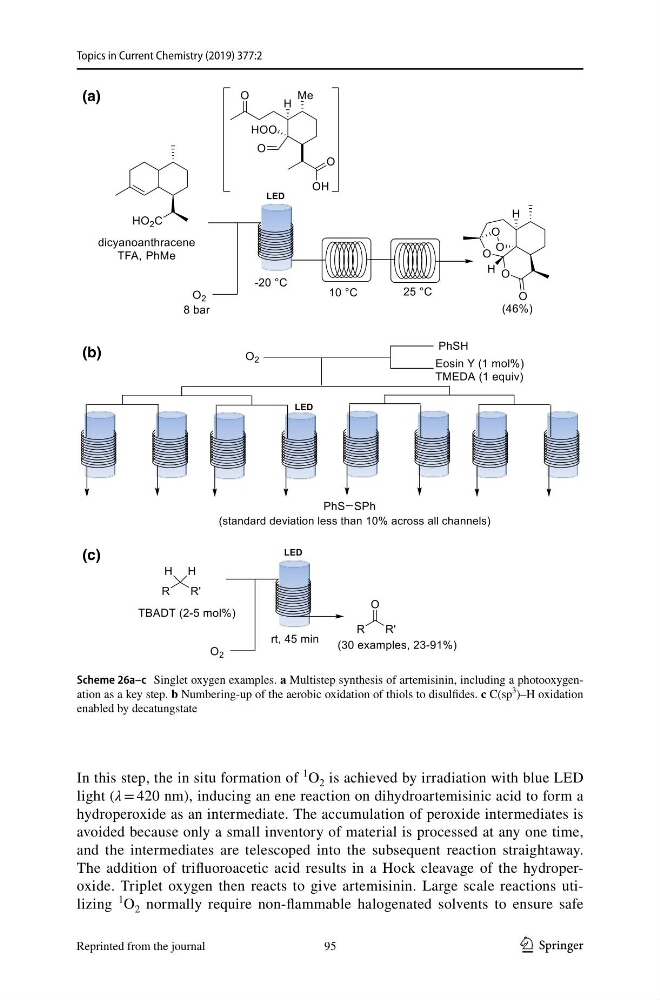
In this step, the in situ formation of
1
O 2 is achieved by irradiation with blue LED
light (λ = 420 nm), inducing an ene reaction on dihydroartemisinic acid to form a
hydroperoxide as an intermediate. The accumulation of peroxide intermediates is
avoided because only a small inventory of material is processed at any one time,
and the intermediates are telescoped into the subsequent reaction straightaway.
The addition of trifluoroacetic acid results in a Hock cleavage of the hydroper‑
oxide. Triplet oxygen then reacts to give artemisinin. Large scale reactions uti‑
lizing
1
O 2 normally require non‑flammable halogenated solvents to ensure safe
(a)
(b)
(c)
Scheme 26a–c Singlet oxygen examples. a Multistep synthesis of artemisinin, including a photooxygen‑
ation as a key step. b Numbering‑up of the aerobic oxidation of thiols to disulfides. c C(sp
3 )–H oxidation
enabled by decatungstate
95
Reprinted from the journal
Topics in Current Chemistry (2019) 377:2
In this step, the in situ formation of
1
O 2 is achieved by irradiation with blue LED
light (λ = 420 nm), inducing an ene reaction on dihydroartemisinic acid to form a
hydroperoxide as an intermediate. The accumulation of peroxide intermediates is
avoided because only a small inventory of material is processed at any one time,
and the intermediates are telescoped into the subsequent reaction straightaway.
The addition of trifluoroacetic acid results in a Hock cleavage of the hydroper‑
oxide. Triplet oxygen then reacts to give artemisinin. Large scale reactions uti‑
lizing
1
O 2 normally require non‑flammable halogenated solvents to ensure safe
(a)
(b)
(c)
Scheme 26a–c Singlet oxygen examples. a Multistep synthesis of artemisinin, including a photooxygen‑
ation as a key step. b Numbering‑up of the aerobic oxidation of thiols to disulfides. c C(sp
3 )–H oxidation
enabled by decatungstate
95
Reprinted from the journal