

1 3
Topics in Current Chemistry (2019) 377:2
reaction exotherm (ΔH = 685 kJ mol
−1
, ΔT adiabatic = 68 °C). The poorer mass trans‑
fer observed at larger scales caused the reaction time to increase from 8 h within a
laboratory setting to 16–24 h at the pilot plant scale. Pure O 2 had been demonstrated
to significantly increase the reaction rate. Thus, BMS sought to identify conditions
under continuous flow that could be used to prepare large quantities [67]. Initial
studies were conducted using pure O 2 at an elevated temperature of −10 °C within a
CPC CYTOS stacked‑plate microreactor (Scheme 16b). A higher cooling efficiency
was possible from the high reactor surface‑to‑volume ratio within the microreactor.
A > 85% conversion could be achieved in less than 3 min residence time to achieve a
throughput of 300 g day
−1
, which, unfortunately, was insufficient to reach manufac‑
turing demands and was much lower than the batch manufacturing protocol. Subse‑
quently, a trickle bed reactor system was developed, which was operated at −38 °C
and < 4 min residence time with a counter current flow of O 2 (Scheme 16c) [67].
Four reactors in parallel through a numbering up strategy enabled the production
of 15.8 kg day
−1
, which was sufficient throughput for late stage clinical trials. The
improvement in yield and throughput from the batch process was attributed to the
higher O 2 mass transfer rate and the utilization of pure O 2 instead of a diluted O 2
blend.
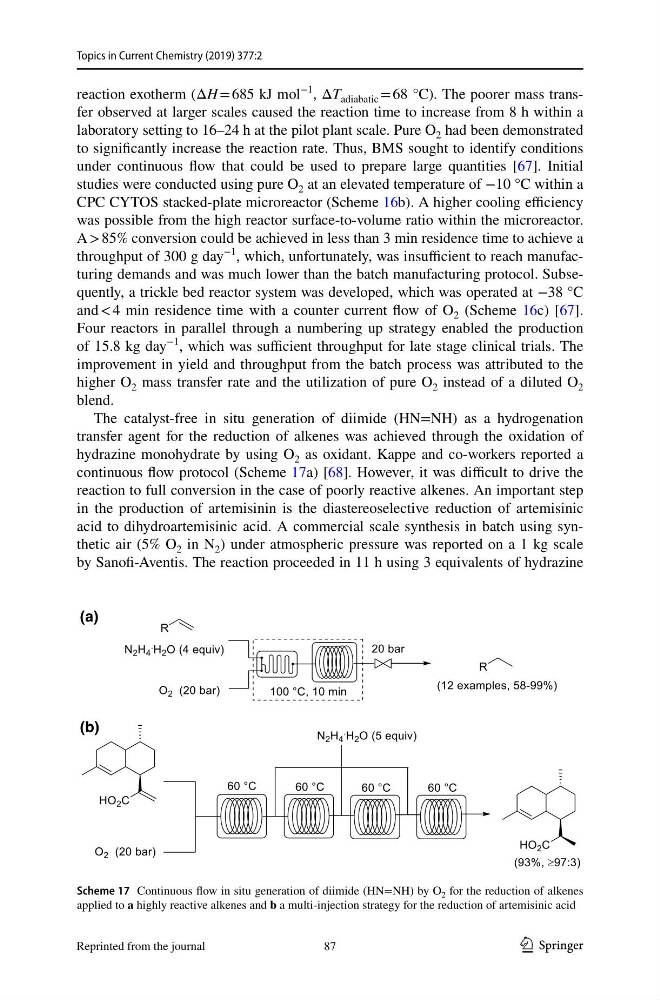
The catalyst‑free in situ generation of diimide (HN=NH) as a hydrogenation
transfer agent for the reduction of alkenes was achieved through the oxidation of
hydrazine monohydrate by using O 2 as oxidant. Kappe and co‑workers reported a
continuous flow protocol (Scheme 17a) [68]. However, it was difficult to drive the
reaction to full conversion in the case of poorly reactive alkenes. An important step
in the production of artemisinin is the diastereoselective reduction of artemisinic
acid to dihydroartemisinic acid. A commercial scale synthesis in batch using syn‑
thetic air (5% O 2 in N 2 ) under atmospheric pressure was reported on a 1 kg scale
by Sanofi‑Aventis. The reaction proceeded in 11 h using 3 equivalents of hydrazine
(a)
(b)
Scheme 17 Continuous flow in situ generation of diimide (HN=NH) by O 2 for the reduction of alkenes
applied to a highly reactive alkenes and b a multi‑injection strategy for the reduction of artemisinic acid
87
Reprinted from the journal
Topics in Current Chemistry (2019) 377:2
reaction exotherm (ΔH = 685 kJ mol
−1
, ΔT adiabatic = 68 °C). The poorer mass trans‑
fer observed at larger scales caused the reaction time to increase from 8 h within a
laboratory setting to 16–24 h at the pilot plant scale. Pure O 2 had been demonstrated
to significantly increase the reaction rate. Thus, BMS sought to identify conditions
under continuous flow that could be used to prepare large quantities [67]. Initial
studies were conducted using pure O 2 at an elevated temperature of −10 °C within a
CPC CYTOS stacked‑plate microreactor (Scheme 16b). A higher cooling efficiency
was possible from the high reactor surface‑to‑volume ratio within the microreactor.
A > 85% conversion could be achieved in less than 3 min residence time to achieve a
throughput of 300 g day
−1
, which, unfortunately, was insufficient to reach manufac‑
turing demands and was much lower than the batch manufacturing protocol. Subse‑
quently, a trickle bed reactor system was developed, which was operated at −38 °C
and < 4 min residence time with a counter current flow of O 2 (Scheme 16c) [67].
Four reactors in parallel through a numbering up strategy enabled the production
of 15.8 kg day
−1
, which was sufficient throughput for late stage clinical trials. The
improvement in yield and throughput from the batch process was attributed to the
higher O 2 mass transfer rate and the utilization of pure O 2 instead of a diluted O 2
blend.
The catalyst‑free in situ generation of diimide (HN=NH) as a hydrogenation
transfer agent for the reduction of alkenes was achieved through the oxidation of
hydrazine monohydrate by using O 2 as oxidant. Kappe and co‑workers reported a
continuous flow protocol (Scheme 17a) [68]. However, it was difficult to drive the
reaction to full conversion in the case of poorly reactive alkenes. An important step
in the production of artemisinin is the diastereoselective reduction of artemisinic
acid to dihydroartemisinic acid. A commercial scale synthesis in batch using syn‑
thetic air (5% O 2 in N 2 ) under atmospheric pressure was reported on a 1 kg scale
by Sanofi‑Aventis. The reaction proceeded in 11 h using 3 equivalents of hydrazine
(a)
(b)
Scheme 17 Continuous flow in situ generation of diimide (HN=NH) by O 2 for the reduction of alkenes
applied to a highly reactive alkenes and b a multi‑injection strategy for the reduction of artemisinic acid
87
Reprinted from the journal