

Topics in Current Chemistry (2019) 377:2
1 3
monohydrate to afford more than 90% yield and 97% diastereoselectivity, corre‑
sponding to a space time yield (STY) of 0.023 mmol L
−1
h
−1
[69]. Kappe and co‑
workers devised a multi‑injection strategy for the introduction of fresh hydrazine
hydrate for the reduction of poorly reactive alkenes. (Scheme 17b) [70]. The synthe‑
sis of dihydroartemisinic acid could be achieved in 93% yield, corresponding to a
STY of 0.56 mmol L
−1
h
−1
. The flow procedure provided a significant improvement
in space–time yield in comparison to the batch synthesis. The reduction of thebaine
was also achieved using a multi‑injection approach but by using four inlet feeds for
hydrazine monohydrate [71].
6 Organomagnesium and Organolithium Reagents
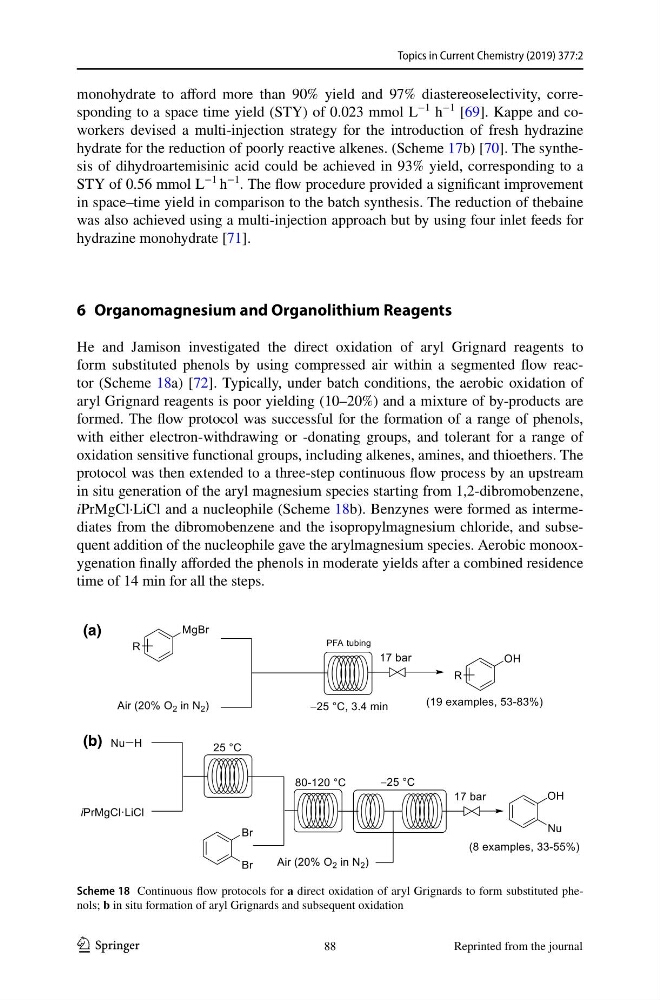
He and Jamison investigated the direct oxidation of aryl Grignard reagents to
form substituted phenols by using compressed air within a segmented flow reac‑
tor (Scheme 18a) [72]. Typically, under batch conditions, the aerobic oxidation of
aryl Grignard reagents is poor yielding (10–20%) and a mixture of by‑products are
formed. The flow protocol was successful for the formation of a range of phenols,
with either electron‑withdrawing or ‑donating groups, and tolerant for a range of
oxidation sensitive functional groups, including alkenes, amines, and thioethers. The
protocol was then extended to a three‑step continuous flow process by an upstream
in situ generation of the aryl magnesium species starting from 1,2‑dibromobenzene,
iPrMgCl·LiCl and a nucleophile (Scheme 18b). Benzynes were formed as interme‑
diates from the dibromobenzene and the isopropylmagnesium chloride, and subse‑
quent addition of the nucleophile gave the arylmagnesium species. Aerobic monoox‑
ygenation finally afforded the phenols in moderate yields after a combined residence
time of 14 min for all the steps.
(a)
(b)
Scheme 18 Continuous flow protocols for a direct oxidation of aryl Grignards to form substituted phe‑
nols; b in situ formation of aryl Grignards and subsequent oxidation
88
Reprinted from the journal
1 3
monohydrate to afford more than 90% yield and 97% diastereoselectivity, corre‑
sponding to a space time yield (STY) of 0.023 mmol L
−1
h
−1
[69]. Kappe and co‑
workers devised a multi‑injection strategy for the introduction of fresh hydrazine
hydrate for the reduction of poorly reactive alkenes. (Scheme 17b) [70]. The synthe‑
sis of dihydroartemisinic acid could be achieved in 93% yield, corresponding to a
STY of 0.56 mmol L
−1
h
−1
. The flow procedure provided a significant improvement
in space–time yield in comparison to the batch synthesis. The reduction of thebaine
was also achieved using a multi‑injection approach but by using four inlet feeds for
hydrazine monohydrate [71].
6 Organomagnesium and Organolithium Reagents
He and Jamison investigated the direct oxidation of aryl Grignard reagents to
form substituted phenols by using compressed air within a segmented flow reac‑
tor (Scheme 18a) [72]. Typically, under batch conditions, the aerobic oxidation of
aryl Grignard reagents is poor yielding (10–20%) and a mixture of by‑products are
formed. The flow protocol was successful for the formation of a range of phenols,
with either electron‑withdrawing or ‑donating groups, and tolerant for a range of
oxidation sensitive functional groups, including alkenes, amines, and thioethers. The
protocol was then extended to a three‑step continuous flow process by an upstream
in situ generation of the aryl magnesium species starting from 1,2‑dibromobenzene,
iPrMgCl·LiCl and a nucleophile (Scheme 18b). Benzynes were formed as interme‑
diates from the dibromobenzene and the isopropylmagnesium chloride, and subse‑
quent addition of the nucleophile gave the arylmagnesium species. Aerobic monoox‑
ygenation finally afforded the phenols in moderate yields after a combined residence
time of 14 min for all the steps.
(a)
(b)
Scheme 18 Continuous flow protocols for a direct oxidation of aryl Grignards to form substituted phe‑
nols; b in situ formation of aryl Grignards and subsequent oxidation
88
Reprinted from the journal