

Topics in Current Chemistry (2019) 377:2
1 3
5 Uncatalyzed Reactions
The earliest example of a translation of a batch manufacturing process to flow for an
aerobic oxidation within the pharmaceutical sector was described by Bristol–Myers
Squibb (BMS). BMS researchers were interested in the oxidation of the imide within
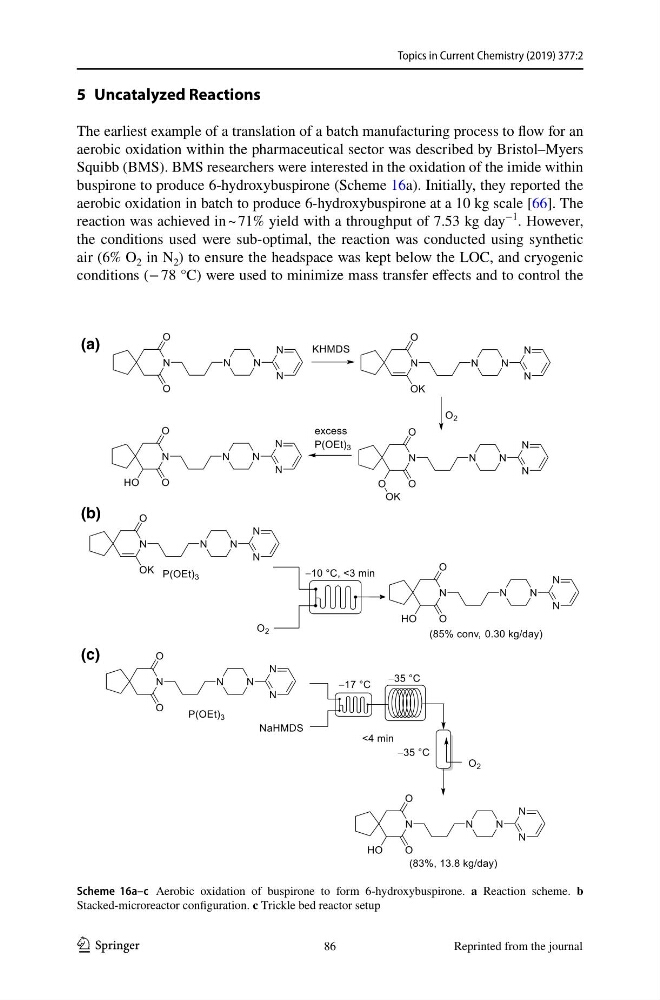
buspirone to produce 6‑hydroxybuspirone (Scheme 16a). Initially, they reported the
aerobic oxidation in batch to produce 6‑hydroxybuspirone at a 10 kg scale [66]. The
reaction was achieved in ~ 71% yield with a throughput of 7.53 kg day
−1
. However,
the conditions used were sub‑optimal, the reaction was conducted using synthetic
air (6% O 2 in N 2 ) to ensure the headspace was kept below the LOC, and cryogenic
conditions (− 78 °C) were used to minimize mass transfer effects and to control the
(a)
(b)
(c)
Scheme 16a–c Aerobic oxidation of buspirone to form 6‑hydroxybuspirone. a Reaction scheme. b
Stacked‑microreactor configuration. c Trickle bed reactor setup
86
Reprinted from the journal
1 3
5 Uncatalyzed Reactions
The earliest example of a translation of a batch manufacturing process to flow for an
aerobic oxidation within the pharmaceutical sector was described by Bristol–Myers
Squibb (BMS). BMS researchers were interested in the oxidation of the imide within
buspirone to produce 6‑hydroxybuspirone (Scheme 16a). Initially, they reported the
aerobic oxidation in batch to produce 6‑hydroxybuspirone at a 10 kg scale [66]. The
reaction was achieved in ~ 71% yield with a throughput of 7.53 kg day
−1
. However,
the conditions used were sub‑optimal, the reaction was conducted using synthetic
air (6% O 2 in N 2 ) to ensure the headspace was kept below the LOC, and cryogenic
conditions (− 78 °C) were used to minimize mass transfer effects and to control the
(a)
(b)
(c)
Scheme 16a–c Aerobic oxidation of buspirone to form 6‑hydroxybuspirone. a Reaction scheme. b
Stacked‑microreactor configuration. c Trickle bed reactor setup
86
Reprinted from the journal