

1 3
Topics in Current Chemistry (2019) 377:2
preparation, with an Au–Pd weight ratio of 1:19. Initially, the researchers dem‑
onstrated that the catalyst was stable over a 30 h time period for the oxidation of
benzyl alcohol to benzaldeyde. For the cinnamyl alcohol oxidation, in addition to
cinnamaldehyde formation, 3‑phenyl‑1‑propanol and trans‑β‑methylstyrene were
also observed as side products. An improved selectivity for cinnamaldehyde was
observed at higher oxygen equivalents, albeit with elevated catalyst decomposi‑
tion. Elevated reaction temperatures were also responsible for catalyst deactiva‑
tion. A partial recovery in catalyst activity could be achieved by treatment with
hydrogen.
A key challenge to designing sustainable flow processes is the discovery of
robust multicomponent catalysts which display high catalyst turnovers. The inclu‑
sion of promoters has been associated with mediating the adsorption and dis‑
sociation of O 2 , thus preventing over oxidation of the metal surface. Stahl and
co‑workers conducted an admixture screening in batch for the discovery of new
heterogeneous Pd catalyst and promoter compositions [65]. Over 4000 catalyst
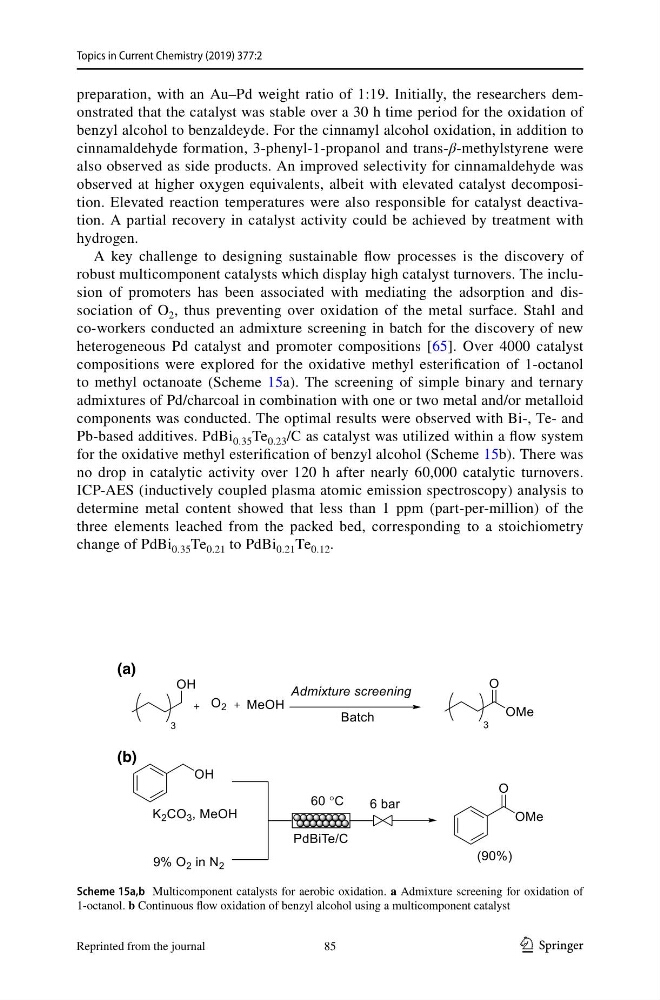
compositions were explored for the oxidative methyl esterification of 1‑octanol
to methyl octanoate (Scheme 15a). The screening of simple binary and ternary
admixtures of Pd/charcoal in combination with one or two metal and/or metalloid
components was conducted. The optimal results were observed with Bi‑, Te‑ and
Pb‑based additives. PdBi 0.35 Te 0.23 /C as catalyst was utilized within a flow system
for the oxidative methyl esterification of benzyl alcohol (Scheme 15b). There was
no drop in catalytic activity over 120 h after nearly 60,000 catalytic turnovers.
ICP‑AES (inductively coupled plasma atomic emission spectroscopy) analysis to
determine metal content showed that less than 1 ppm (part‑per‑million) of the
three elements leached from the packed bed, corresponding to a stoichiometry
change of PdBi 0.35 Te 0.21 to PdBi 0.21 Te 0.12 .
(a)
(b)
Scheme 15a,b Multicomponent catalysts for aerobic oxidation. a Admixture screening for oxidation of
1‑octanol. b Continuous flow oxidation of benzyl alcohol using a multicomponent catalyst
85
Reprinted from the journal
Topics in Current Chemistry (2019) 377:2
preparation, with an Au–Pd weight ratio of 1:19. Initially, the researchers dem‑
onstrated that the catalyst was stable over a 30 h time period for the oxidation of
benzyl alcohol to benzaldeyde. For the cinnamyl alcohol oxidation, in addition to
cinnamaldehyde formation, 3‑phenyl‑1‑propanol and trans‑β‑methylstyrene were
also observed as side products. An improved selectivity for cinnamaldehyde was
observed at higher oxygen equivalents, albeit with elevated catalyst decomposi‑
tion. Elevated reaction temperatures were also responsible for catalyst deactiva‑
tion. A partial recovery in catalyst activity could be achieved by treatment with
hydrogen.
A key challenge to designing sustainable flow processes is the discovery of
robust multicomponent catalysts which display high catalyst turnovers. The inclu‑
sion of promoters has been associated with mediating the adsorption and dis‑
sociation of O 2 , thus preventing over oxidation of the metal surface. Stahl and
co‑workers conducted an admixture screening in batch for the discovery of new
heterogeneous Pd catalyst and promoter compositions [65]. Over 4000 catalyst
compositions were explored for the oxidative methyl esterification of 1‑octanol
to methyl octanoate (Scheme 15a). The screening of simple binary and ternary
admixtures of Pd/charcoal in combination with one or two metal and/or metalloid
components was conducted. The optimal results were observed with Bi‑, Te‑ and
Pb‑based additives. PdBi 0.35 Te 0.23 /C as catalyst was utilized within a flow system
for the oxidative methyl esterification of benzyl alcohol (Scheme 15b). There was
no drop in catalytic activity over 120 h after nearly 60,000 catalytic turnovers.
ICP‑AES (inductively coupled plasma atomic emission spectroscopy) analysis to
determine metal content showed that less than 1 ppm (part‑per‑million) of the
three elements leached from the packed bed, corresponding to a stoichiometry
change of PdBi 0.35 Te 0.21 to PdBi 0.21 Te 0.12 .
(a)
(b)
Scheme 15a,b Multicomponent catalysts for aerobic oxidation. a Admixture screening for oxidation of
1‑octanol. b Continuous flow oxidation of benzyl alcohol using a multicomponent catalyst
85
Reprinted from the journal