

Topics in Current Chemistry (2019) 377:2
1 3
to take only a few seconds under continuous flow conditions, compared to several
hours under semi‑batch conditions. Very recently, Lee and co‑workers reported the
oxidation of cinnamaldehyde to cinnamic acid using silica supported Pt nanoparti‑
cles under base‑free continuous flow conditions [61].
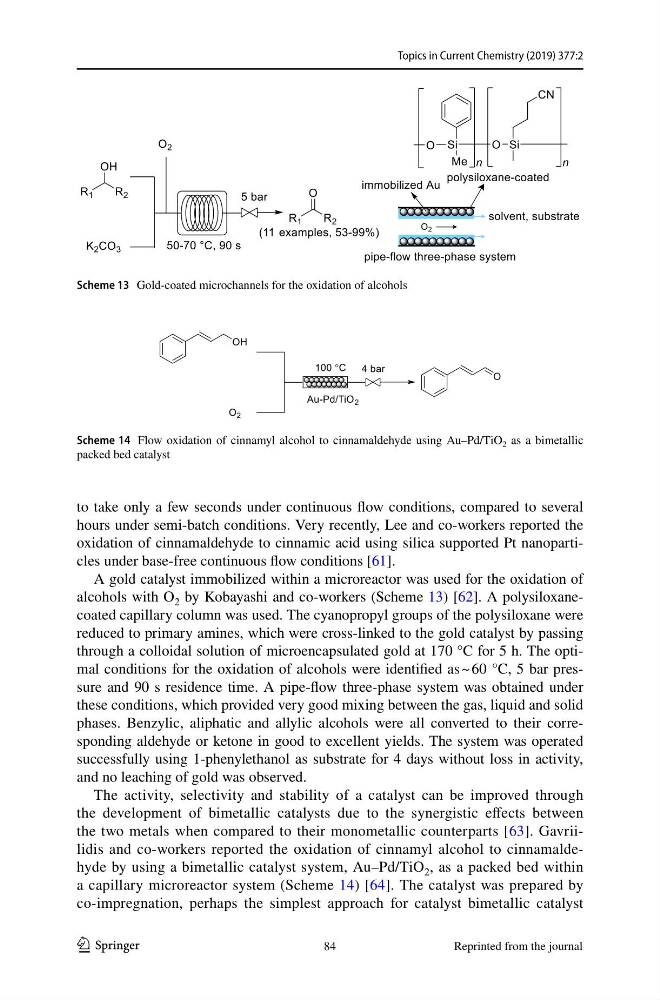
A gold catalyst immobilized within a microreactor was used for the oxidation of
alcohols with O 2 by Kobayashi and co‑workers (Scheme 13) [62]. A polysiloxane‑
coated capillary column was used. The cyanopropyl groups of the polysiloxane were
reduced to primary amines, which were cross‑linked to the gold catalyst by passing
through a colloidal solution of microencapsulated gold at 170 °C for 5 h. The opti‑
mal conditions for the oxidation of alcohols were identified as ~ 60 °C, 5 bar pres‑
sure and 90 s residence time. A pipe‑flow three‑phase system was obtained under
these conditions, which provided very good mixing between the gas, liquid and solid
phases. Benzylic, aliphatic and allylic alcohols were all converted to their corre‑
sponding aldehyde or ketone in good to excellent yields. The system was operated
successfully using 1‑phenylethanol as substrate for 4 days without loss in activity,
and no leaching of gold was observed.
The activity, selectivity and stability of a catalyst can be improved through
the development of bimetallic catalysts due to the synergistic effects between
the two metals when compared to their monometallic counterparts [63]. Gavrii‑
lidis and co‑workers reported the oxidation of cinnamyl alcohol to cinnamalde‑
hyde by using a bimetallic catalyst system, Au–Pd/TiO 2 , as a packed bed within
a capillary microreactor system (Scheme 14) [64]. The catalyst was prepared by
co‑impregnation, perhaps the simplest approach for catalyst bimetallic catalyst
Scheme 13 Gold‑coated microchannels for the oxidation of alcohols
Scheme 14 Flow oxidation of cinnamyl alcohol to cinnamaldehyde using Au–Pd/TiO 2 as a bimetallic
packed bed catalyst
84
Reprinted from the journal
1 3
to take only a few seconds under continuous flow conditions, compared to several
hours under semi‑batch conditions. Very recently, Lee and co‑workers reported the
oxidation of cinnamaldehyde to cinnamic acid using silica supported Pt nanoparti‑
cles under base‑free continuous flow conditions [61].
A gold catalyst immobilized within a microreactor was used for the oxidation of
alcohols with O 2 by Kobayashi and co‑workers (Scheme 13) [62]. A polysiloxane‑
coated capillary column was used. The cyanopropyl groups of the polysiloxane were
reduced to primary amines, which were cross‑linked to the gold catalyst by passing
through a colloidal solution of microencapsulated gold at 170 °C for 5 h. The opti‑
mal conditions for the oxidation of alcohols were identified as ~ 60 °C, 5 bar pres‑
sure and 90 s residence time. A pipe‑flow three‑phase system was obtained under
these conditions, which provided very good mixing between the gas, liquid and solid
phases. Benzylic, aliphatic and allylic alcohols were all converted to their corre‑
sponding aldehyde or ketone in good to excellent yields. The system was operated
successfully using 1‑phenylethanol as substrate for 4 days without loss in activity,
and no leaching of gold was observed.
The activity, selectivity and stability of a catalyst can be improved through
the development of bimetallic catalysts due to the synergistic effects between
the two metals when compared to their monometallic counterparts [63]. Gavrii‑
lidis and co‑workers reported the oxidation of cinnamyl alcohol to cinnamalde‑
hyde by using a bimetallic catalyst system, Au–Pd/TiO 2 , as a packed bed within
a capillary microreactor system (Scheme 14) [64]. The catalyst was prepared by
co‑impregnation, perhaps the simplest approach for catalyst bimetallic catalyst
Scheme 13 Gold‑coated microchannels for the oxidation of alcohols
Scheme 14 Flow oxidation of cinnamyl alcohol to cinnamaldehyde using Au–Pd/TiO 2 as a bimetallic
packed bed catalyst
84
Reprinted from the journal