

1 3
Topics in Current Chemistry (2019) 377:2
heat corresponds to an adiabatic temperature rise, ΔT ad = 77 °C, and pressure rise,
ΔP = 7.1 bar, from the liberation of CO 2 , a temperature and pressure rise that the
reactor can safely withstand. High yields were obtained; however, the flow system
was essentially operated in a semi‑batch manner, because the reacting mixture was
recirculated continuously through the packed bed reactor to achieve high conver‑
sions. The resulting reaction times were between 0.75 h to 7 h for the different sub‑
strates. Stahl and co‑workers also reported using a heterogeneous Ru(OH) x /Al 2 O 3
catalyst for the aerobic oxidation of alcohols (Scheme 10b) [58]. However, in this
case, a diluted oxygen source (8% O 2 in N 2 ) was used. The catalyst deactivation
kinetics were characterized to provide a basis for identification of process conditions
that enabled high single‑pass yields for a number of aldehydes. In particular, the
oxidation of 2‑thiophenemethanol was achieved in > 99% yield, which was success‑
fully maintained over a 72 h operation time. The same flow system was also applied
to the dehydrogenation of indoline to indole (Scheme 10c).
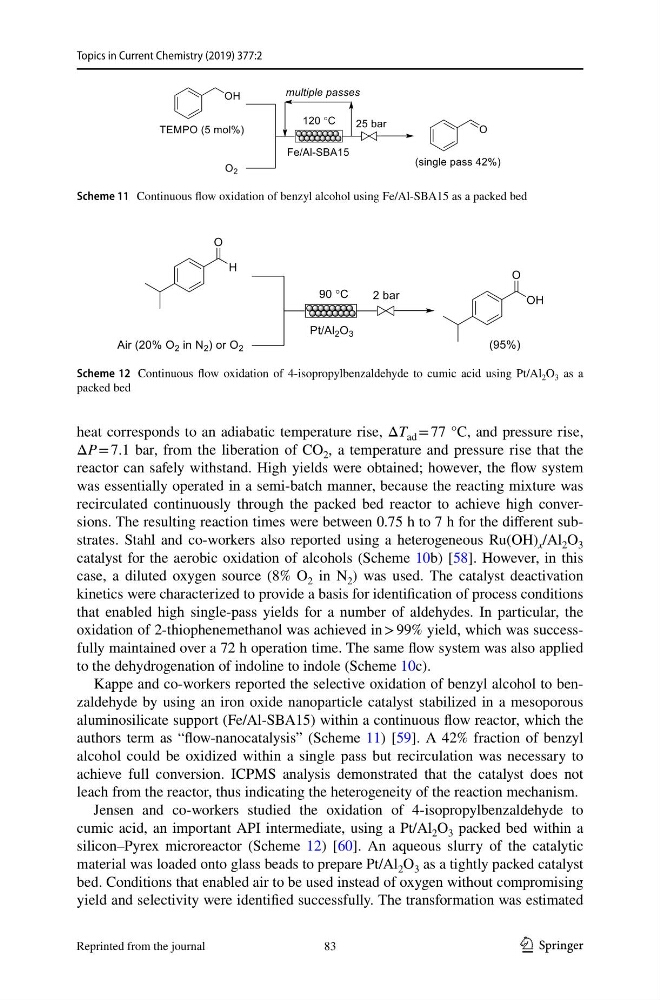
Kappe and co‑workers reported the selective oxidation of benzyl alcohol to ben‑
zaldehyde by using an iron oxide nanoparticle catalyst stabilized in a mesoporous
aluminosilicate support (Fe/Al‑SBA15) within a continuous flow reactor, which the
authors term as “flow‑nanocatalysis” (Scheme 11) [59]. A 42% fraction of benzyl
alcohol could be oxidized within a single pass but recirculation was necessary to
achieve full conversion. ICPMS analysis demonstrated that the catalyst does not
leach from the reactor, thus indicating the heterogeneity of the reaction mechanism.
Jensen and co‑workers studied the oxidation of 4‑isopropylbenzaldehyde to
cumic acid, an important API intermediate, using a Pt/Al 2 O 3 packed bed within a
silicon–Pyrex microreactor (Scheme 12) [60]. An aqueous slurry of the catalytic
material was loaded onto glass beads to prepare Pt/Al 2 O 3 as a tightly packed catalyst
bed. Conditions that enabled air to be used instead of oxygen without compromising
yield and selectivity were identified successfully. The transformation was estimated
Scheme 11 Continuous flow oxidation of benzyl alcohol using Fe/Al‑SBA15 as a packed bed
Scheme 12 Continuous flow oxidation of 4‑isopropylbenzaldehyde to cumic acid using Pt/Al 2 O 3 as a
packed bed
83
Reprinted from the journal
Topics in Current Chemistry (2019) 377:2
heat corresponds to an adiabatic temperature rise, ΔT ad = 77 °C, and pressure rise,
ΔP = 7.1 bar, from the liberation of CO 2 , a temperature and pressure rise that the
reactor can safely withstand. High yields were obtained; however, the flow system
was essentially operated in a semi‑batch manner, because the reacting mixture was
recirculated continuously through the packed bed reactor to achieve high conver‑
sions. The resulting reaction times were between 0.75 h to 7 h for the different sub‑
strates. Stahl and co‑workers also reported using a heterogeneous Ru(OH) x /Al 2 O 3
catalyst for the aerobic oxidation of alcohols (Scheme 10b) [58]. However, in this
case, a diluted oxygen source (8% O 2 in N 2 ) was used. The catalyst deactivation
kinetics were characterized to provide a basis for identification of process conditions
that enabled high single‑pass yields for a number of aldehydes. In particular, the
oxidation of 2‑thiophenemethanol was achieved in > 99% yield, which was success‑
fully maintained over a 72 h operation time. The same flow system was also applied
to the dehydrogenation of indoline to indole (Scheme 10c).
Kappe and co‑workers reported the selective oxidation of benzyl alcohol to ben‑
zaldehyde by using an iron oxide nanoparticle catalyst stabilized in a mesoporous
aluminosilicate support (Fe/Al‑SBA15) within a continuous flow reactor, which the
authors term as “flow‑nanocatalysis” (Scheme 11) [59]. A 42% fraction of benzyl
alcohol could be oxidized within a single pass but recirculation was necessary to
achieve full conversion. ICPMS analysis demonstrated that the catalyst does not
leach from the reactor, thus indicating the heterogeneity of the reaction mechanism.
Jensen and co‑workers studied the oxidation of 4‑isopropylbenzaldehyde to
cumic acid, an important API intermediate, using a Pt/Al 2 O 3 packed bed within a
silicon–Pyrex microreactor (Scheme 12) [60]. An aqueous slurry of the catalytic
material was loaded onto glass beads to prepare Pt/Al 2 O 3 as a tightly packed catalyst
bed. Conditions that enabled air to be used instead of oxygen without compromising
yield and selectivity were identified successfully. The transformation was estimated
Scheme 11 Continuous flow oxidation of benzyl alcohol using Fe/Al‑SBA15 as a packed bed
Scheme 12 Continuous flow oxidation of 4‑isopropylbenzaldehyde to cumic acid using Pt/Al 2 O 3 as a
packed bed
83
Reprinted from the journal