

Topics in Current Chemistry (2019) 377:2
1 3
material as a packed bed within a flow system [53]. A number of techniques are used
for the preparation of catalysts, including impregnation, adsorption, precipitation or
ion exchange [54]. The stabilization of a catalyst on an inert solid support can also
improve the thermal stability of catalysts. The improved thermal stability is particu‑
larly beneficial given the high temperatures often employed within continuous flow
reactors. The incorporation of one or more promoters, derived from the early transi‑
tion metals, lanthanides and/or main group elements, can further modulate activity
and selectivity. However, additional challenges exist for heterogeneous catalyst sys‑
tems compared to their homogeneous counterparts. Isothermal temperature control
can be difficult to obtain and the efficient mixing between the gas, liquid and solid
phases can be difficult to achieve [28]. A high steady‑state conversion is sometimes
not possible to achieve due to catalyst deactivation and/or leaching [55]. An addi‑
tional difficulty regarding their widespread uptake is that the preparation of hetero‑
geneous catalysts is often outside the skill set of a standard organic chemist.
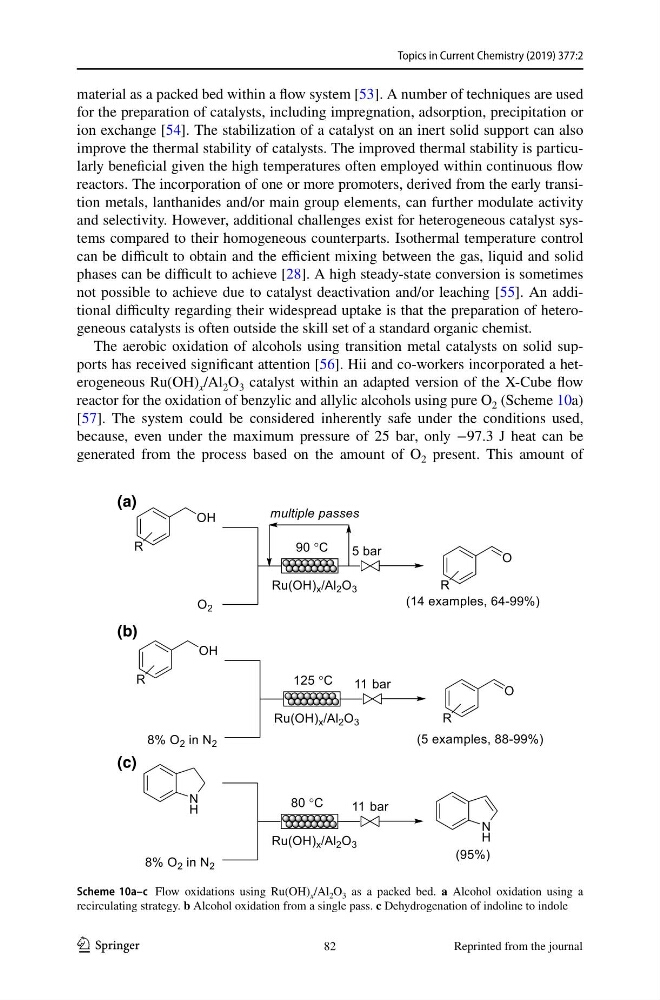
The aerobic oxidation of alcohols using transition metal catalysts on solid sup‑
ports has received significant attention [56]. Hii and co‑workers incorporated a het‑
erogeneous Ru(OH) x /Al 2 O 3 catalyst within an adapted version of the X‑Cube flow
reactor for the oxidation of benzylic and allylic alcohols using pure O 2 (Scheme 10a)
[57]. The system could be considered inherently safe under the conditions used,
because, even under the maximum pressure of 25 bar, only −97.3 J heat can be
generated from the process based on the amount of O 2 present. This amount of
(a)
(b)
(c)
Scheme 10a–c Flow oxidations using Ru(OH) x /Al 2 O 3 as a packed bed. a Alcohol oxidation using a
recirculating strategy. b Alcohol oxidation from a single pass. c Dehydrogenation of indoline to indole
82
Reprinted from the journal
1 3
material as a packed bed within a flow system [53]. A number of techniques are used
for the preparation of catalysts, including impregnation, adsorption, precipitation or
ion exchange [54]. The stabilization of a catalyst on an inert solid support can also
improve the thermal stability of catalysts. The improved thermal stability is particu‑
larly beneficial given the high temperatures often employed within continuous flow
reactors. The incorporation of one or more promoters, derived from the early transi‑
tion metals, lanthanides and/or main group elements, can further modulate activity
and selectivity. However, additional challenges exist for heterogeneous catalyst sys‑
tems compared to their homogeneous counterparts. Isothermal temperature control
can be difficult to obtain and the efficient mixing between the gas, liquid and solid
phases can be difficult to achieve [28]. A high steady‑state conversion is sometimes
not possible to achieve due to catalyst deactivation and/or leaching [55]. An addi‑
tional difficulty regarding their widespread uptake is that the preparation of hetero‑
geneous catalysts is often outside the skill set of a standard organic chemist.
The aerobic oxidation of alcohols using transition metal catalysts on solid sup‑
ports has received significant attention [56]. Hii and co‑workers incorporated a het‑
erogeneous Ru(OH) x /Al 2 O 3 catalyst within an adapted version of the X‑Cube flow
reactor for the oxidation of benzylic and allylic alcohols using pure O 2 (Scheme 10a)
[57]. The system could be considered inherently safe under the conditions used,
because, even under the maximum pressure of 25 bar, only −97.3 J heat can be
generated from the process based on the amount of O 2 present. This amount of
(a)
(b)
(c)
Scheme 10a–c Flow oxidations using Ru(OH) x /Al 2 O 3 as a packed bed. a Alcohol oxidation using a
recirculating strategy. b Alcohol oxidation from a single pass. c Dehydrogenation of indoline to indole
82
Reprinted from the journal