

1 3
Topics in Current Chemistry (2019) 377:2
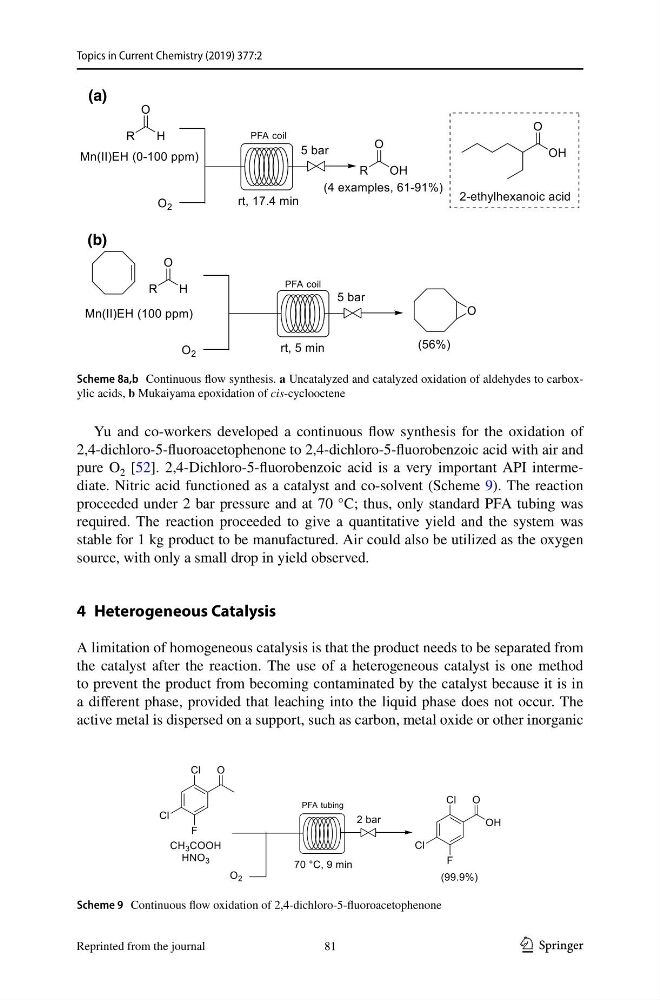
Yu and co‑workers developed a continuous flow synthesis for the oxidation of
2,4‑dichloro‑5‑fluoroacetophenone to 2,4‑dichloro‑5‑fluorobenzoic acid with air and
pure O 2 [52]. 2,4‑Dichloro‑5‑fluorobenzoic acid is a very important API interme‑
diate. Nitric acid functioned as a catalyst and co‑solvent (Scheme 9). The reaction
proceeded under 2 bar pressure and at 70 °C; thus, only standard PFA tubing was
required. The reaction proceeded to give a quantitative yield and the system was
stable for 1 kg product to be manufactured. Air could also be utilized as the oxygen
source, with only a small drop in yield observed.
4 Heterogeneous Catalysis
A limitation of homogeneous catalysis is that the product needs to be separated from
the catalyst after the reaction. The use of a heterogeneous catalyst is one method
to prevent the product from becoming contaminated by the catalyst because it is in
a different phase, provided that leaching into the liquid phase does not occur. The
active metal is dispersed on a support, such as carbon, metal oxide or other inorganic
(a)
(b)
Scheme 8a,b Continuous flow synthesis. a Uncatalyzed and catalyzed oxidation of aldehydes to carbox‑
ylic acids, b Mukaiyama epoxidation of cis‑cyclooctene
Scheme 9 Continuous flow oxidation of 2,4‑dichloro‑5‑fluoroacetophenone
81
Reprinted from the journal
Topics in Current Chemistry (2019) 377:2
Yu and co‑workers developed a continuous flow synthesis for the oxidation of
2,4‑dichloro‑5‑fluoroacetophenone to 2,4‑dichloro‑5‑fluorobenzoic acid with air and
pure O 2 [52]. 2,4‑Dichloro‑5‑fluorobenzoic acid is a very important API interme‑
diate. Nitric acid functioned as a catalyst and co‑solvent (Scheme 9). The reaction
proceeded under 2 bar pressure and at 70 °C; thus, only standard PFA tubing was
required. The reaction proceeded to give a quantitative yield and the system was
stable for 1 kg product to be manufactured. Air could also be utilized as the oxygen
source, with only a small drop in yield observed.
4 Heterogeneous Catalysis
A limitation of homogeneous catalysis is that the product needs to be separated from
the catalyst after the reaction. The use of a heterogeneous catalyst is one method
to prevent the product from becoming contaminated by the catalyst because it is in
a different phase, provided that leaching into the liquid phase does not occur. The
active metal is dispersed on a support, such as carbon, metal oxide or other inorganic
(a)
(b)
Scheme 8a,b Continuous flow synthesis. a Uncatalyzed and catalyzed oxidation of aldehydes to carbox‑
ylic acids, b Mukaiyama epoxidation of cis‑cyclooctene
Scheme 9 Continuous flow oxidation of 2,4‑dichloro‑5‑fluoroacetophenone
81
Reprinted from the journal