

Topics in Current Chemistry (2019) 377:2
1 3
used as solvent instead of using environmentally less desirable DMSO. Propylene
carbonate is a nontoxic and biodegradable cyclic carbonate.
Favre‑Réguillon and co‑workers studied the liquid phase uncatalyzed autoxida‑
tion of aldehydes to carboxylic acids within a relatively simple and cost‑effective
PFA coil reactor operated at room temperature and 5 bar pressure (Scheme 8a)
[48]. The group successfully showed that an increase in the two‑phase superficial
velocity resulted in higher conversions due to the increase of the recirculation
velocity within the liquid slugs. At room temperature, and in less than 2 min resi‑
dence time, without using metal catalysts or radical initiators, conversions up to
50% were observed. By increasing the residence time and, in some instances, by
addition of Mn(II) 2‑ethylhexanoate (Mn(II)EH) as a catalyst at 100 ppm, conver‑
sions could be improved to > 95%. In a later study, the same group conducted a
high‑throughput optimization for the oxidation of 2‑ethylhexanal to 2‑ethylhexa‑
noic acid, one of the acids with the highest production capacity worldwide, using
a sequential pulse experimentation approach to minimize material consumption
[49]. Through this study, the group demonstrated the synergistic use of a large
range of salts and Mn(II) catalyst resulted in highly selective aldehyde oxidation.
The optimization provided conditions that afforded ethylhexanoic acid in 98%
yield within 6 min residence time. In a subsequent final optimization and scale‑
up study, the oxidation of 2‑ethylhexanal in flow was achieved successfully at a
throughput of 130 g/h [50]. The same group investigated a Mukaiyama epoxida‑
tion of cis‑cyclooctene by using a similar flow configuration (Scheme 8b) [51].
(a)
(b)
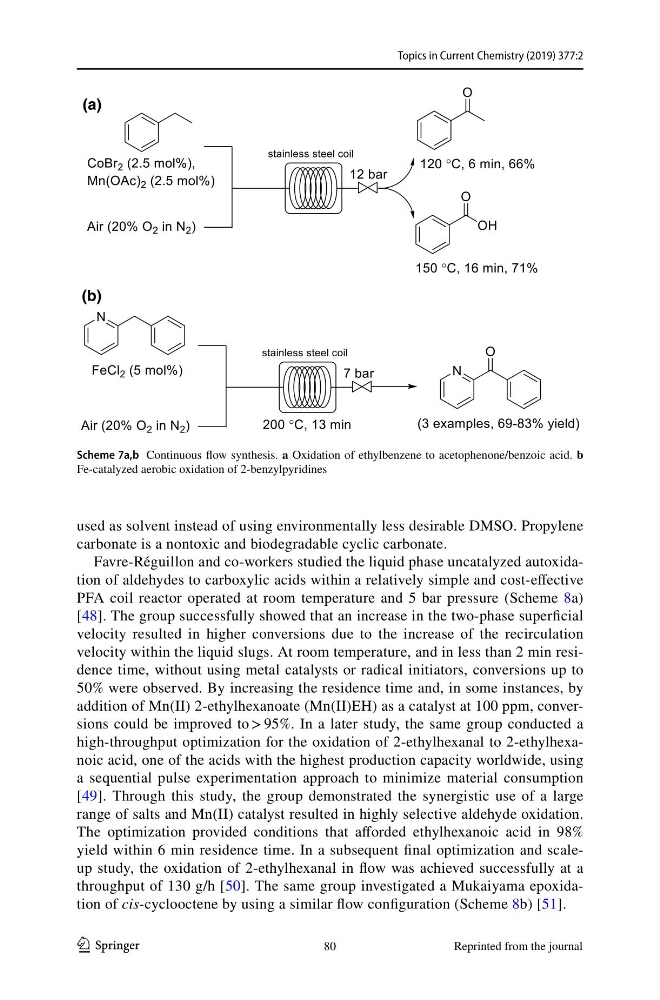
Scheme 7a,b Continuous flow synthesis. a Oxidation of ethylbenzene to acetophenone/benzoic acid. b
Fe‑catalyzed aerobic oxidation of 2‑benzylpyridines
80
Reprinted from the journal
1 3
used as solvent instead of using environmentally less desirable DMSO. Propylene
carbonate is a nontoxic and biodegradable cyclic carbonate.
Favre‑Réguillon and co‑workers studied the liquid phase uncatalyzed autoxida‑
tion of aldehydes to carboxylic acids within a relatively simple and cost‑effective
PFA coil reactor operated at room temperature and 5 bar pressure (Scheme 8a)
[48]. The group successfully showed that an increase in the two‑phase superficial
velocity resulted in higher conversions due to the increase of the recirculation
velocity within the liquid slugs. At room temperature, and in less than 2 min resi‑
dence time, without using metal catalysts or radical initiators, conversions up to
50% were observed. By increasing the residence time and, in some instances, by
addition of Mn(II) 2‑ethylhexanoate (Mn(II)EH) as a catalyst at 100 ppm, conver‑
sions could be improved to > 95%. In a later study, the same group conducted a
high‑throughput optimization for the oxidation of 2‑ethylhexanal to 2‑ethylhexa‑
noic acid, one of the acids with the highest production capacity worldwide, using
a sequential pulse experimentation approach to minimize material consumption
[49]. Through this study, the group demonstrated the synergistic use of a large
range of salts and Mn(II) catalyst resulted in highly selective aldehyde oxidation.
The optimization provided conditions that afforded ethylhexanoic acid in 98%
yield within 6 min residence time. In a subsequent final optimization and scale‑
up study, the oxidation of 2‑ethylhexanal in flow was achieved successfully at a
throughput of 130 g/h [50]. The same group investigated a Mukaiyama epoxida‑
tion of cis‑cyclooctene by using a similar flow configuration (Scheme 8b) [51].
(a)
(b)
Scheme 7a,b Continuous flow synthesis. a Oxidation of ethylbenzene to acetophenone/benzoic acid. b
Fe‑catalyzed aerobic oxidation of 2‑benzylpyridines
80
Reprinted from the journal