

1 3
Topics in Current Chemistry (2019) 377:2
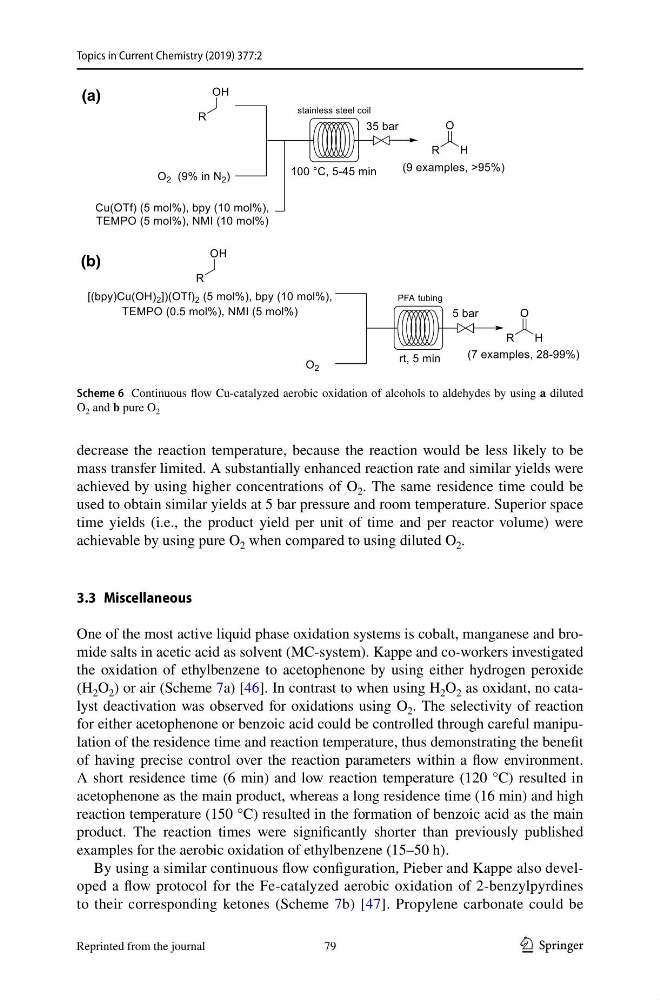
decrease the reaction temperature, because the reaction would be less likely to be
mass transfer limited. A substantially enhanced reaction rate and similar yields were
achieved by using higher concentrations of O 2 . The same residence time could be
used to obtain similar yields at 5 bar pressure and room temperature. Superior space
time yields (i.e., the product yield per unit of time and per reactor volume) were
achievable by using pure O 2 when compared to using diluted O 2 .
3.3 Miscellaneous
One of the most active liquid phase oxidation systems is cobalt, manganese and bro‑
mide salts in acetic acid as solvent (MC‑system). Kappe and co‑workers investigated
the oxidation of ethylbenzene to acetophenone by using either hydrogen peroxide
(H 2 O 2 ) or air (Scheme 7a) [46]. In contrast to when using H 2 O 2 as oxidant, no cata‑
lyst deactivation was observed for oxidations using O 2 . The selectivity of reaction
for either acetophenone or benzoic acid could be controlled through careful manipu‑
lation of the residence time and reaction temperature, thus demonstrating the benefit
of having precise control over the reaction parameters within a flow environment.
A short residence time (6 min) and low reaction temperature (120 °C) resulted in
acetophenone as the main product, whereas a long residence time (16 min) and high
reaction temperature (150 °C) resulted in the formation of benzoic acid as the main
product. The reaction times were significantly shorter than previously published
examples for the aerobic oxidation of ethylbenzene (15–50 h).
By using a similar continuous flow configuration, Pieber and Kappe also devel‑
oped a flow protocol for the Fe‑catalyzed aerobic oxidation of 2‑benzylpyrdines
to their corresponding ketones (Scheme 7b) [47]. Propylene carbonate could be
(a)
(b)
Scheme 6 Continuous flow Cu‑catalyzed aerobic oxidation of alcohols to aldehydes by using a diluted
O 2 and b pure O 2
79
Reprinted from the journal
Topics in Current Chemistry (2019) 377:2
decrease the reaction temperature, because the reaction would be less likely to be
mass transfer limited. A substantially enhanced reaction rate and similar yields were
achieved by using higher concentrations of O 2 . The same residence time could be
used to obtain similar yields at 5 bar pressure and room temperature. Superior space
time yields (i.e., the product yield per unit of time and per reactor volume) were
achievable by using pure O 2 when compared to using diluted O 2 .
3.3 Miscellaneous
One of the most active liquid phase oxidation systems is cobalt, manganese and bro‑
mide salts in acetic acid as solvent (MC‑system). Kappe and co‑workers investigated
the oxidation of ethylbenzene to acetophenone by using either hydrogen peroxide
(H 2 O 2 ) or air (Scheme 7a) [46]. In contrast to when using H 2 O 2 as oxidant, no cata‑
lyst deactivation was observed for oxidations using O 2 . The selectivity of reaction
for either acetophenone or benzoic acid could be controlled through careful manipu‑
lation of the residence time and reaction temperature, thus demonstrating the benefit
of having precise control over the reaction parameters within a flow environment.
A short residence time (6 min) and low reaction temperature (120 °C) resulted in
acetophenone as the main product, whereas a long residence time (16 min) and high
reaction temperature (150 °C) resulted in the formation of benzoic acid as the main
product. The reaction times were significantly shorter than previously published
examples for the aerobic oxidation of ethylbenzene (15–50 h).
By using a similar continuous flow configuration, Pieber and Kappe also devel‑
oped a flow protocol for the Fe‑catalyzed aerobic oxidation of 2‑benzylpyrdines
to their corresponding ketones (Scheme 7b) [47]. Propylene carbonate could be
(a)
(b)
Scheme 6 Continuous flow Cu‑catalyzed aerobic oxidation of alcohols to aldehydes by using a diluted
O 2 and b pure O 2
79
Reprinted from the journal