

Topics in Current Chemistry (2019) 377:2
1 3
A benefit of continuous flow reactors is the ability to precisely control the gas
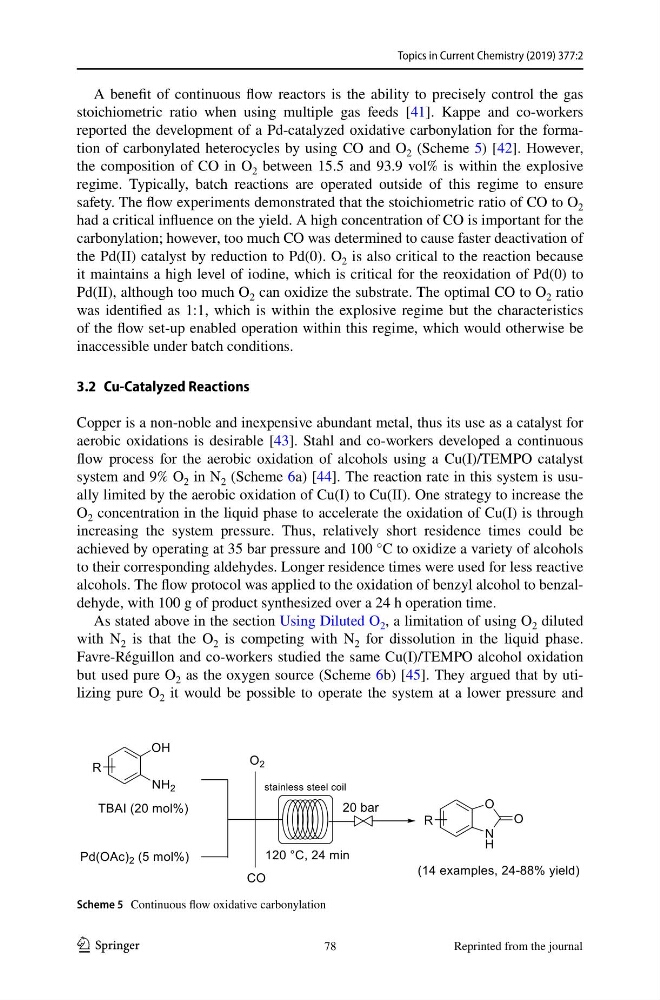
stoichiometric ratio when using multiple gas feeds [41]. Kappe and co‑workers
reported the development of a Pd‑catalyzed oxidative carbonylation for the forma‑
tion of carbonylated heterocycles by using CO and O 2 (Scheme 5) [42]. However,
the composition of CO in O 2 between 15.5 and 93.9 vol% is within the explosive
regime. Typically, batch reactions are operated outside of this regime to ensure
safety. The flow experiments demonstrated that the stoichiometric ratio of CO to O 2
had a critical influence on the yield. A high concentration of CO is important for the
carbonylation; however, too much CO was determined to cause faster deactivation of
the Pd(II) catalyst by reduction to Pd(0). O 2 is also critical to the reaction because
it maintains a high level of iodine, which is critical for the reoxidation of Pd(0) to
Pd(II), although too much O 2 can oxidize the substrate. The optimal CO to O 2 ratio
was identified as 1:1, which is within the explosive regime but the characteristics
of the flow set‑up enabled operation within this regime, which would otherwise be
inaccessible under batch conditions.
3.2 Cu‑Catalyzed Reactions
Copper is a non‑noble and inexpensive abundant metal, thus its use as a catalyst for
aerobic oxidations is desirable [43]. Stahl and co‑workers developed a continuous
flow process for the aerobic oxidation of alcohols using a Cu(I)/TEMPO catalyst
system and 9% O 2 in N 2 (Scheme 6a) [44]. The reaction rate in this system is usu‑
ally limited by the aerobic oxidation of Cu(I) to Cu(II). One strategy to increase the
O 2 concentration in the liquid phase to accelerate the oxidation of Cu(I) is through
increasing the system pressure. Thus, relatively short residence times could be
achieved by operating at 35 bar pressure and 100 °C to oxidize a variety of alcohols
to their corresponding aldehydes. Longer residence times were used for less reactive
alcohols. The flow protocol was applied to the oxidation of benzyl alcohol to benzal‑
dehyde, with 100 g of product synthesized over a 24 h operation time.
As stated above in the section Using Diluted O 2 , a limitation of using O 2 diluted
with N 2 is that the O 2 is competing with N 2 for dissolution in the liquid phase.
Favre‑Réguillon and co‑workers studied the same Cu(I)/TEMPO alcohol oxidation
but used pure O 2 as the oxygen source (Scheme 6b) [45]. They argued that by uti‑
lizing pure O 2 it would be possible to operate the system at a lower pressure and
Scheme 5 Continuous flow oxidative carbonylation
78
Reprinted from the journal
1 3
A benefit of continuous flow reactors is the ability to precisely control the gas
stoichiometric ratio when using multiple gas feeds [41]. Kappe and co‑workers
reported the development of a Pd‑catalyzed oxidative carbonylation for the forma‑
tion of carbonylated heterocycles by using CO and O 2 (Scheme 5) [42]. However,
the composition of CO in O 2 between 15.5 and 93.9 vol% is within the explosive
regime. Typically, batch reactions are operated outside of this regime to ensure
safety. The flow experiments demonstrated that the stoichiometric ratio of CO to O 2
had a critical influence on the yield. A high concentration of CO is important for the
carbonylation; however, too much CO was determined to cause faster deactivation of
the Pd(II) catalyst by reduction to Pd(0). O 2 is also critical to the reaction because
it maintains a high level of iodine, which is critical for the reoxidation of Pd(0) to
Pd(II), although too much O 2 can oxidize the substrate. The optimal CO to O 2 ratio
was identified as 1:1, which is within the explosive regime but the characteristics
of the flow set‑up enabled operation within this regime, which would otherwise be
inaccessible under batch conditions.
3.2 Cu‑Catalyzed Reactions
Copper is a non‑noble and inexpensive abundant metal, thus its use as a catalyst for
aerobic oxidations is desirable [43]. Stahl and co‑workers developed a continuous
flow process for the aerobic oxidation of alcohols using a Cu(I)/TEMPO catalyst
system and 9% O 2 in N 2 (Scheme 6a) [44]. The reaction rate in this system is usu‑
ally limited by the aerobic oxidation of Cu(I) to Cu(II). One strategy to increase the
O 2 concentration in the liquid phase to accelerate the oxidation of Cu(I) is through
increasing the system pressure. Thus, relatively short residence times could be
achieved by operating at 35 bar pressure and 100 °C to oxidize a variety of alcohols
to their corresponding aldehydes. Longer residence times were used for less reactive
alcohols. The flow protocol was applied to the oxidation of benzyl alcohol to benzal‑
dehyde, with 100 g of product synthesized over a 24 h operation time.
As stated above in the section Using Diluted O 2 , a limitation of using O 2 diluted
with N 2 is that the O 2 is competing with N 2 for dissolution in the liquid phase.
Favre‑Réguillon and co‑workers studied the same Cu(I)/TEMPO alcohol oxidation
but used pure O 2 as the oxygen source (Scheme 6b) [45]. They argued that by uti‑
lizing pure O 2 it would be possible to operate the system at a lower pressure and
Scheme 5 Continuous flow oxidative carbonylation
78
Reprinted from the journal