

1 3
Topics in Current Chemistry (2019) 377:2
calorimetry (DSC) had demonstrated that a safe operation can be ensured. The reac‑
tion could be successfully scaled‑up by selecting a proper structure geometry for the
gas–liquid mixing function [36]. The combination of a FlowPlate A6 and a coiled
tube provided good mixing of the gas and liquid phases and sufficient residence
time, respectively, for almost quantitative conversion. Subsequent hydrogenation
and hydrolysis in flow resulted in noroxymorphone—a precursor to naloxone used
to block the effects of opioids in the case of overdose.
The American Chemical Society (ACS) Green Chemistry Institute (GCI) Phar‑
maceutical Roundtable identified the direct activation of an aryl hydrogen (C–H
activation), the conversion of Ar–H into Ar–Ar, as one of the top aspirational reac‑
tion classes [37]. One of the benefits of developing selective C–H activation proce‑
dures is that it avoids the preparation of aryl halides. An interesting example that
highlights the use of process intensified conditions under continuous flow for C–H
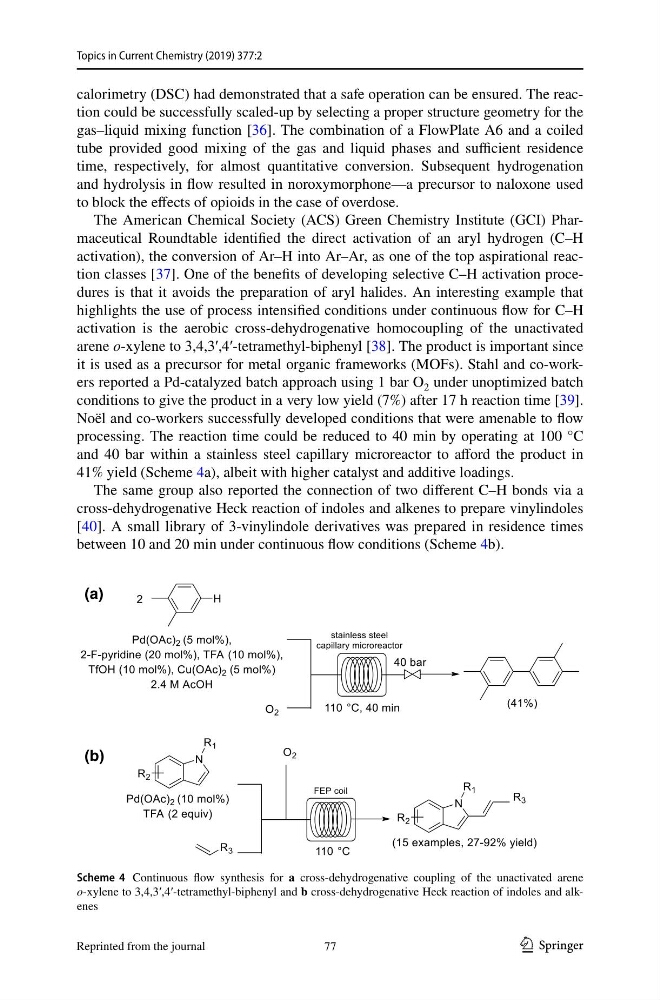
activation is the aerobic cross‑dehydrogenative homocoupling of the unactivated
arene o‑xylene to 3,4,3′,4′‑tetramethyl‑biphenyl [38]. The product is important since
it is used as a precursor for metal organic frameworks (MOFs). Stahl and co‑work‑
ers reported a Pd‑catalyzed batch approach using 1 bar O 2 under unoptimized batch
conditions to give the product in a very low yield (7%) after 17 h reaction time [39].
Noël and co‑workers successfully developed conditions that were amenable to flow
processing. The reaction time could be reduced to 40 min by operating at 100 °C
and 40 bar within a stainless steel capillary microreactor to afford the product in
41% yield (Scheme 4a), albeit with higher catalyst and additive loadings.
The same group also reported the connection of two different C–H bonds via a
cross‑dehydrogenative Heck reaction of indoles and alkenes to prepare vinylindoles
[40]. A small library of 3‑vinylindole derivatives was prepared in residence times
between 10 and 20 min under continuous flow conditions (Scheme 4b).
(a)
(b)
Scheme 4 Continuous flow synthesis for a cross‑dehydrogenative coupling of the unactivated arene
o‑xylene to 3,4,3′,4′‑tetramethyl‑biphenyl and b cross‑dehydrogenative Heck reaction of indoles and alk‑
enes
77
Reprinted from the journal
Topics in Current Chemistry (2019) 377:2
calorimetry (DSC) had demonstrated that a safe operation can be ensured. The reac‑
tion could be successfully scaled‑up by selecting a proper structure geometry for the
gas–liquid mixing function [36]. The combination of a FlowPlate A6 and a coiled
tube provided good mixing of the gas and liquid phases and sufficient residence
time, respectively, for almost quantitative conversion. Subsequent hydrogenation
and hydrolysis in flow resulted in noroxymorphone—a precursor to naloxone used
to block the effects of opioids in the case of overdose.
The American Chemical Society (ACS) Green Chemistry Institute (GCI) Phar‑
maceutical Roundtable identified the direct activation of an aryl hydrogen (C–H
activation), the conversion of Ar–H into Ar–Ar, as one of the top aspirational reac‑
tion classes [37]. One of the benefits of developing selective C–H activation proce‑
dures is that it avoids the preparation of aryl halides. An interesting example that
highlights the use of process intensified conditions under continuous flow for C–H
activation is the aerobic cross‑dehydrogenative homocoupling of the unactivated
arene o‑xylene to 3,4,3′,4′‑tetramethyl‑biphenyl [38]. The product is important since
it is used as a precursor for metal organic frameworks (MOFs). Stahl and co‑work‑
ers reported a Pd‑catalyzed batch approach using 1 bar O 2 under unoptimized batch
conditions to give the product in a very low yield (7%) after 17 h reaction time [39].
Noël and co‑workers successfully developed conditions that were amenable to flow
processing. The reaction time could be reduced to 40 min by operating at 100 °C
and 40 bar within a stainless steel capillary microreactor to afford the product in
41% yield (Scheme 4a), albeit with higher catalyst and additive loadings.
The same group also reported the connection of two different C–H bonds via a
cross‑dehydrogenative Heck reaction of indoles and alkenes to prepare vinylindoles
[40]. A small library of 3‑vinylindole derivatives was prepared in residence times
between 10 and 20 min under continuous flow conditions (Scheme 4b).
(a)
(b)
Scheme 4 Continuous flow synthesis for a cross‑dehydrogenative coupling of the unactivated arene
o‑xylene to 3,4,3′,4′‑tetramethyl‑biphenyl and b cross‑dehydrogenative Heck reaction of indoles and alk‑
enes
77
Reprinted from the journal