

Topics in Current Chemistry (2019) 377:2
1 3
was necessary. Eli Lilly and Co. calculated that it is possible to scale‑up from the
7 L reactor vessel by a minimum of two orders of magnitude, while retaining the
high pressure rating, low cost, and a length/diameter ratio for the tube of ≥ 20,000/1.
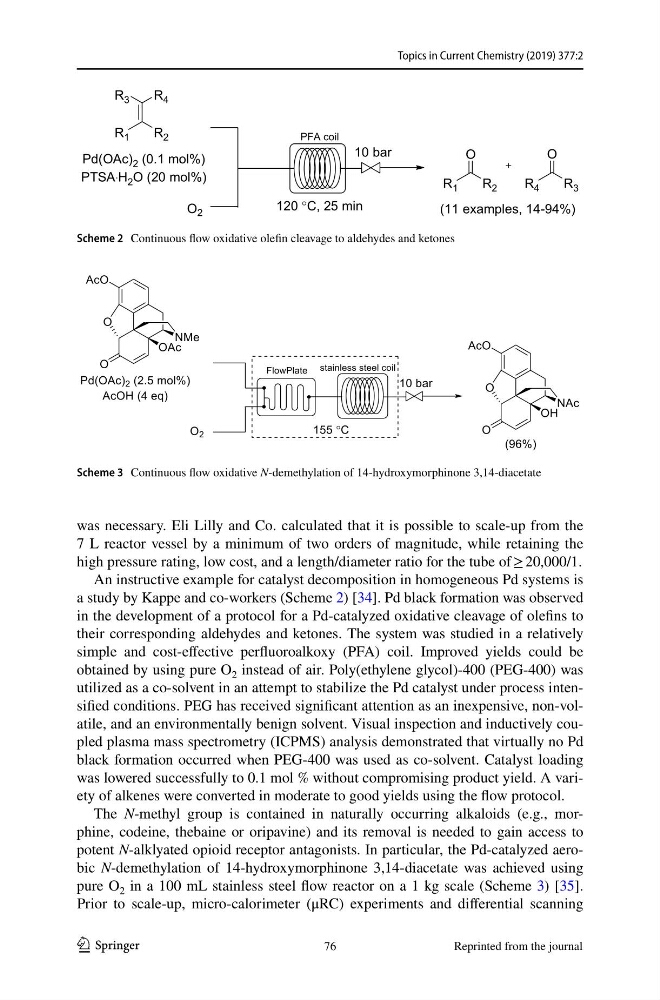
An instructive example for catalyst decomposition in homogeneous Pd systems is
a study by Kappe and co‑workers (Scheme 2) [34]. Pd black formation was observed
in the development of a protocol for a Pd‑catalyzed oxidative cleavage of olefins to
their corresponding aldehydes and ketones. The system was studied in a relatively
simple and cost‑effective perfluoroalkoxy (PFA) coil. Improved yields could be
obtained by using pure O 2 instead of air. Poly(ethylene glycol)‑400 (PEG‑400) was
utilized as a co‑solvent in an attempt to stabilize the Pd catalyst under process inten‑
sified conditions. PEG has received significant attention as an inexpensive, non‑vol‑
atile, and an environmentally benign solvent. Visual inspection and inductively cou‑
pled plasma mass spectrometry (ICPMS) analysis demonstrated that virtually no Pd
black formation occurred when PEG‑400 was used as co‑solvent. Catalyst loading
was lowered successfully to 0.1 mol % without compromising product yield. A vari‑
ety of alkenes were converted in moderate to good yields using the flow protocol.
The N‑methyl group is contained in naturally occurring alkaloids (e.g., mor‑
phine, codeine, thebaine or oripavine) and its removal is needed to gain access to
potent N‑alklyated opioid receptor antagonists. In particular, the Pd‑catalyzed aero‑
bic N‑demethylation of 14‑hydroxymorphinone 3,14‑diacetate was achieved using
pure O 2 in a 100 mL stainless steel flow reactor on a 1 kg scale (Scheme 3) [35].
Prior to scale‑up, micro‑calorimeter (μRC) experiments and differential scanning
120 °C, 25 min
O 2
10 bar
R 1
R 2
PFA coil
R 4
R 3
Pd(OAc) 2 (0.1 mol%)
PTSA . H 2 O (20 mol%)
R 1
R 2
O
O
R 4
R 3
(11 examples, 14-94%)
Scheme 2 Continuous flow oxidative olefin cleavage to aldehydes and ketones
Scheme 3 Continuous flow oxidative N‑demethylation of 14‑hydroxymorphinone 3,14‑diacetate
76
Reprinted from the journal
1 3
was necessary. Eli Lilly and Co. calculated that it is possible to scale‑up from the
7 L reactor vessel by a minimum of two orders of magnitude, while retaining the
high pressure rating, low cost, and a length/diameter ratio for the tube of ≥ 20,000/1.
An instructive example for catalyst decomposition in homogeneous Pd systems is
a study by Kappe and co‑workers (Scheme 2) [34]. Pd black formation was observed
in the development of a protocol for a Pd‑catalyzed oxidative cleavage of olefins to
their corresponding aldehydes and ketones. The system was studied in a relatively
simple and cost‑effective perfluoroalkoxy (PFA) coil. Improved yields could be
obtained by using pure O 2 instead of air. Poly(ethylene glycol)‑400 (PEG‑400) was
utilized as a co‑solvent in an attempt to stabilize the Pd catalyst under process inten‑
sified conditions. PEG has received significant attention as an inexpensive, non‑vol‑
atile, and an environmentally benign solvent. Visual inspection and inductively cou‑
pled plasma mass spectrometry (ICPMS) analysis demonstrated that virtually no Pd
black formation occurred when PEG‑400 was used as co‑solvent. Catalyst loading
was lowered successfully to 0.1 mol % without compromising product yield. A vari‑
ety of alkenes were converted in moderate to good yields using the flow protocol.
The N‑methyl group is contained in naturally occurring alkaloids (e.g., mor‑
phine, codeine, thebaine or oripavine) and its removal is needed to gain access to
potent N‑alklyated opioid receptor antagonists. In particular, the Pd‑catalyzed aero‑
bic N‑demethylation of 14‑hydroxymorphinone 3,14‑diacetate was achieved using
pure O 2 in a 100 mL stainless steel flow reactor on a 1 kg scale (Scheme 3) [35].
Prior to scale‑up, micro‑calorimeter (μRC) experiments and differential scanning
120 °C, 25 min
O 2
10 bar
R 1
R 2
PFA coil
R 4
R 3
Pd(OAc) 2 (0.1 mol%)
PTSA . H 2 O (20 mol%)
R 1
R 2
O
O
R 4
R 3
(11 examples, 14-94%)
Scheme 2 Continuous flow oxidative olefin cleavage to aldehydes and ketones
Scheme 3 Continuous flow oxidative N‑demethylation of 14‑hydroxymorphinone 3,14‑diacetate
76
Reprinted from the journal