

1 3
Topics in Current Chemistry (2019) 377:2
enlarging to provide a larger volume through smart dimensioning [30]. Examples of
all of these strategies are shown below.
3 Homogeneous Catalysis
3.1 Pd‑Catalyzed Reactions
Oxygen in its ground state, triplet oxygen (
3
O 2 ), displays relatively low reactivity
and poor selectivity; therefore, a catalyst system and/or elevated temperatures and
pressures are required to increase reaction rates and improve selectivity. Palladium
is perhaps the most studied metal for homogeneous catalyzed aerobic oxidations. A
broad range of homogeneous Pd‑catalyzed aerobic oxidations reactions have been
developed over the last 10–15 years [31]. Palladium catalysts are very sensitive to
the oxygen concentration. Pd(II) is reduced to Pd(0) species, which aggregate to
form inactive Pd black [32]. This phenomenon causes a significant challenge when
attempting to scale‑up this chemistry under batch conditions due to poor mixing and
temperature control. The direct oxidation of Pd(0) by O 2 is kinetically unfavored.
With this in mind, the utilization of continuous flow reactors that provide good heat
and mass transfer can be beneficial for this type of chemistry by preventing catalyst
decomposition through the rapid reoxidation of Pd(0) to Pd(II).
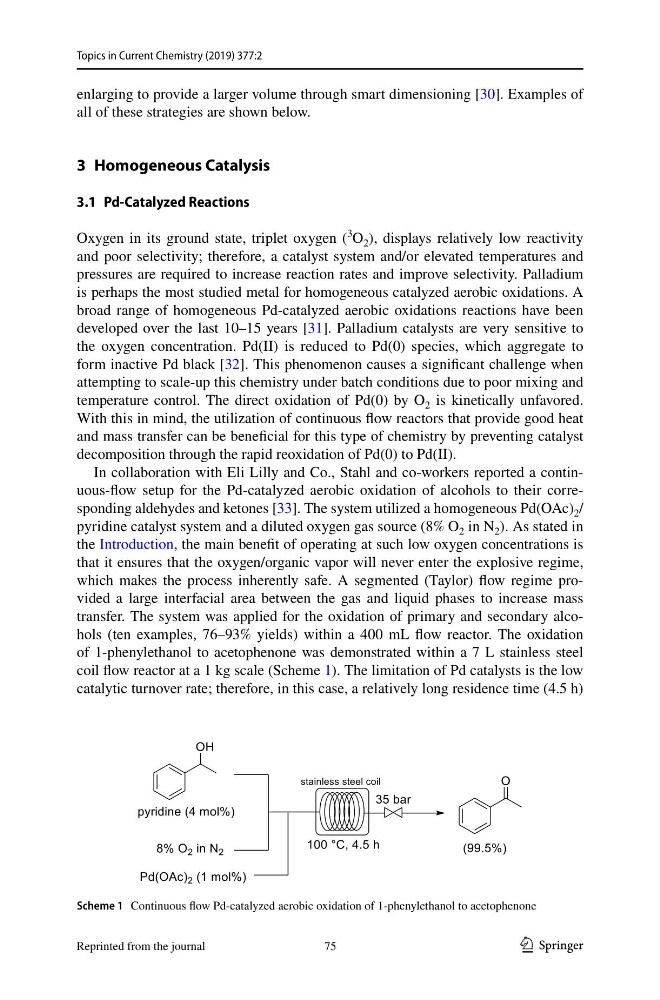
In collaboration with Eli Lilly and Co., Stahl and co‑workers reported a contin‑
uous‑flow setup for the Pd‑catalyzed aerobic oxidation of alcohols to their corre‑
sponding aldehydes and ketones [33]. The system utilized a homogeneous Pd(OAc) 2 /
pyridine catalyst system and a diluted oxygen gas source (8% O 2 in N 2 ). As stated in
the Introduction, the main benefit of operating at such low oxygen concentrations is
that it ensures that the oxygen/organic vapor will never enter the explosive regime,
which makes the process inherently safe. A segmented (Taylor) flow regime pro‑
vided a large interfacial area between the gas and liquid phases to increase mass
transfer. The system was applied for the oxidation of primary and secondary alco‑
hols (ten examples, 76–93% yields) within a 400 mL flow reactor. The oxidation
of 1‑phenylethanol to acetophenone was demonstrated within a 7 L stainless steel
coil flow reactor at a 1 kg scale (Scheme 1). The limitation of Pd catalysts is the low
catalytic turnover rate; therefore, in this case, a relatively long residence time (4.5 h)
Scheme 1 Continuous flow Pd‑catalyzed aerobic oxidation of 1‑phenylethanol to acetophenone
75
Reprinted from the journal
Topics in Current Chemistry (2019) 377:2
enlarging to provide a larger volume through smart dimensioning [30]. Examples of
all of these strategies are shown below.
3 Homogeneous Catalysis
3.1 Pd‑Catalyzed Reactions
Oxygen in its ground state, triplet oxygen (
3
O 2 ), displays relatively low reactivity
and poor selectivity; therefore, a catalyst system and/or elevated temperatures and
pressures are required to increase reaction rates and improve selectivity. Palladium
is perhaps the most studied metal for homogeneous catalyzed aerobic oxidations. A
broad range of homogeneous Pd‑catalyzed aerobic oxidations reactions have been
developed over the last 10–15 years [31]. Palladium catalysts are very sensitive to
the oxygen concentration. Pd(II) is reduced to Pd(0) species, which aggregate to
form inactive Pd black [32]. This phenomenon causes a significant challenge when
attempting to scale‑up this chemistry under batch conditions due to poor mixing and
temperature control. The direct oxidation of Pd(0) by O 2 is kinetically unfavored.
With this in mind, the utilization of continuous flow reactors that provide good heat
and mass transfer can be beneficial for this type of chemistry by preventing catalyst
decomposition through the rapid reoxidation of Pd(0) to Pd(II).
In collaboration with Eli Lilly and Co., Stahl and co‑workers reported a contin‑
uous‑flow setup for the Pd‑catalyzed aerobic oxidation of alcohols to their corre‑
sponding aldehydes and ketones [33]. The system utilized a homogeneous Pd(OAc) 2 /
pyridine catalyst system and a diluted oxygen gas source (8% O 2 in N 2 ). As stated in
the Introduction, the main benefit of operating at such low oxygen concentrations is
that it ensures that the oxygen/organic vapor will never enter the explosive regime,
which makes the process inherently safe. A segmented (Taylor) flow regime pro‑
vided a large interfacial area between the gas and liquid phases to increase mass
transfer. The system was applied for the oxidation of primary and secondary alco‑
hols (ten examples, 76–93% yields) within a 400 mL flow reactor. The oxidation
of 1‑phenylethanol to acetophenone was demonstrated within a 7 L stainless steel
coil flow reactor at a 1 kg scale (Scheme 1). The limitation of Pd catalysts is the low
catalytic turnover rate; therefore, in this case, a relatively long residence time (4.5 h)
Scheme 1 Continuous flow Pd‑catalyzed aerobic oxidation of 1‑phenylethanol to acetophenone
75
Reprinted from the journal