

Topics in Current Chemistry (2019) 377:2
1 3
studies carried out in microreactors examine the use of O 2 for reactions occurring
in the gas phase. Veser demonstrated for a Pt‑catalyzed H 2 /O 2 reaction to H 2 O 2 that
explosion propagation can be completely suppressed at channel sizes below the
millimeter range, and thus the process is inherently safe [27]. However, at larger
channel dimensions (> 0.4 cm) Poliakoff and co‑workers, when investigating the
catalytic dehydrogenation of 4‑vinylcyclohexane, observed periodic temperature
spikes near the surface of the Pd/Al 2 O 3 catalyst bed that indicated the occurrence of
cycles of propagating flames [28]. In the case of liquid phase aerobic oxidation reac‑
tions, O 2 is substoichiometric to solvent, which significantly reduces the likelihood
of an explosion. Small oxygen segments alleviate the likelihood that autoignition
will occur, because the small channel dimensions do not exceed typical quenching
distances for explosion propagation. Furthermore, the solvent plays a role as a heat
sink. Unlike batch reactors, tubular flow reactors possess no headspace; therefore
there is no headspace containing a large volume of potentially combustible oxygen/
organic vapor. Nonetheless, the safety associated with a process should be assessed
carefully on a case by case basis. Safe operation can be ensured by employing a
properly designed continuous flow reactor that can withstand an explosion event in
a worst case scenario [18]. A key benefit of continuous processing is that, generally,
a far smaller inventory of the overall material to be processed is present within the
system at any one time. Miniaturization reduces the risks and allows for secondary
containment of the reactor in the case of an explosion event.
2.5 Scale‑up and Manufacture
When there is sufficient understanding of a reaction system and adequate process
design to address safety concerns and mitigate risks, aerobic oxidations, even using
pure O 2 , can be adopted at large scales through the utilization of appropriate con‑
tinuous‑flow processing systems. Experiments including microcalorimetry, differ‑
ential scanning calorimetry (DSC) and autoclave explosion pressure measurements
should focus on minimizing the perceived scale‑up risk through contingency plan‑
ning for worst case scenarios [29]. There are a number of scale‑up strategies that can
be applied, including: (1) running the process for a longer time in the same equip‑
ment (scale‑out); (2) a larger reactor volume with the same channel diameter but
faster flow rates; (3) unit parallelization (numbering up); and (4) channel dimension
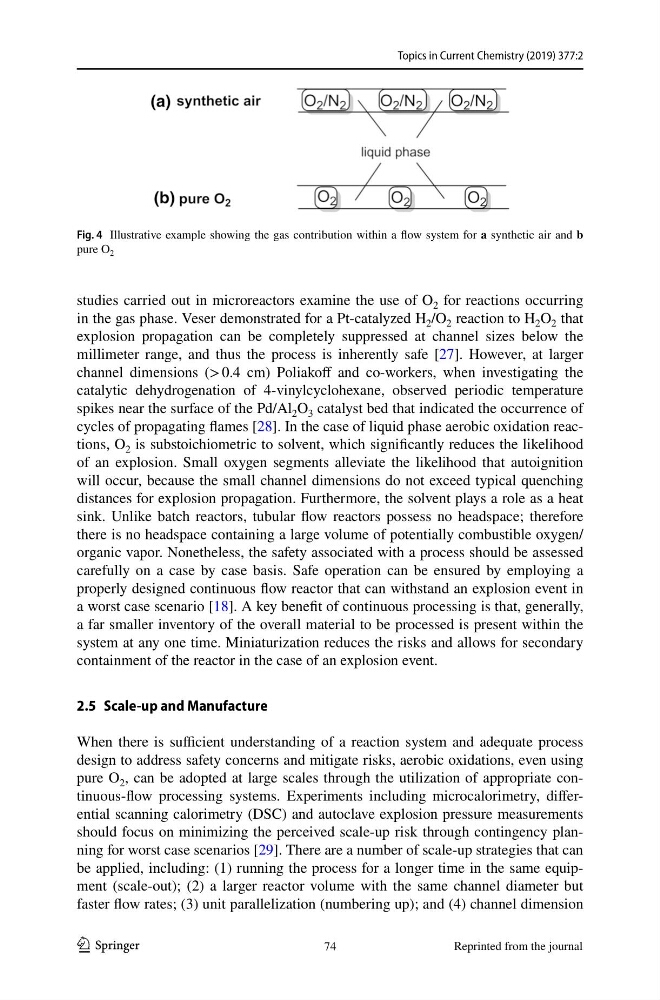
Fig. 4 Illustrative example showing the gas contribution within a flow system for a synthetic air and b
pure O 2
74
Reprinted from the journal
1 3
studies carried out in microreactors examine the use of O 2 for reactions occurring
in the gas phase. Veser demonstrated for a Pt‑catalyzed H 2 /O 2 reaction to H 2 O 2 that
explosion propagation can be completely suppressed at channel sizes below the
millimeter range, and thus the process is inherently safe [27]. However, at larger
channel dimensions (> 0.4 cm) Poliakoff and co‑workers, when investigating the
catalytic dehydrogenation of 4‑vinylcyclohexane, observed periodic temperature
spikes near the surface of the Pd/Al 2 O 3 catalyst bed that indicated the occurrence of
cycles of propagating flames [28]. In the case of liquid phase aerobic oxidation reac‑
tions, O 2 is substoichiometric to solvent, which significantly reduces the likelihood
of an explosion. Small oxygen segments alleviate the likelihood that autoignition
will occur, because the small channel dimensions do not exceed typical quenching
distances for explosion propagation. Furthermore, the solvent plays a role as a heat
sink. Unlike batch reactors, tubular flow reactors possess no headspace; therefore
there is no headspace containing a large volume of potentially combustible oxygen/
organic vapor. Nonetheless, the safety associated with a process should be assessed
carefully on a case by case basis. Safe operation can be ensured by employing a
properly designed continuous flow reactor that can withstand an explosion event in
a worst case scenario [18]. A key benefit of continuous processing is that, generally,
a far smaller inventory of the overall material to be processed is present within the
system at any one time. Miniaturization reduces the risks and allows for secondary
containment of the reactor in the case of an explosion event.
2.5 Scale‑up and Manufacture
When there is sufficient understanding of a reaction system and adequate process
design to address safety concerns and mitigate risks, aerobic oxidations, even using
pure O 2 , can be adopted at large scales through the utilization of appropriate con‑
tinuous‑flow processing systems. Experiments including microcalorimetry, differ‑
ential scanning calorimetry (DSC) and autoclave explosion pressure measurements
should focus on minimizing the perceived scale‑up risk through contingency plan‑
ning for worst case scenarios [29]. There are a number of scale‑up strategies that can
be applied, including: (1) running the process for a longer time in the same equip‑
ment (scale‑out); (2) a larger reactor volume with the same channel diameter but
faster flow rates; (3) unit parallelization (numbering up); and (4) channel dimension
Fig. 4 Illustrative example showing the gas contribution within a flow system for a synthetic air and b
pure O 2
74
Reprinted from the journal