

1 3
Topics in Current Chemistry (2019) 377:2
to operate below the limiting oxygen concentration (LOC) value by diluting O 2 gas
with an inert gas, typically consisting of less than 10% O 2 in N 2 (“synthetic air”),
to ensure the system never enters the explosive regime. The LOC value is defined
as “the minimum partial pressure of oxygen that supports a combustible mixture”.
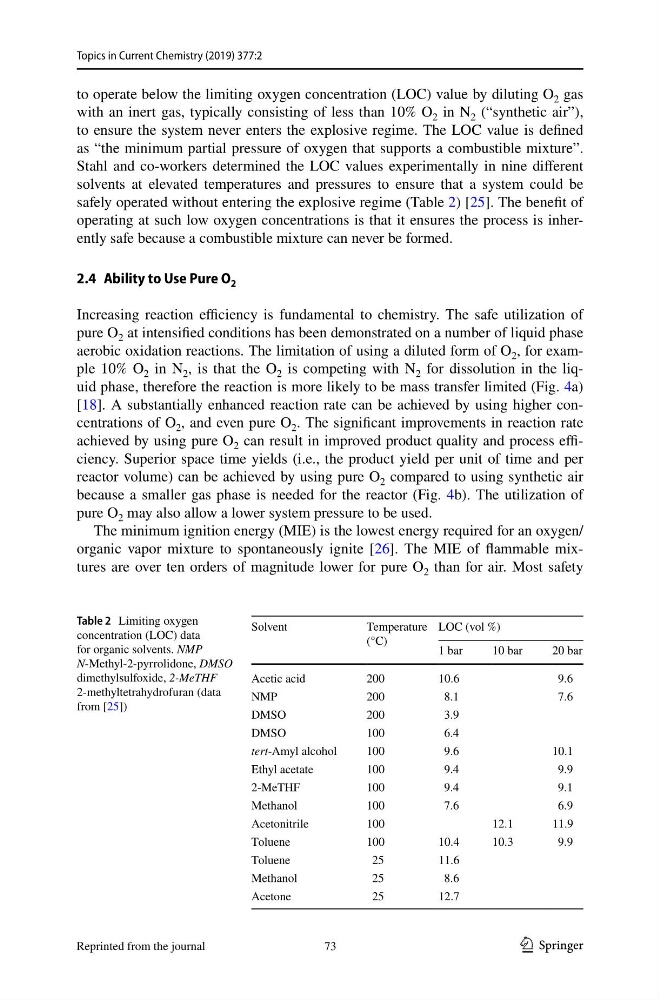
Stahl and co‑workers determined the LOC values experimentally in nine different
solvents at elevated temperatures and pressures to ensure that a system could be
safely operated without entering the explosive regime (Table 2) [25]. The benefit of
operating at such low oxygen concentrations is that it ensures the process is inher‑
ently safe because a combustible mixture can never be formed.
2.4 Ability to Use Pure O 2
Increasing reaction efficiency is fundamental to chemistry. The safe utilization of
pure O 2 at intensified conditions has been demonstrated on a number of liquid phase
aerobic oxidation reactions. The limitation of using a diluted form of O 2 , for exam‑
ple 10% O 2 in N 2 , is that the O 2 is competing with N 2 for dissolution in the liq‑
uid phase, therefore the reaction is more likely to be mass transfer limited (Fig. 4a)
[18]. A substantially enhanced reaction rate can be achieved by using higher con‑
centrations of O 2 , and even pure O 2 . The significant improvements in reaction rate
achieved by using pure O 2 can result in improved product quality and process effi‑
ciency. Superior space time yields (i.e., the product yield per unit of time and per
reactor volume) can be achieved by using pure O 2 compared to using synthetic air
because a smaller gas phase is needed for the reactor (Fig. 4b). The utilization of
pure O 2 may also allow a lower system pressure to be used.
The minimum ignition energy (MIE) is the lowest energy required for an oxygen/
organic vapor mixture to spontaneously ignite [26]. The MIE of flammable mix‑
tures are over ten orders of magnitude lower for pure O 2 than for air. Most safety
Table 2 Limiting oxygen
concentration (LOC) data
for organic solvents. NMP
N‑Methyl‑2‑pyrrolidone, DMSO
dimethylsulfoxide, 2-MeTHF
2‑methyltetrahydrofuran (data
from [25])
Solvent
Temperature
(°C)
LOC (vol %)
1 bar
10 bar
20 bar
Acetic acid
200
10.6
9.6
NMP
200
8.1
7.6
DMSO
200
3.9
DMSO
100
6.4
tert‑Amyl alcohol
100
9.6
10.1
Ethyl acetate
100
9.4
9.9
2‑MeTHF
100
9.4
9.1
Methanol
100
7.6
6.9
Acetonitrile
100
12.1
11.9
Toluene
100
10.4
10.3
9.9
Toluene
25
11.6
Methanol
25
8.6
Acetone
25
12.7
73
Reprinted from the journal
Topics in Current Chemistry (2019) 377:2
to operate below the limiting oxygen concentration (LOC) value by diluting O 2 gas
with an inert gas, typically consisting of less than 10% O 2 in N 2 (“synthetic air”),
to ensure the system never enters the explosive regime. The LOC value is defined
as “the minimum partial pressure of oxygen that supports a combustible mixture”.
Stahl and co‑workers determined the LOC values experimentally in nine different
solvents at elevated temperatures and pressures to ensure that a system could be
safely operated without entering the explosive regime (Table 2) [25]. The benefit of
operating at such low oxygen concentrations is that it ensures the process is inher‑
ently safe because a combustible mixture can never be formed.
2.4 Ability to Use Pure O 2
Increasing reaction efficiency is fundamental to chemistry. The safe utilization of
pure O 2 at intensified conditions has been demonstrated on a number of liquid phase
aerobic oxidation reactions. The limitation of using a diluted form of O 2 , for exam‑
ple 10% O 2 in N 2 , is that the O 2 is competing with N 2 for dissolution in the liq‑
uid phase, therefore the reaction is more likely to be mass transfer limited (Fig. 4a)
[18]. A substantially enhanced reaction rate can be achieved by using higher con‑
centrations of O 2 , and even pure O 2 . The significant improvements in reaction rate
achieved by using pure O 2 can result in improved product quality and process effi‑
ciency. Superior space time yields (i.e., the product yield per unit of time and per
reactor volume) can be achieved by using pure O 2 compared to using synthetic air
because a smaller gas phase is needed for the reactor (Fig. 4b). The utilization of
pure O 2 may also allow a lower system pressure to be used.
The minimum ignition energy (MIE) is the lowest energy required for an oxygen/
organic vapor mixture to spontaneously ignite [26]. The MIE of flammable mix‑
tures are over ten orders of magnitude lower for pure O 2 than for air. Most safety
Table 2 Limiting oxygen
concentration (LOC) data
for organic solvents. NMP
N‑Methyl‑2‑pyrrolidone, DMSO
dimethylsulfoxide, 2-MeTHF
2‑methyltetrahydrofuran (data
from [25])
Solvent
Temperature
(°C)
LOC (vol %)
1 bar
10 bar
20 bar
Acetic acid
200
10.6
9.6
NMP
200
8.1
7.6
DMSO
200
3.9
DMSO
100
6.4
tert‑Amyl alcohol
100
9.6
10.1
Ethyl acetate
100
9.4
9.9
2‑MeTHF
100
9.4
9.1
Methanol
100
7.6
6.9
Acetonitrile
100
12.1
11.9
Toluene
100
10.4
10.3
9.9
Toluene
25
11.6
Methanol
25
8.6
Acetone
25
12.7
73
Reprinted from the journal