

Topics in Current Chemistry (2018) 376:46
1 3
(10:1) with quantitative conversion in 10 min and only 0.002 mol% of OsO 4 was
needed for complete conversion of 10 mmol of olefins. Compared with batch conditions, this system was 50 times more efficient. Examples of oxidative cleavage were
also performed with complete conversion of alkenes and satisfactory yields in a
THF/water mixture and NaIO 4 as an oxidant in 7 min. Furthermore, the productivity
(1.0 mmol h
−1
) was ascertained through running the microreactor continuously for
10 h under identical conditions in a typical dihydroxylation reaction (Scheme 37).
Recently, Kim et al. devised another nanobrushed microreactor accommodating
many metal catalysts grafted onto the microchannel chitosan surface [83]. Applying a reproducible protocol, the desired amount of catalyst could be loaded onto
the chitosan wall, inside the microreactor, by infusion with differently concentrated
catalyst solutions. After setting up a complex protocol for the fabrication of this chitosan–metal complex microreactor, a variety of heterogeneous catalytic microchemical reactions were tested: CuBr 2 -catalyzed click reaction, Au-catalyzed ester-assisted
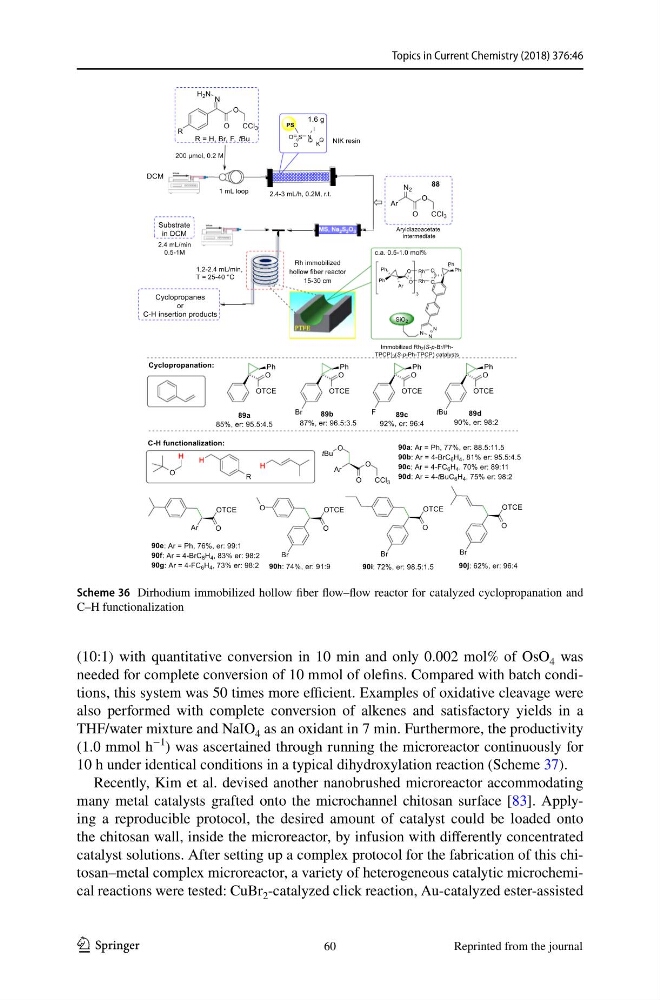
Scheme 36 Dirhodium immobilized hollow fiber flow–flow reactor for catalyzed cyclopropanation and
C–H functionalization
60
Reprinted from the journal
1 3
(10:1) with quantitative conversion in 10 min and only 0.002 mol% of OsO 4 was
needed for complete conversion of 10 mmol of olefins. Compared with batch conditions, this system was 50 times more efficient. Examples of oxidative cleavage were
also performed with complete conversion of alkenes and satisfactory yields in a
THF/water mixture and NaIO 4 as an oxidant in 7 min. Furthermore, the productivity
(1.0 mmol h
−1
) was ascertained through running the microreactor continuously for
10 h under identical conditions in a typical dihydroxylation reaction (Scheme 37).
Recently, Kim et al. devised another nanobrushed microreactor accommodating
many metal catalysts grafted onto the microchannel chitosan surface [83]. Applying a reproducible protocol, the desired amount of catalyst could be loaded onto
the chitosan wall, inside the microreactor, by infusion with differently concentrated
catalyst solutions. After setting up a complex protocol for the fabrication of this chitosan–metal complex microreactor, a variety of heterogeneous catalytic microchemical reactions were tested: CuBr 2 -catalyzed click reaction, Au-catalyzed ester-assisted
Scheme 36 Dirhodium immobilized hollow fiber flow–flow reactor for catalyzed cyclopropanation and
C–H functionalization
60
Reprinted from the journal