

1 3
Topics in Current Chemistry (2018) 376:46
6 Use of Wall‑Coated Approaches in Heterogeneous Flow Catalysis
The use of flow reactors containing a supported catalyst deposited on the inner wall
of the channels or of the tube will be discussed in this section. In continuation of
previous studies concerning C–H functionalization via metal carbene structures as
intermediate species using dirhodium catalysts, Davies and Jones group’s described
representative examples of cyclopropanation and selective C–H functionalization
reactions, employing a prepared Rh immobilized hollow fiber flow reactor [81]. This
new fiber reactor is based on a commercially available poly(amide-imide)-based
polymeric material (Torlon
®
), which is completely wrapped with PTFE tubing. In
this porous polymer matrix were jammed silica particles on which the prepared
dirhodium catalysts were grafted. The cascade reaction protocol consisted of a first
column filled with poly(styrene) supported NIK resin (PSSO 2 NIK), where pre-synthesized hydrazones were converted to aryldiazoacetates 88 (Scheme 36). The latter
were dried and mixed with styrene or ethers or benzyl derivatives in the hollow fiber
reactor giving respectively cyclopropanation and C-H functionalization products
(89a–d, 90a–j) with high yields and enantioselectivities (scheme 36). The recyclability was evaluated for a C-H activation reaction model: using the same immobilized catalyst, the isolated yield and enantioselectivity of product 90 was preserved
over ten consecutive runs (Scheme 36).
Kim et al. developed a highly efficient osmium oxide bonded nanobrush microreactor system, whose catalytic performance was investigated in two reactions:
dihydroxylation and oxidative cleavage of olefins [82]. The techniques of the attachment of a nanobrush-like P4VP polymer layer to the PVSZ wall by a “grafting-to”
approach guaranteed an excellent immobilization of OsO 4 catalyst. Moreover, the
solubility and wettability of the nanobrushes in the reaction medium, and the reaction efficiency was a result of the uniform distribution of the OsO 4 at the molecular
level in the microreactor. The dihydroxylation reactions occurred in the presence of
N-methylmorpholine N-oxide (NMO) as a co-oxidant in an acetone/water mixture
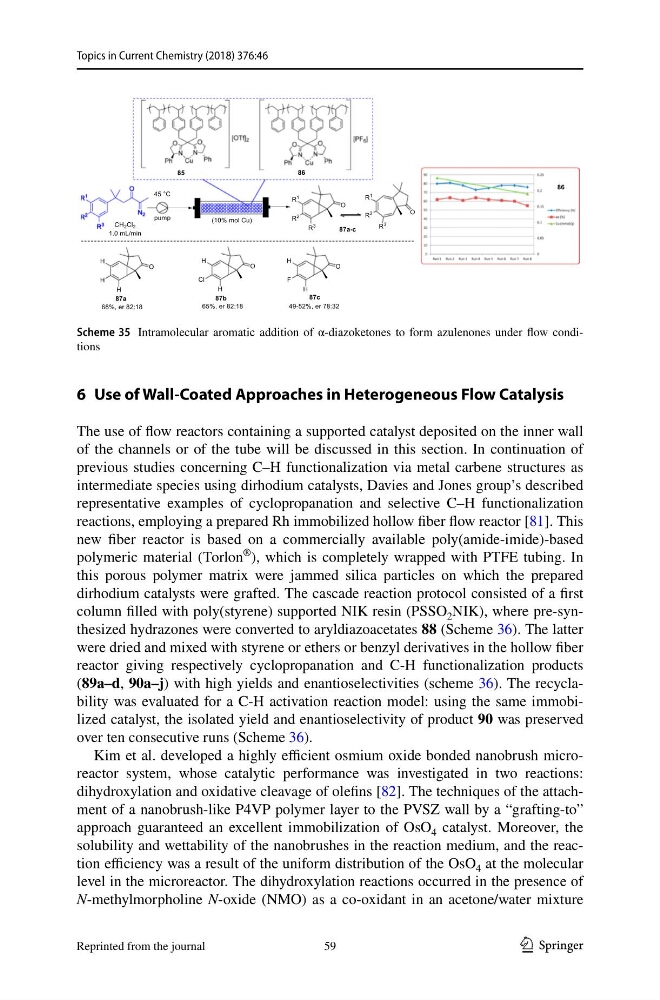
Scheme 35 Intramolecular aromatic addition of α-diazoketones to form azulenones under flow conditions
59
Reprinted from the journal
Topics in Current Chemistry (2018) 376:46
6 Use of Wall‑Coated Approaches in Heterogeneous Flow Catalysis
The use of flow reactors containing a supported catalyst deposited on the inner wall
of the channels or of the tube will be discussed in this section. In continuation of
previous studies concerning C–H functionalization via metal carbene structures as
intermediate species using dirhodium catalysts, Davies and Jones group’s described
representative examples of cyclopropanation and selective C–H functionalization
reactions, employing a prepared Rh immobilized hollow fiber flow reactor [81]. This
new fiber reactor is based on a commercially available poly(amide-imide)-based
polymeric material (Torlon
®
), which is completely wrapped with PTFE tubing. In
this porous polymer matrix were jammed silica particles on which the prepared
dirhodium catalysts were grafted. The cascade reaction protocol consisted of a first
column filled with poly(styrene) supported NIK resin (PSSO 2 NIK), where pre-synthesized hydrazones were converted to aryldiazoacetates 88 (Scheme 36). The latter
were dried and mixed with styrene or ethers or benzyl derivatives in the hollow fiber
reactor giving respectively cyclopropanation and C-H functionalization products
(89a–d, 90a–j) with high yields and enantioselectivities (scheme 36). The recyclability was evaluated for a C-H activation reaction model: using the same immobilized catalyst, the isolated yield and enantioselectivity of product 90 was preserved
over ten consecutive runs (Scheme 36).
Kim et al. developed a highly efficient osmium oxide bonded nanobrush microreactor system, whose catalytic performance was investigated in two reactions:
dihydroxylation and oxidative cleavage of olefins [82]. The techniques of the attachment of a nanobrush-like P4VP polymer layer to the PVSZ wall by a “grafting-to”
approach guaranteed an excellent immobilization of OsO 4 catalyst. Moreover, the
solubility and wettability of the nanobrushes in the reaction medium, and the reaction efficiency was a result of the uniform distribution of the OsO 4 at the molecular
level in the microreactor. The dihydroxylation reactions occurred in the presence of
N-methylmorpholine N-oxide (NMO) as a co-oxidant in an acetone/water mixture
Scheme 35 Intramolecular aromatic addition of α-diazoketones to form azulenones under flow conditions
59
Reprinted from the journal