

Topics in Current Chemistry (2018) 376:46
1 3
high yields and high levels of asymmetric induction (up to 98:2 er) for the product
78 [78]. The efficiency of 76 was due to the combination of excellent swelling in
CF 3 C 6 H 5 and good accessibility of the soluble reactants to the catalytic sites in the
polymer matrix. The robustness of the flow reactor was demonstrated by the retention of full activity and enantioselectivity for up to 60 h with a low level of leaching
(2.1 ppm).
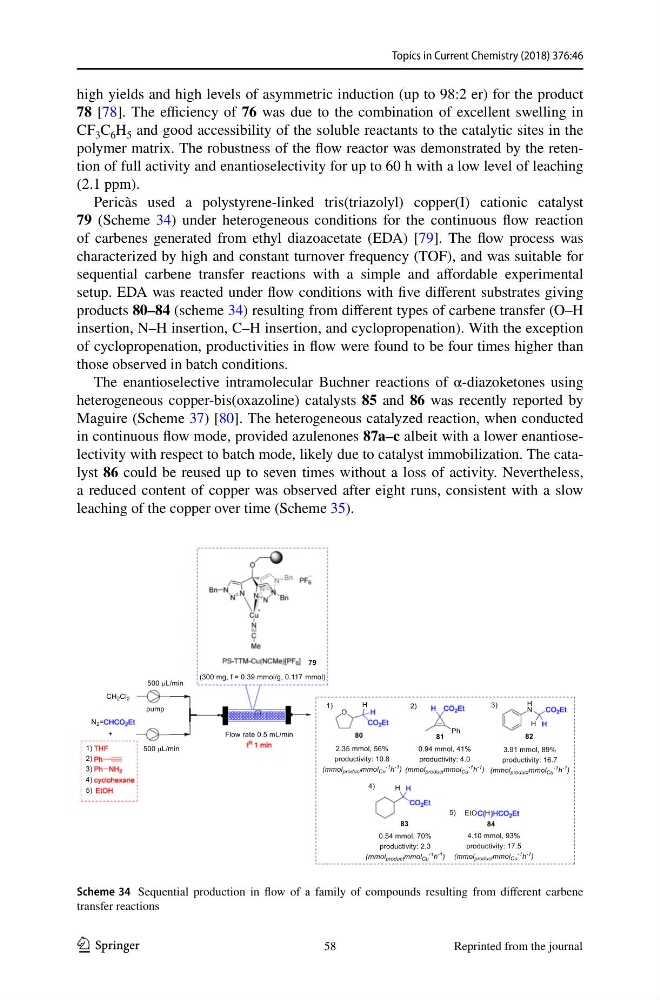
Pericàs used a polystyrene-linked tris(triazolyl) copper(I) cationic catalyst
79 (Scheme 34) under heterogeneous conditions for the continuous flow reaction
of carbenes generated from ethyl diazoacetate (EDA) [79]. The flow process was
characterized by high and constant turnover frequency (TOF), and was suitable for
sequential carbene transfer reactions with a simple and affordable experimental
setup. EDA was reacted under flow conditions with five different substrates giving
products 80–84 (scheme 34) resulting from different types of carbene transfer (O–H
insertion, N–H insertion, C–H insertion, and cyclopropenation). With the exception
of cyclopropenation, productivities in flow were found to be four times higher than
those observed in batch conditions.
The enantioselective intramolecular Buchner reactions of α-diazoketones using
heterogeneous copper-bis(oxazoline) catalysts 85 and 86 was recently reported by
Maguire (Scheme 37) [80]. The heterogeneous catalyzed reaction, when conducted
in continuous flow mode, provided azulenones 87a–c albeit with a lower enantioselectivity with respect to batch mode, likely due to catalyst immobilization. The catalyst 86 could be reused up to seven times without a loss of activity. Nevertheless,
a reduced content of copper was observed after eight runs, consistent with a slow
leaching of the copper over time (Scheme 35).
Scheme 34 Sequential production in flow of a family of compounds resulting from different carbene
transfer reactions
58
Reprinted from the journal
1 3
high yields and high levels of asymmetric induction (up to 98:2 er) for the product
78 [78]. The efficiency of 76 was due to the combination of excellent swelling in
CF 3 C 6 H 5 and good accessibility of the soluble reactants to the catalytic sites in the
polymer matrix. The robustness of the flow reactor was demonstrated by the retention of full activity and enantioselectivity for up to 60 h with a low level of leaching
(2.1 ppm).
Pericàs used a polystyrene-linked tris(triazolyl) copper(I) cationic catalyst
79 (Scheme 34) under heterogeneous conditions for the continuous flow reaction
of carbenes generated from ethyl diazoacetate (EDA) [79]. The flow process was
characterized by high and constant turnover frequency (TOF), and was suitable for
sequential carbene transfer reactions with a simple and affordable experimental
setup. EDA was reacted under flow conditions with five different substrates giving
products 80–84 (scheme 34) resulting from different types of carbene transfer (O–H
insertion, N–H insertion, C–H insertion, and cyclopropenation). With the exception
of cyclopropenation, productivities in flow were found to be four times higher than
those observed in batch conditions.
The enantioselective intramolecular Buchner reactions of α-diazoketones using
heterogeneous copper-bis(oxazoline) catalysts 85 and 86 was recently reported by
Maguire (Scheme 37) [80]. The heterogeneous catalyzed reaction, when conducted
in continuous flow mode, provided azulenones 87a–c albeit with a lower enantioselectivity with respect to batch mode, likely due to catalyst immobilization. The catalyst 86 could be reused up to seven times without a loss of activity. Nevertheless,
a reduced content of copper was observed after eight runs, consistent with a slow
leaching of the copper over time (Scheme 35).
Scheme 34 Sequential production in flow of a family of compounds resulting from different carbene
transfer reactions
58
Reprinted from the journal