

1 3
Topics in Current Chemistry (2018) 376:46
hydration, PdCl 2 -catalyzed Suzuki coupling, PdCl 2 -catalyzed isocyanide coupling, Ru-catalyzed oxidation of alkenes. In all transformations, a few micrograms
(25–30 μg) of metal were able to catalyze more than 0.1 mol of the substrate in a
few minutes, confirming the versatility of the system. The TONs amounted on the
order of 10
5
, while leaching tests revealed no detectable metal species except for the
ruthenium complex (~ 100 ppb), demonstrating the chemical robustness, stability,
and durability of the chitosan–metal composite (Scheme 38).
Gallium-containing polymer brush film in a glass microreactor has been reported
by Verboom et al. [84]. The authors fabricated polystyrene sulfonate-based polymer
brushes to anchor gallium as a Lewis acid catalyst on a flat SiO 2 onto the microchannel cavity. In order to prove its catalytic activity, the dehydration of cinnamaldehyde oxime was used as a model reaction at 90 °C, in acetonitrile as solvent, and
5 atm pressure. Moreover, a kinetic analysis was performed, giving a first-order
rate equation for the dehydration process with an activation energy calculated to be
6.55 kJ mol
−1
. The scope of the reaction was investigated with the preparation of
different aromatic nitriles with acceptable conversion within 13-min reaction time.
In the presence of hydroxyl group at the ortho position with respect to oxime group,
the dehydration of oximes gave a ring closure of ortho-hydroxy oximes furnishing
the corresponding oxazoles (Scheme 39).
7 Conclusions
The selected examples described in this chapter try to highlight the potential of supported heterogenous catalysts in continuous flow synthesis. Several approaches can
be followed to run continuous flow reactors using supported catalysts, each with
its own advantages and disadvantages. Moreover, progress in this field during the
last decade paved the way. However, more effort must be put into solving important
issues such as reducing or eliminating leaching, improving stability and durability of
the catalyst, and increasing process productivity. As shown here, chemoselectivity
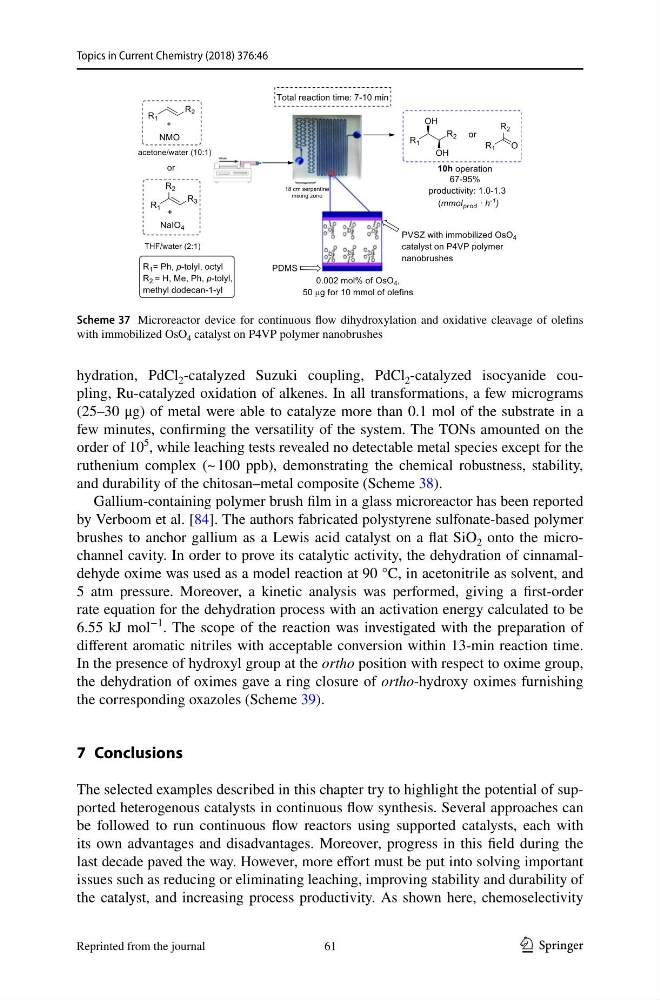
Scheme 37 Microreactor device for continuous flow dihydroxylation and oxidative cleavage of olefins
with immobilized OsO 4 catalyst on P4VP polymer nanobrushes
61
Reprinted from the journal
Topics in Current Chemistry (2018) 376:46
hydration, PdCl 2 -catalyzed Suzuki coupling, PdCl 2 -catalyzed isocyanide coupling, Ru-catalyzed oxidation of alkenes. In all transformations, a few micrograms
(25–30 μg) of metal were able to catalyze more than 0.1 mol of the substrate in a
few minutes, confirming the versatility of the system. The TONs amounted on the
order of 10
5
, while leaching tests revealed no detectable metal species except for the
ruthenium complex (~ 100 ppb), demonstrating the chemical robustness, stability,
and durability of the chitosan–metal composite (Scheme 38).
Gallium-containing polymer brush film in a glass microreactor has been reported
by Verboom et al. [84]. The authors fabricated polystyrene sulfonate-based polymer
brushes to anchor gallium as a Lewis acid catalyst on a flat SiO 2 onto the microchannel cavity. In order to prove its catalytic activity, the dehydration of cinnamaldehyde oxime was used as a model reaction at 90 °C, in acetonitrile as solvent, and
5 atm pressure. Moreover, a kinetic analysis was performed, giving a first-order
rate equation for the dehydration process with an activation energy calculated to be
6.55 kJ mol
−1
. The scope of the reaction was investigated with the preparation of
different aromatic nitriles with acceptable conversion within 13-min reaction time.
In the presence of hydroxyl group at the ortho position with respect to oxime group,
the dehydration of oximes gave a ring closure of ortho-hydroxy oximes furnishing
the corresponding oxazoles (Scheme 39).
7 Conclusions
The selected examples described in this chapter try to highlight the potential of supported heterogenous catalysts in continuous flow synthesis. Several approaches can
be followed to run continuous flow reactors using supported catalysts, each with
its own advantages and disadvantages. Moreover, progress in this field during the
last decade paved the way. However, more effort must be put into solving important
issues such as reducing or eliminating leaching, improving stability and durability of
the catalyst, and increasing process productivity. As shown here, chemoselectivity
Scheme 37 Microreactor device for continuous flow dihydroxylation and oxidative cleavage of olefins
with immobilized OsO 4 catalyst on P4VP polymer nanobrushes
61
Reprinted from the journal