

Topics in Current Chemistry (2018) 376:46
1 3
batch reactions, but a slight decrease in enantioselectivity was observed. The
flow system could be reused at least seven times, without any loss in activity and
selectivity.
Shibasaki developed an anti-selective catalytic asymmetric nitroaldol reaction in
a continuous flow platform [71, 72]. The active catalyst was supported on a multiwalled nano tube (MWNT) via self-assembly of the amide-based chiral ligand and
metal salts (Nd
3+
and Na
+
). A stainless-steel column filled with the Nd/Na heterogeneous catalyst 63 was incorporated in a flow system to promote the nitroaldol
reaction with high stereoselectivity. A solution of m-methoxybenzaldehyde was first
passed through scavenger columns filled with NaHCO 3 and 3 Å MS before mixing
with a THF solution of nitromethane. The mixed stream was precooled to − 40 °C in
a coil tube before introduction into the packed column containing the catalyst. The
flow reactor system was operated for 30 h at 3.0 ml/h yielding product 64 with 96%
of conversion, an anti/syn ratio of 96/4 and er 95:5 (anti) (Scheme 28). This system
could easily be scaled up to produce more than 10 g of the product in a minimized
cooling volume.
Luis reported the preparation of polymeric monoliths containing TADDOL subunits by polymerization of the corresponding functional monomers [73]. Treatment
with Ti(iOPr) 4 afforded Ti-TADDOLates, which was used for the ZnEt 2 addition
to benzaldehyde. The ZnEt 2 addition was clearly improved when the reaction was
carried out under flow conditions, achieving high enantioselectivity (Scheme 29).
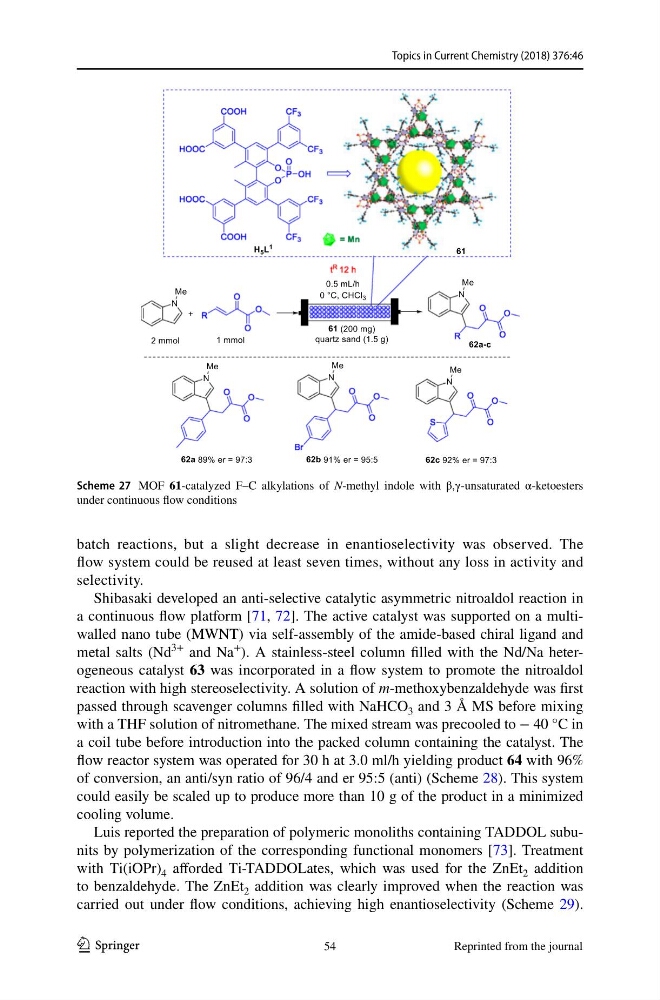
Scheme 27 MOF 61-catalyzed F–C alkylations of N-methyl indole with β,γ-unsaturated α-ketoesters
under continuous flow conditions
54
Reprinted from the journal
1 3
batch reactions, but a slight decrease in enantioselectivity was observed. The
flow system could be reused at least seven times, without any loss in activity and
selectivity.
Shibasaki developed an anti-selective catalytic asymmetric nitroaldol reaction in
a continuous flow platform [71, 72]. The active catalyst was supported on a multiwalled nano tube (MWNT) via self-assembly of the amide-based chiral ligand and
metal salts (Nd
3+
and Na
+
). A stainless-steel column filled with the Nd/Na heterogeneous catalyst 63 was incorporated in a flow system to promote the nitroaldol
reaction with high stereoselectivity. A solution of m-methoxybenzaldehyde was first
passed through scavenger columns filled with NaHCO 3 and 3 Å MS before mixing
with a THF solution of nitromethane. The mixed stream was precooled to − 40 °C in
a coil tube before introduction into the packed column containing the catalyst. The
flow reactor system was operated for 30 h at 3.0 ml/h yielding product 64 with 96%
of conversion, an anti/syn ratio of 96/4 and er 95:5 (anti) (Scheme 28). This system
could easily be scaled up to produce more than 10 g of the product in a minimized
cooling volume.
Luis reported the preparation of polymeric monoliths containing TADDOL subunits by polymerization of the corresponding functional monomers [73]. Treatment
with Ti(iOPr) 4 afforded Ti-TADDOLates, which was used for the ZnEt 2 addition
to benzaldehyde. The ZnEt 2 addition was clearly improved when the reaction was
carried out under flow conditions, achieving high enantioselectivity (Scheme 29).
Scheme 27 MOF 61-catalyzed F–C alkylations of N-methyl indole with β,γ-unsaturated α-ketoesters
under continuous flow conditions
54
Reprinted from the journal