

Topics in Current Chemistry (2018) 376:46
1 3
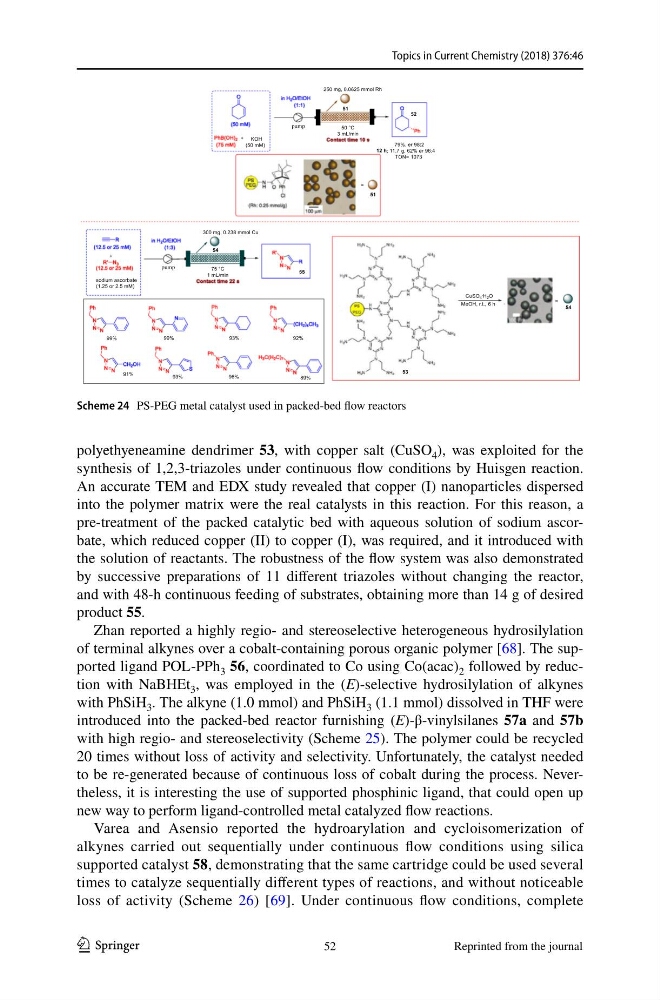
polyethyeneamine dendrimer 53, with copper salt (CuSO 4 ), was exploited for the
synthesis of 1,2,3-triazoles under continuous flow conditions by Huisgen reaction.
An accurate TEM and EDX study revealed that copper (I) nanoparticles dispersed
into the polymer matrix were the real catalysts in this reaction. For this reason, a
pre-treatment of the packed catalytic bed with aqueous solution of sodium ascorbate, which reduced copper (II) to copper (I), was required, and it introduced with
the solution of reactants. The robustness of the flow system was also demonstrated
by successive preparations of 11 different triazoles without changing the reactor,
and with 48-h continuous feeding of substrates, obtaining more than 14 g of desired
product 55.
Zhan reported a highly regio- and stereoselective heterogeneous hydrosilylation
of terminal alkynes over a cobalt-containing porous organic polymer [68]. The supported ligand POL-PPh 3 56, coordinated to Co using Co(acac) 2 followed by reduction with NaBHEt 3 , was employed in the (E)-selective hydrosilylation of alkynes
with PhSiH 3 . The alkyne (1.0 mmol) and PhSiH 3 (1.1 mmol) dissolved in THF were
introduced into the packed-bed reactor furnishing (E)-β-vinylsilanes 57a and 57b
with high regio- and stereoselectivity (Scheme 25). The polymer could be recycled
20 times without loss of activity and selectivity. Unfortunately, the catalyst needed
to be re-generated because of continuous loss of cobalt during the process. Nevertheless, it is interesting the use of supported phosphinic ligand, that could open up
new way to perform ligand-controlled metal catalyzed flow reactions.
Varea and Asensio reported the hydroarylation and cycloisomerization of
alkynes carried out sequentially under continuous flow conditions using silica
supported catalyst 58, demonstrating that the same cartridge could be used several
times to catalyze sequentially different types of reactions, and without noticeable
loss of activity (Scheme 26) [69]. Under continuous flow conditions, complete
Scheme 24 PS-PEG metal catalyst used in packed-bed flow reactors
52
Reprinted from the journal
1 3
polyethyeneamine dendrimer 53, with copper salt (CuSO 4 ), was exploited for the
synthesis of 1,2,3-triazoles under continuous flow conditions by Huisgen reaction.
An accurate TEM and EDX study revealed that copper (I) nanoparticles dispersed
into the polymer matrix were the real catalysts in this reaction. For this reason, a
pre-treatment of the packed catalytic bed with aqueous solution of sodium ascorbate, which reduced copper (II) to copper (I), was required, and it introduced with
the solution of reactants. The robustness of the flow system was also demonstrated
by successive preparations of 11 different triazoles without changing the reactor,
and with 48-h continuous feeding of substrates, obtaining more than 14 g of desired
product 55.
Zhan reported a highly regio- and stereoselective heterogeneous hydrosilylation
of terminal alkynes over a cobalt-containing porous organic polymer [68]. The supported ligand POL-PPh 3 56, coordinated to Co using Co(acac) 2 followed by reduction with NaBHEt 3 , was employed in the (E)-selective hydrosilylation of alkynes
with PhSiH 3 . The alkyne (1.0 mmol) and PhSiH 3 (1.1 mmol) dissolved in THF were
introduced into the packed-bed reactor furnishing (E)-β-vinylsilanes 57a and 57b
with high regio- and stereoselectivity (Scheme 25). The polymer could be recycled
20 times without loss of activity and selectivity. Unfortunately, the catalyst needed
to be re-generated because of continuous loss of cobalt during the process. Nevertheless, it is interesting the use of supported phosphinic ligand, that could open up
new way to perform ligand-controlled metal catalyzed flow reactions.
Varea and Asensio reported the hydroarylation and cycloisomerization of
alkynes carried out sequentially under continuous flow conditions using silica
supported catalyst 58, demonstrating that the same cartridge could be used several
times to catalyze sequentially different types of reactions, and without noticeable
loss of activity (Scheme 26) [69]. Under continuous flow conditions, complete
Scheme 24 PS-PEG metal catalyst used in packed-bed flow reactors
52
Reprinted from the journal