

1 3
Topics in Current Chemistry (2018) 376:46
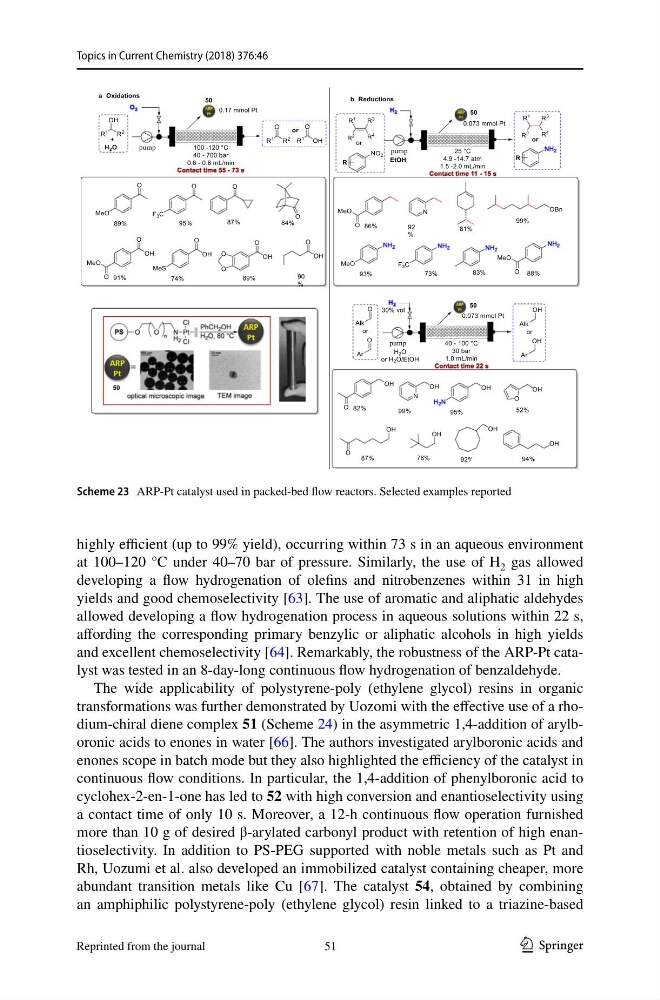
highly efficient (up to 99% yield), occurring within 73 s in an aqueous environment
at 100–120 °C under 40–70 bar of pressure. Similarly, the use of H 2 gas allowed
developing a flow hydrogenation of olefins and nitrobenzenes within 31 in high
yields and good chemoselectivity [63]. The use of aromatic and aliphatic aldehydes
allowed developing a flow hydrogenation process in aqueous solutions within 22 s,
affording the corresponding primary benzylic or aliphatic alcohols in high yields
and excellent chemoselectivity [64]. Remarkably, the robustness of the ARP-Pt catalyst was tested in an 8-day-long continuous flow hydrogenation of benzaldehyde.
The wide applicability of polystyrene-poly (ethylene glycol) resins in organic
transformations was further demonstrated by Uozomi with the effective use of a rhodium-chiral diene complex 51 (Scheme 24) in the asymmetric 1,4-addition of arylboronic acids to enones in water [66]. The authors investigated arylboronic acids and
enones scope in batch mode but they also highlighted the efficiency of the catalyst in
continuous flow conditions. In particular, the 1,4-addition of phenylboronic acid to
cyclohex-2-en-1-one has led to 52 with high conversion and enantioselectivity using
a contact time of only 10 s. Moreover, a 12-h continuous flow operation furnished
more than 10 g of desired β-arylated carbonyl product with retention of high enantioselectivity. In addition to PS-PEG supported with noble metals such as Pt and
Rh, Uozumi et al. also developed an immobilized catalyst containing cheaper, more
abundant transition metals like Cu [67]. The catalyst 54, obtained by combining
an amphiphilic polystyrene-poly (ethylene glycol) resin linked to a triazine-based
Scheme 23 ARP-Pt catalyst used in packed-bed flow reactors. Selected examples reported
51
Reprinted from the journal
Topics in Current Chemistry (2018) 376:46
highly efficient (up to 99% yield), occurring within 73 s in an aqueous environment
at 100–120 °C under 40–70 bar of pressure. Similarly, the use of H 2 gas allowed
developing a flow hydrogenation of olefins and nitrobenzenes within 31 in high
yields and good chemoselectivity [63]. The use of aromatic and aliphatic aldehydes
allowed developing a flow hydrogenation process in aqueous solutions within 22 s,
affording the corresponding primary benzylic or aliphatic alcohols in high yields
and excellent chemoselectivity [64]. Remarkably, the robustness of the ARP-Pt catalyst was tested in an 8-day-long continuous flow hydrogenation of benzaldehyde.
The wide applicability of polystyrene-poly (ethylene glycol) resins in organic
transformations was further demonstrated by Uozomi with the effective use of a rhodium-chiral diene complex 51 (Scheme 24) in the asymmetric 1,4-addition of arylboronic acids to enones in water [66]. The authors investigated arylboronic acids and
enones scope in batch mode but they also highlighted the efficiency of the catalyst in
continuous flow conditions. In particular, the 1,4-addition of phenylboronic acid to
cyclohex-2-en-1-one has led to 52 with high conversion and enantioselectivity using
a contact time of only 10 s. Moreover, a 12-h continuous flow operation furnished
more than 10 g of desired β-arylated carbonyl product with retention of high enantioselectivity. In addition to PS-PEG supported with noble metals such as Pt and
Rh, Uozumi et al. also developed an immobilized catalyst containing cheaper, more
abundant transition metals like Cu [67]. The catalyst 54, obtained by combining
an amphiphilic polystyrene-poly (ethylene glycol) resin linked to a triazine-based
Scheme 23 ARP-Pt catalyst used in packed-bed flow reactors. Selected examples reported
51
Reprinted from the journal