

Topics in Current Chemistry (2018) 376:46
1 3
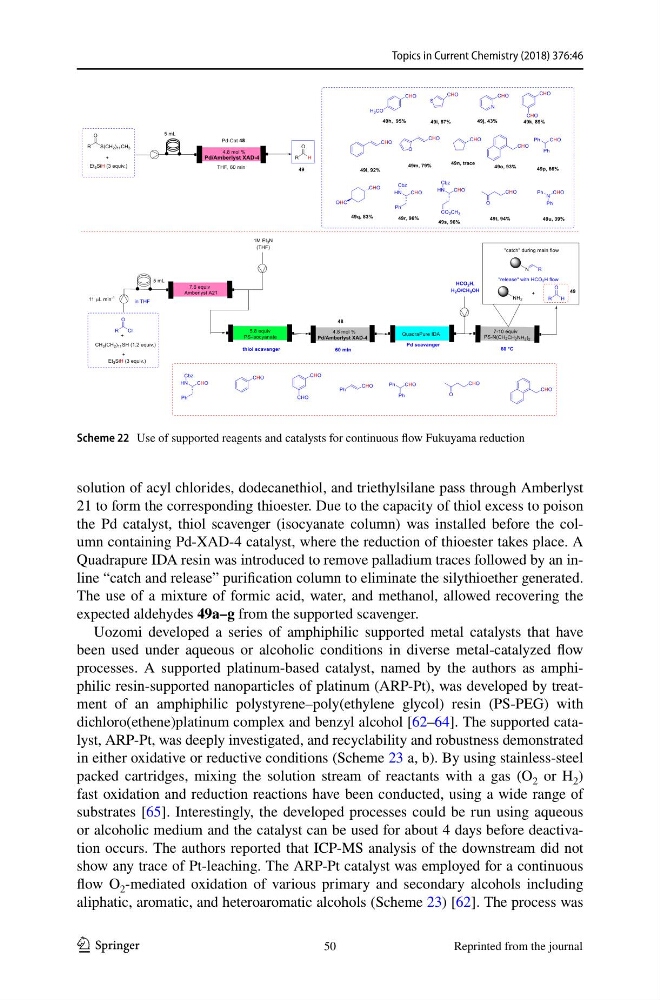
solution of acyl chlorides, dodecanethiol, and triethylsilane pass through Amberlyst
21 to form the corresponding thioester. Due to the capacity of thiol excess to poison
the Pd catalyst, thiol scavenger (isocyanate column) was installed before the column containing Pd-XAD-4 catalyst, where the reduction of thioester takes place. A
Quadrapure IDA resin was introduced to remove palladium traces followed by an inline “catch and release” purification column to eliminate the silythioether generated.
The use of a mixture of formic acid, water, and methanol, allowed recovering the
expected aldehydes 49a–g from the supported scavenger.
Uozomi developed a series of amphiphilic supported metal catalysts that have
been used under aqueous or alcoholic conditions in diverse metal-catalyzed flow
processes. A supported platinum-based catalyst, named by the authors as amphiphilic resin-supported nanoparticles of platinum (ARP-Pt), was developed by treatment of an amphiphilic polystyrene–poly(ethylene glycol) resin (PS-PEG) with
dichloro(ethene)platinum complex and benzyl alcohol [62–64]. The supported catalyst, ARP-Pt, was deeply investigated, and recyclability and robustness demonstrated
in either oxidative or reductive conditions (Scheme 23 a, b). By using stainless-steel
packed cartridges, mixing the solution stream of reactants with a gas (O 2 or H 2 )
fast oxidation and reduction reactions have been conducted, using a wide range of
substrates [65]. Interestingly, the developed processes could be run using aqueous
or alcoholic medium and the catalyst can be used for about 4 days before deactivation occurs. The authors reported that ICP-MS analysis of the downstream did not
show any trace of Pt-leaching. The ARP-Pt catalyst was employed for a continuous
flow O 2 -mediated oxidation of various primary and secondary alcohols including
aliphatic, aromatic, and heteroaromatic alcohols (Scheme 23) [62]. The process was
Scheme 22 Use of supported reagents and catalysts for continuous flow Fukuyama reduction
50
Reprinted from the journal
1 3
solution of acyl chlorides, dodecanethiol, and triethylsilane pass through Amberlyst
21 to form the corresponding thioester. Due to the capacity of thiol excess to poison
the Pd catalyst, thiol scavenger (isocyanate column) was installed before the column containing Pd-XAD-4 catalyst, where the reduction of thioester takes place. A
Quadrapure IDA resin was introduced to remove palladium traces followed by an inline “catch and release” purification column to eliminate the silythioether generated.
The use of a mixture of formic acid, water, and methanol, allowed recovering the
expected aldehydes 49a–g from the supported scavenger.
Uozomi developed a series of amphiphilic supported metal catalysts that have
been used under aqueous or alcoholic conditions in diverse metal-catalyzed flow
processes. A supported platinum-based catalyst, named by the authors as amphiphilic resin-supported nanoparticles of platinum (ARP-Pt), was developed by treatment of an amphiphilic polystyrene–poly(ethylene glycol) resin (PS-PEG) with
dichloro(ethene)platinum complex and benzyl alcohol [62–64]. The supported catalyst, ARP-Pt, was deeply investigated, and recyclability and robustness demonstrated
in either oxidative or reductive conditions (Scheme 23 a, b). By using stainless-steel
packed cartridges, mixing the solution stream of reactants with a gas (O 2 or H 2 )
fast oxidation and reduction reactions have been conducted, using a wide range of
substrates [65]. Interestingly, the developed processes could be run using aqueous
or alcoholic medium and the catalyst can be used for about 4 days before deactivation occurs. The authors reported that ICP-MS analysis of the downstream did not
show any trace of Pt-leaching. The ARP-Pt catalyst was employed for a continuous
flow O 2 -mediated oxidation of various primary and secondary alcohols including
aliphatic, aromatic, and heteroaromatic alcohols (Scheme 23) [62]. The process was
Scheme 22 Use of supported reagents and catalysts for continuous flow Fukuyama reduction
50
Reprinted from the journal