

1 3
Topics in Current Chemistry (2018) 376:46
flow conditions. This approach might have drastically reduced palladium leaching in
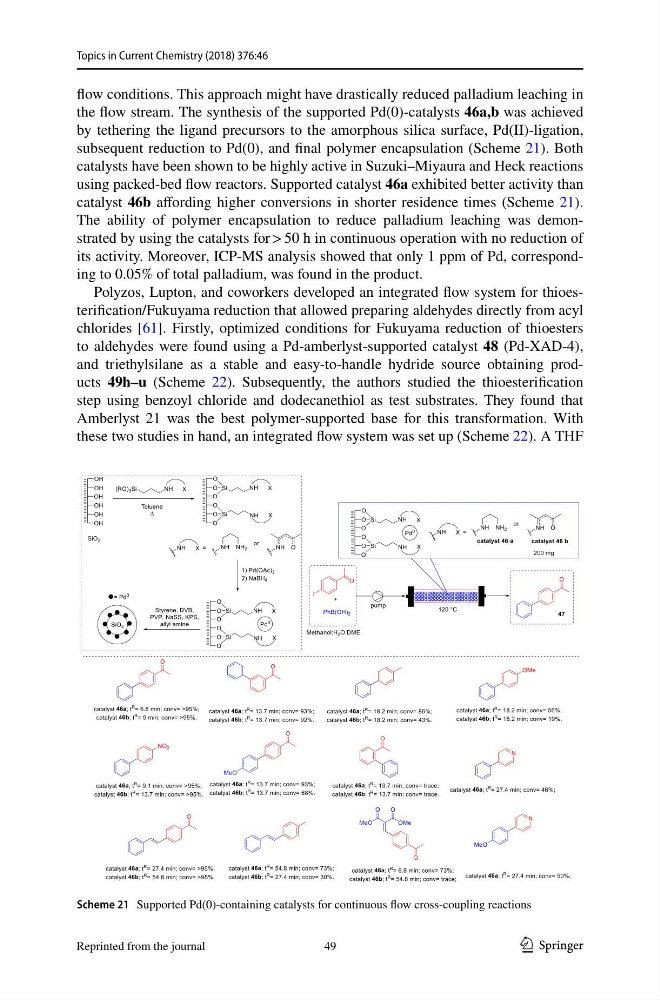
the flow stream. The synthesis of the supported Pd(0)-catalysts 46a,b was achieved
by tethering the ligand precursors to the amorphous silica surface, Pd(II)-ligation,
subsequent reduction to Pd(0), and final polymer encapsulation (Scheme 21). Both
catalysts have been shown to be highly active in Suzuki–Miyaura and Heck reactions
using packed-bed flow reactors. Supported catalyst 46a exhibited better activity than
catalyst 46b affording higher conversions in shorter residence times (Scheme 21).
The ability of polymer encapsulation to reduce palladium leaching was demonstrated by using the catalysts for > 50 h in continuous operation with no reduction of
its activity. Moreover, ICP-MS analysis showed that only 1 ppm of Pd, corresponding to 0.05% of total palladium, was found in the product.
Polyzos, Lupton, and coworkers developed an integrated flow system for thioesterification/Fukuyama reduction that allowed preparing aldehydes directly from acyl
chlorides [61]. Firstly, optimized conditions for Fukuyama reduction of thioesters
to aldehydes were found using a Pd-amberlyst-supported catalyst 48 (Pd-XAD-4),
and triethylsilane as a stable and easy-to-handle hydride source obtaining products 49h–u (Scheme 22). Subsequently, the authors studied the thioesterification
step using benzoyl chloride and dodecanethiol as test substrates. They found that
Amberlyst 21 was the best polymer-supported base for this transformation. With
these two studies in hand, an integrated flow system was set up (Scheme 22). A THF
Scheme 21 Supported Pd(0)-containing catalysts for continuous flow cross-coupling reactions
49
Reprinted from the journal
Topics in Current Chemistry (2018) 376:46
flow conditions. This approach might have drastically reduced palladium leaching in
the flow stream. The synthesis of the supported Pd(0)-catalysts 46a,b was achieved
by tethering the ligand precursors to the amorphous silica surface, Pd(II)-ligation,
subsequent reduction to Pd(0), and final polymer encapsulation (Scheme 21). Both
catalysts have been shown to be highly active in Suzuki–Miyaura and Heck reactions
using packed-bed flow reactors. Supported catalyst 46a exhibited better activity than
catalyst 46b affording higher conversions in shorter residence times (Scheme 21).
The ability of polymer encapsulation to reduce palladium leaching was demonstrated by using the catalysts for > 50 h in continuous operation with no reduction of
its activity. Moreover, ICP-MS analysis showed that only 1 ppm of Pd, corresponding to 0.05% of total palladium, was found in the product.
Polyzos, Lupton, and coworkers developed an integrated flow system for thioesterification/Fukuyama reduction that allowed preparing aldehydes directly from acyl
chlorides [61]. Firstly, optimized conditions for Fukuyama reduction of thioesters
to aldehydes were found using a Pd-amberlyst-supported catalyst 48 (Pd-XAD-4),
and triethylsilane as a stable and easy-to-handle hydride source obtaining products 49h–u (Scheme 22). Subsequently, the authors studied the thioesterification
step using benzoyl chloride and dodecanethiol as test substrates. They found that
Amberlyst 21 was the best polymer-supported base for this transformation. With
these two studies in hand, an integrated flow system was set up (Scheme 22). A THF
Scheme 21 Supported Pd(0)-containing catalysts for continuous flow cross-coupling reactions
49
Reprinted from the journal