

Topics in Current Chemistry (2018) 376:46
1 3
Friedel–Crafts reaction of indoles and sulfonylimines in both batch and flow modes
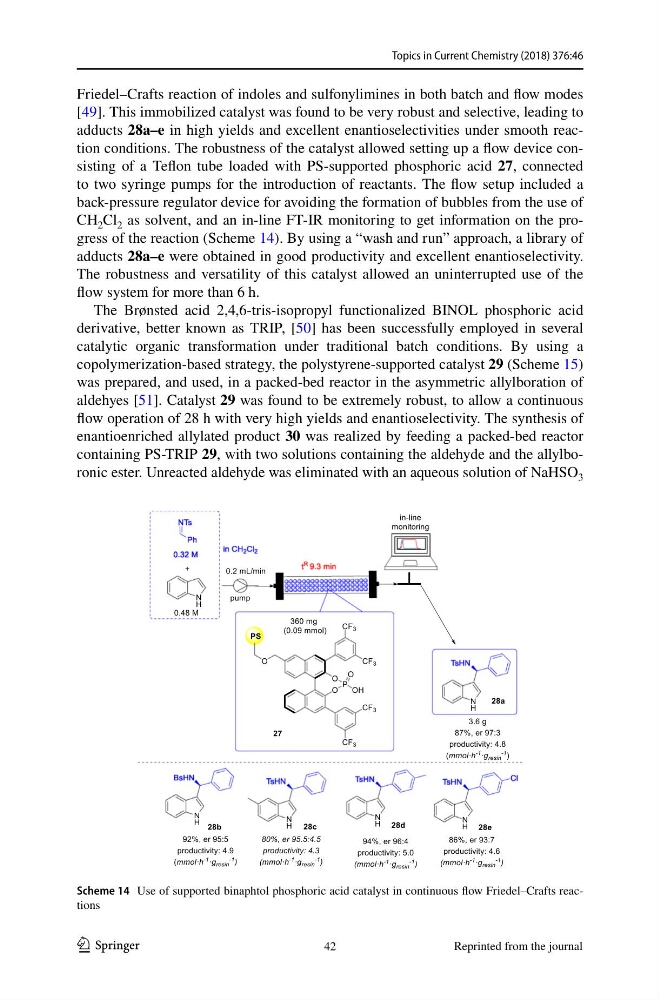
[49]. This immobilized catalyst was found to be very robust and selective, leading to
adducts 28a–e in high yields and excellent enantioselectivities under smooth reaction conditions. The robustness of the catalyst allowed setting up a flow device consisting of a Teflon tube loaded with PS-supported phosphoric acid 27, connected
to two syringe pumps for the introduction of reactants. The flow setup included a
back-pressure regulator device for avoiding the formation of bubbles from the use of
CH 2 Cl 2 as solvent, and an in-line FT-IR monitoring to get information on the progress of the reaction (Scheme 14). By using a “wash and run” approach, a library of
adducts 28a–e were obtained in good productivity and excellent enantioselectivity.
The robustness and versatility of this catalyst allowed an uninterrupted use of the
flow system for more than 6 h.
The Brønsted acid 2,4,6-tris-isopropyl functionalized BINOL phosphoric acid
derivative, better known as TRIP, [50] has been successfully employed in several
catalytic organic transformation under traditional batch conditions. By using a
copolymerization-based strategy, the polystyrene-supported catalyst 29 (Scheme 15)
was prepared, and used, in a packed-bed reactor in the asymmetric allylboration of
aldehyes [51]. Catalyst 29 was found to be extremely robust, to allow a continuous
flow operation of 28 h with very high yields and enantioselectivity. The synthesis of
enantioenriched allylated product 30 was realized by feeding a packed-bed reactor
containing PS-TRIP 29, with two solutions containing the aldehyde and the allylboronic ester. Unreacted aldehyde was eliminated with an aqueous solution of NaHSO 3
Scheme 14 Use of supported binaphtol phosphoric acid catalyst in continuous flow Friedel–Crafts reactions
42
Reprinted from the journal
1 3
Friedel–Crafts reaction of indoles and sulfonylimines in both batch and flow modes
[49]. This immobilized catalyst was found to be very robust and selective, leading to
adducts 28a–e in high yields and excellent enantioselectivities under smooth reaction conditions. The robustness of the catalyst allowed setting up a flow device consisting of a Teflon tube loaded with PS-supported phosphoric acid 27, connected
to two syringe pumps for the introduction of reactants. The flow setup included a
back-pressure regulator device for avoiding the formation of bubbles from the use of
CH 2 Cl 2 as solvent, and an in-line FT-IR monitoring to get information on the progress of the reaction (Scheme 14). By using a “wash and run” approach, a library of
adducts 28a–e were obtained in good productivity and excellent enantioselectivity.
The robustness and versatility of this catalyst allowed an uninterrupted use of the
flow system for more than 6 h.
The Brønsted acid 2,4,6-tris-isopropyl functionalized BINOL phosphoric acid
derivative, better known as TRIP, [50] has been successfully employed in several
catalytic organic transformation under traditional batch conditions. By using a
copolymerization-based strategy, the polystyrene-supported catalyst 29 (Scheme 15)
was prepared, and used, in a packed-bed reactor in the asymmetric allylboration of
aldehyes [51]. Catalyst 29 was found to be extremely robust, to allow a continuous
flow operation of 28 h with very high yields and enantioselectivity. The synthesis of
enantioenriched allylated product 30 was realized by feeding a packed-bed reactor
containing PS-TRIP 29, with two solutions containing the aldehyde and the allylboronic ester. Unreacted aldehyde was eliminated with an aqueous solution of NaHSO 3
Scheme 14 Use of supported binaphtol phosphoric acid catalyst in continuous flow Friedel–Crafts reactions
42
Reprinted from the journal