

1 3
Topics in Current Chemistry (2018) 376:46
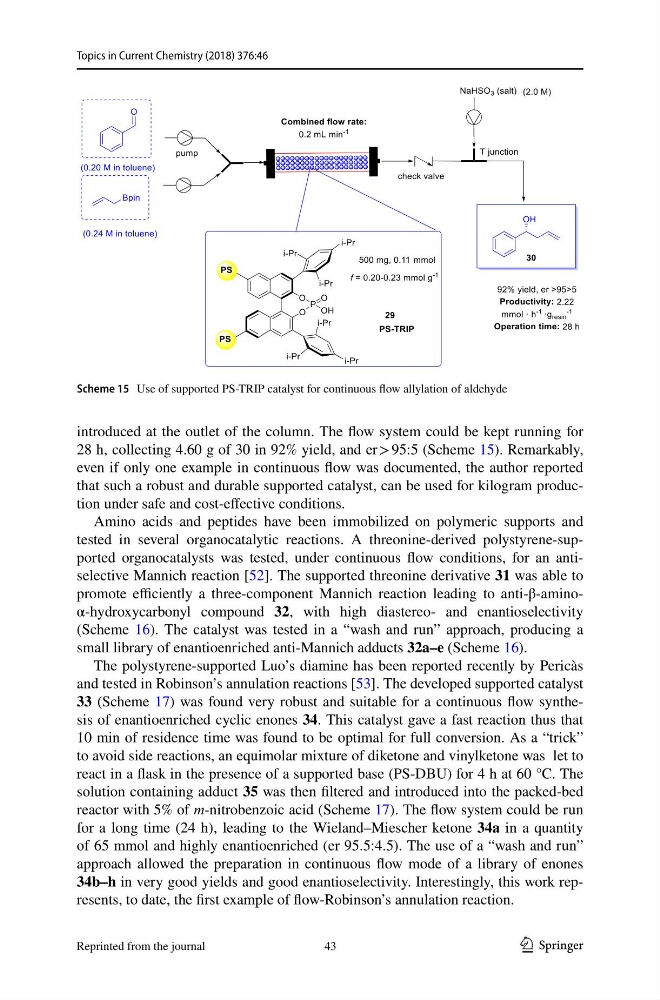
introduced at the outlet of the column. The flow system could be kept running for
28 h, collecting 4.60 g of 30 in 92% yield, and er > 95:5 (Scheme 15). Remarkably,
even if only one example in continuous flow was documented, the author reported
that such a robust and durable supported catalyst, can be used for kilogram production under safe and cost-effective conditions.
Amino acids and peptides have been immobilized on polymeric supports and
tested in several organocatalytic reactions. A threonine-derived polystyrene-supported organocatalysts was tested, under continuous flow conditions, for an antiselective Mannich reaction [52]. The supported threonine derivative 31 was able to
promote efficiently a three-component Mannich reaction leading to anti-β-aminoα-hydroxycarbonyl compound 32, with high diastereo- and enantioselectivity
(Scheme 16). The catalyst was tested in a “wash and run” approach, producing a
small library of enantioenriched anti-Mannich adducts 32a–e (Scheme 16).
The polystyrene-supported Luo’s diamine has been reported recently by Pericàs
and tested in Robinson’s annulation reactions [53]. The developed supported catalyst
33 (Scheme 17) was found very robust and suitable for a continuous flow synthesis of enantioenriched cyclic enones 34. This catalyst gave a fast reaction thus that
10 min of residence time was found to be optimal for full conversion. As a “trick”
to avoid side reactions, an equimolar mixture of diketone and vinylketone was let to
react in a flask in the presence of a supported base (PS-DBU) for 4 h at 60 °C. The
solution containing adduct 35 was then filtered and introduced into the packed-bed
reactor with 5% of m-nitrobenzoic acid (Scheme 17). The flow system could be run
for a long time (24 h), leading to the Wieland–Miescher ketone 34a in a quantity
of 65 mmol and highly enantioenriched (er 95.5:4.5). The use of a “wash and run”
approach allowed the preparation in continuous flow mode of a library of enones
34b–h in very good yields and good enantioselectivity. Interestingly, this work represents, to date, the first example of flow-Robinson’s annulation reaction.
Scheme 15 Use of supported PS-TRIP catalyst for continuous flow allylation of aldehyde
43
Reprinted from the journal
Topics in Current Chemistry (2018) 376:46
introduced at the outlet of the column. The flow system could be kept running for
28 h, collecting 4.60 g of 30 in 92% yield, and er > 95:5 (Scheme 15). Remarkably,
even if only one example in continuous flow was documented, the author reported
that such a robust and durable supported catalyst, can be used for kilogram production under safe and cost-effective conditions.
Amino acids and peptides have been immobilized on polymeric supports and
tested in several organocatalytic reactions. A threonine-derived polystyrene-supported organocatalysts was tested, under continuous flow conditions, for an antiselective Mannich reaction [52]. The supported threonine derivative 31 was able to
promote efficiently a three-component Mannich reaction leading to anti-β-aminoα-hydroxycarbonyl compound 32, with high diastereo- and enantioselectivity
(Scheme 16). The catalyst was tested in a “wash and run” approach, producing a
small library of enantioenriched anti-Mannich adducts 32a–e (Scheme 16).
The polystyrene-supported Luo’s diamine has been reported recently by Pericàs
and tested in Robinson’s annulation reactions [53]. The developed supported catalyst
33 (Scheme 17) was found very robust and suitable for a continuous flow synthesis of enantioenriched cyclic enones 34. This catalyst gave a fast reaction thus that
10 min of residence time was found to be optimal for full conversion. As a “trick”
to avoid side reactions, an equimolar mixture of diketone and vinylketone was let to
react in a flask in the presence of a supported base (PS-DBU) for 4 h at 60 °C. The
solution containing adduct 35 was then filtered and introduced into the packed-bed
reactor with 5% of m-nitrobenzoic acid (Scheme 17). The flow system could be run
for a long time (24 h), leading to the Wieland–Miescher ketone 34a in a quantity
of 65 mmol and highly enantioenriched (er 95.5:4.5). The use of a “wash and run”
approach allowed the preparation in continuous flow mode of a library of enones
34b–h in very good yields and good enantioselectivity. Interestingly, this work represents, to date, the first example of flow-Robinson’s annulation reaction.
Scheme 15 Use of supported PS-TRIP catalyst for continuous flow allylation of aldehyde
43
Reprinted from the journal