

1 3
Topics in Current Chemistry (2018) 376:46
Remarkably, the authors reported that this supported catalytic reactor could be
used in an intermittent manner form more than 1-year period without showing any
signs of deactivation or decrease in performance.
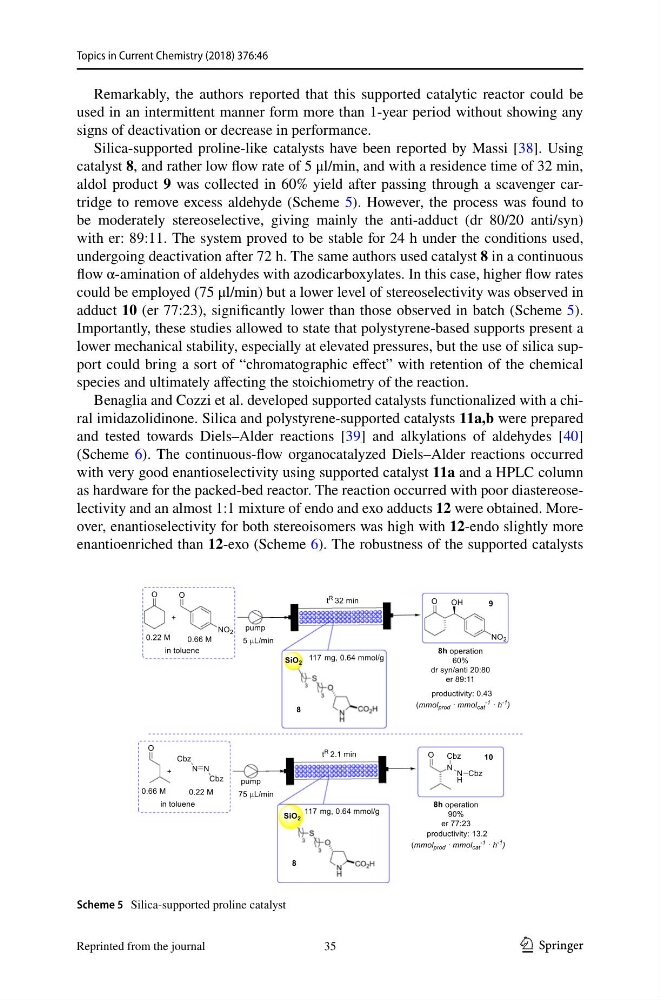
Silica-supported proline-like catalysts have been reported by Massi [38]. Using
catalyst 8, and rather low flow rate of 5 μl/min, and with a residence time of 32 min,
aldol product 9 was collected in 60% yield after passing through a scavenger cartridge to remove excess aldehyde (Scheme 5). However, the process was found to
be moderately stereoselective, giving mainly the anti-adduct (dr 80/20 anti/syn)
with er: 89:11. The system proved to be stable for 24 h under the conditions used,
undergoing deactivation after 72 h. The same authors used catalyst 8 in a continuous
flow α-amination of aldehydes with azodicarboxylates. In this case, higher flow rates
could be employed (75 μl/min) but a lower level of stereoselectivity was observed in
adduct 10 (er 77:23), significantly lower than those observed in batch (Scheme 5).
Importantly, these studies allowed to state that polystyrene-based supports present a
lower mechanical stability, especially at elevated pressures, but the use of silica support could bring a sort of “chromatographic effect” with retention of the chemical
species and ultimately affecting the stoichiometry of the reaction.
Benaglia and Cozzi et al. developed supported catalysts functionalized with a chiral imidazolidinone. Silica and polystyrene-supported catalysts 11a,b were prepared
and tested towards Diels–Alder reactions [39] and alkylations of aldehydes [40]
(Scheme 6). The continuous-flow organocatalyzed Diels–Alder reactions occurred
with very good enantioselectivity using supported catalyst 11a and a HPLC column
as hardware for the packed-bed reactor. The reaction occurred with poor diastereoselectivity and an almost 1:1 mixture of endo and exo adducts 12 were obtained. Moreover, enantioselectivity for both stereoisomers was high with 12-endo slightly more
enantioenriched than 12-exo (Scheme 6). The robustness of the supported catalysts
Scheme 5 Silica-supported proline catalyst
35
Reprinted from the journal
Topics in Current Chemistry (2018) 376:46
Remarkably, the authors reported that this supported catalytic reactor could be
used in an intermittent manner form more than 1-year period without showing any
signs of deactivation or decrease in performance.
Silica-supported proline-like catalysts have been reported by Massi [38]. Using
catalyst 8, and rather low flow rate of 5 μl/min, and with a residence time of 32 min,
aldol product 9 was collected in 60% yield after passing through a scavenger cartridge to remove excess aldehyde (Scheme 5). However, the process was found to
be moderately stereoselective, giving mainly the anti-adduct (dr 80/20 anti/syn)
with er: 89:11. The system proved to be stable for 24 h under the conditions used,
undergoing deactivation after 72 h. The same authors used catalyst 8 in a continuous
flow α-amination of aldehydes with azodicarboxylates. In this case, higher flow rates
could be employed (75 μl/min) but a lower level of stereoselectivity was observed in
adduct 10 (er 77:23), significantly lower than those observed in batch (Scheme 5).
Importantly, these studies allowed to state that polystyrene-based supports present a
lower mechanical stability, especially at elevated pressures, but the use of silica support could bring a sort of “chromatographic effect” with retention of the chemical
species and ultimately affecting the stoichiometry of the reaction.
Benaglia and Cozzi et al. developed supported catalysts functionalized with a chiral imidazolidinone. Silica and polystyrene-supported catalysts 11a,b were prepared
and tested towards Diels–Alder reactions [39] and alkylations of aldehydes [40]
(Scheme 6). The continuous-flow organocatalyzed Diels–Alder reactions occurred
with very good enantioselectivity using supported catalyst 11a and a HPLC column
as hardware for the packed-bed reactor. The reaction occurred with poor diastereoselectivity and an almost 1:1 mixture of endo and exo adducts 12 were obtained. Moreover, enantioselectivity for both stereoisomers was high with 12-endo slightly more
enantioenriched than 12-exo (Scheme 6). The robustness of the supported catalysts
Scheme 5 Silica-supported proline catalyst
35
Reprinted from the journal