

Topics in Current Chemistry (2018) 376:46
1 3
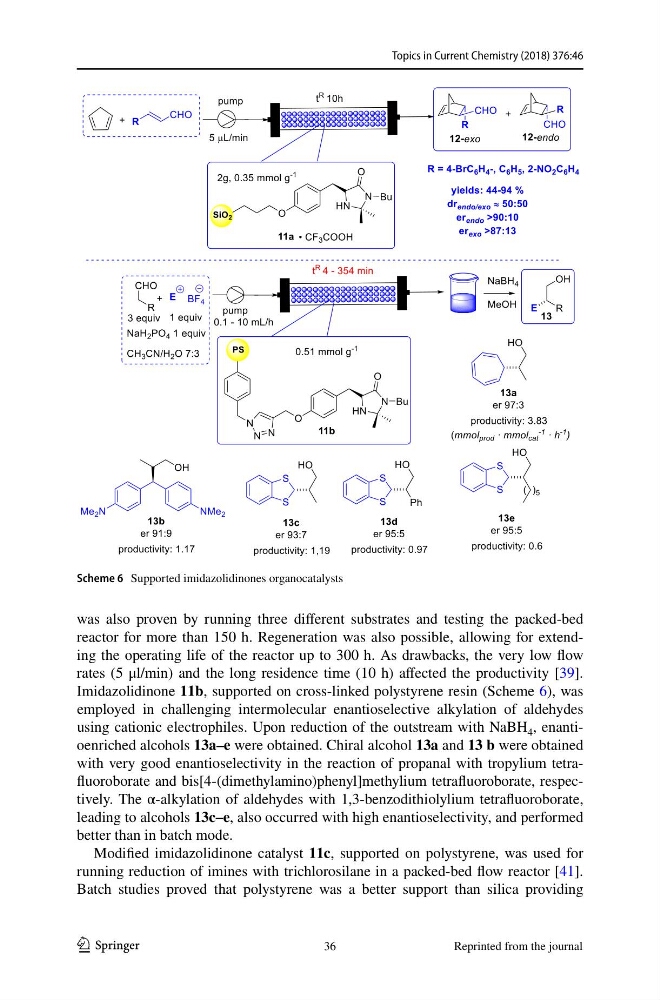
was also proven by running three different substrates and testing the packed-bed
reactor for more than 150 h. Regeneration was also possible, allowing for extending the operating life of the reactor up to 300 h. As drawbacks, the very low flow
rates (5 μl/min) and the long residence time (10 h) affected the productivity [39].
Imidazolidinone 11b, supported on cross-linked polystyrene resin (Scheme 6), was
employed in challenging intermolecular enantioselective alkylation of aldehydes
using cationic electrophiles. Upon reduction of the outstream with NaBH 4 , enantioenriched alcohols 13a–e were obtained. Chiral alcohol 13a and 13 b were obtained
with very good enantioselectivity in the reaction of propanal with tropylium tetrafluoroborate and bis[4-(dimethylamino)phenyl]methylium tetrafluoroborate, respectively. The α-alkylation of aldehydes with 1,3-benzodithiolylium tetrafluoroborate,
leading to alcohols 13c–e, also occurred with high enantioselectivity, and performed
better than in batch mode.
Modified imidazolidinone catalyst 11c, supported on polystyrene, was used for
running reduction of imines with trichlorosilane in a packed-bed flow reactor [41].
Batch studies proved that polystyrene was a better support than silica providing
Scheme 6 Supported imidazolidinones organocatalysts
36
Reprinted from the journal
1 3
was also proven by running three different substrates and testing the packed-bed
reactor for more than 150 h. Regeneration was also possible, allowing for extending the operating life of the reactor up to 300 h. As drawbacks, the very low flow
rates (5 μl/min) and the long residence time (10 h) affected the productivity [39].
Imidazolidinone 11b, supported on cross-linked polystyrene resin (Scheme 6), was
employed in challenging intermolecular enantioselective alkylation of aldehydes
using cationic electrophiles. Upon reduction of the outstream with NaBH 4 , enantioenriched alcohols 13a–e were obtained. Chiral alcohol 13a and 13 b were obtained
with very good enantioselectivity in the reaction of propanal with tropylium tetrafluoroborate and bis[4-(dimethylamino)phenyl]methylium tetrafluoroborate, respectively. The α-alkylation of aldehydes with 1,3-benzodithiolylium tetrafluoroborate,
leading to alcohols 13c–e, also occurred with high enantioselectivity, and performed
better than in batch mode.
Modified imidazolidinone catalyst 11c, supported on polystyrene, was used for
running reduction of imines with trichlorosilane in a packed-bed flow reactor [41].
Batch studies proved that polystyrene was a better support than silica providing
Scheme 6 Supported imidazolidinones organocatalysts
36
Reprinted from the journal