

Topics in Current Chemistry (2018) 376:46
1 3
was obtained in 95% yield, in 8.87 g with an overall catalyst loading for the process period of 1.6%. Further, the flow setup consisting of the packed bed reactor, a T-mixer for a basic quenching, and a final liquid–liquid separator (LLS)
was employed for running 16 different and consecutives Michael reactions with
high yields and stereoselectivities (Scheme 3). The continuous flow synthesis of
a library of adducts 5a–m during 3 days of operation demonstrates the robustness
of this catalyst.
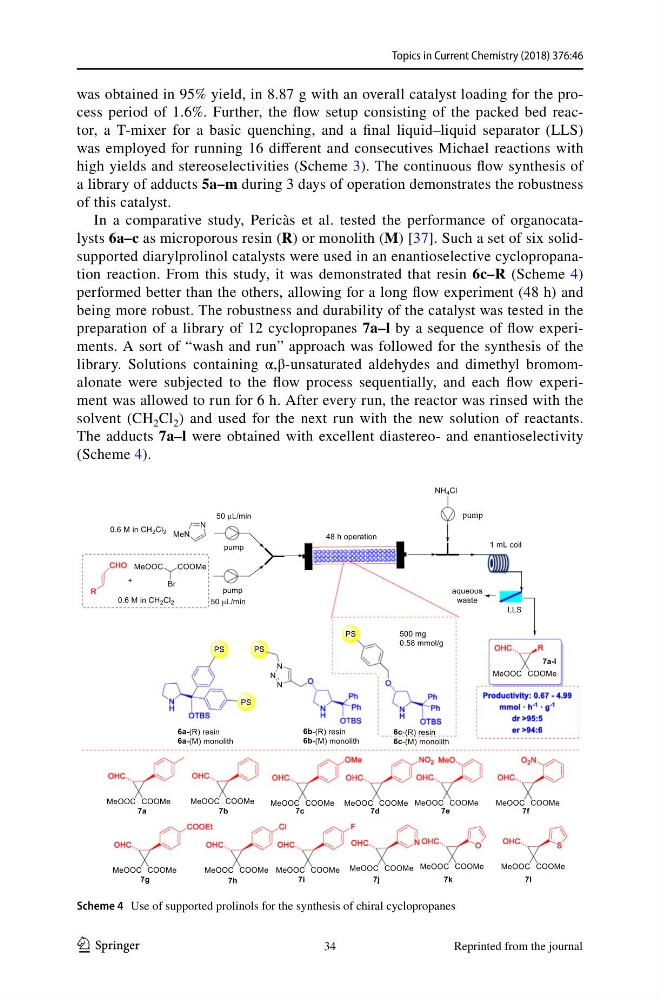
In a comparative study, Pericàs et al. tested the performance of organocatalysts 6a–c as microporous resin (R) or monolith (M) [37]. Such a set of six solidsupported diarylprolinol catalysts were used in an enantioselective cyclopropanation reaction. From this study, it was demonstrated that resin 6c–R (Scheme 4)
performed better than the others, allowing for a long flow experiment (48 h) and
being more robust. The robustness and durability of the catalyst was tested in the
preparation of a library of 12 cyclopropanes 7a–l by a sequence of flow experiments. A sort of “wash and run” approach was followed for the synthesis of the
library. Solutions containing α,β-unsaturated aldehydes and dimethyl bromomalonate were subjected to the flow process sequentially, and each flow experiment was allowed to run for 6 h. After every run, the reactor was rinsed with the
solvent (CH 2 Cl 2 ) and used for the next run with the new solution of reactants.
The adducts 7a–l were obtained with excellent diastereo- and enantioselectivity
(Scheme 4).
Scheme 4 Use of supported prolinols for the synthesis of chiral cyclopropanes
34
Reprinted from the journal
1 3
was obtained in 95% yield, in 8.87 g with an overall catalyst loading for the process period of 1.6%. Further, the flow setup consisting of the packed bed reactor, a T-mixer for a basic quenching, and a final liquid–liquid separator (LLS)
was employed for running 16 different and consecutives Michael reactions with
high yields and stereoselectivities (Scheme 3). The continuous flow synthesis of
a library of adducts 5a–m during 3 days of operation demonstrates the robustness
of this catalyst.
In a comparative study, Pericàs et al. tested the performance of organocatalysts 6a–c as microporous resin (R) or monolith (M) [37]. Such a set of six solidsupported diarylprolinol catalysts were used in an enantioselective cyclopropanation reaction. From this study, it was demonstrated that resin 6c–R (Scheme 4)
performed better than the others, allowing for a long flow experiment (48 h) and
being more robust. The robustness and durability of the catalyst was tested in the
preparation of a library of 12 cyclopropanes 7a–l by a sequence of flow experiments. A sort of “wash and run” approach was followed for the synthesis of the
library. Solutions containing α,β-unsaturated aldehydes and dimethyl bromomalonate were subjected to the flow process sequentially, and each flow experiment was allowed to run for 6 h. After every run, the reactor was rinsed with the
solvent (CH 2 Cl 2 ) and used for the next run with the new solution of reactants.
The adducts 7a–l were obtained with excellent diastereo- and enantioselectivity
(Scheme 4).
Scheme 4 Use of supported prolinols for the synthesis of chiral cyclopropanes
34
Reprinted from the journal