

Topics in Current Chemistry (2018) 376:46
1 3
and this also reduces the risk of leaching of the catalytically active species. In addition, this kind of supported catalyst can be very robust and can be used for a relatively long time. On the contrary, organocatalyzed reactions could require high catalyst loadings, and could have slow kinetics. Within a flow system, this can lead to
very low flow rates, compromising hourly productivity. In 2000, Lectka reported
what is recognized as the first example of continuous flow organocatalyzed reaction using a cinchona derivative supported on a Wang resin. The flow device was
set up in order to overcome problems related to incompatibility of reagents observed
in batch conditions. The system worked very well, and a series of enantioenriched
β-lactams were prepared in continuous flow [33]. Some years later, after the widespread dissemination on the use of proline and proline derivatives in stereoselective
organocatalyzed reactions, Pericàs reported the first example of Mannich reaction
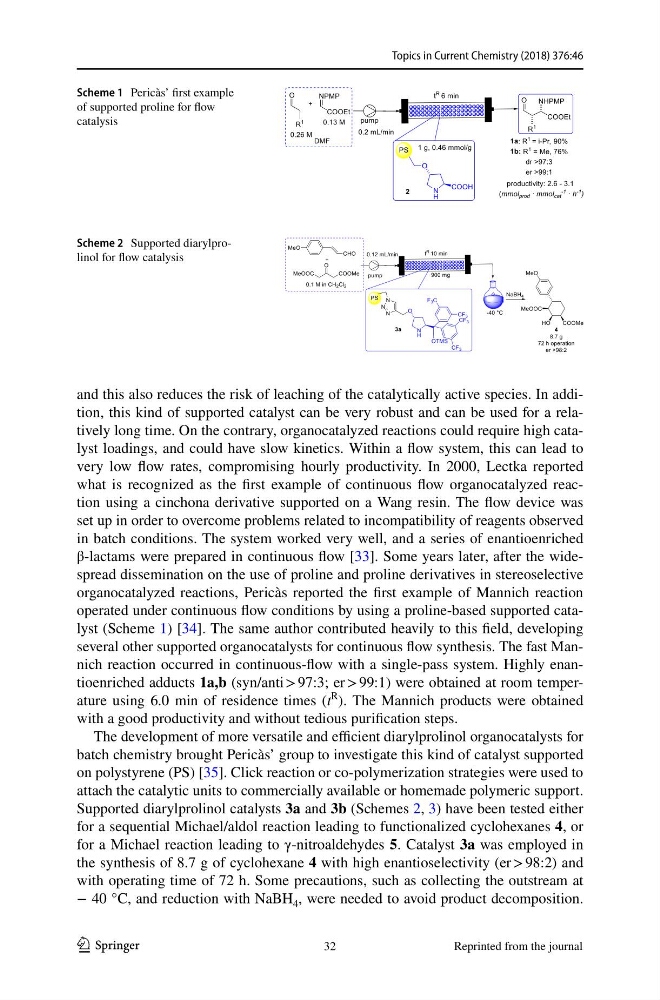
operated under continuous flow conditions by using a proline-based supported catalyst (Scheme 1) [34]. The same author contributed heavily to this field, developing
several other supported organocatalysts for continuous flow synthesis. The fast Mannich reaction occurred in continuous-flow with a single-pass system. Highly enantioenriched adducts 1a,b (syn/anti > 97:3; er > 99:1) were obtained at room temperature using 6.0 min of residence times (t
R
). The Mannich products were obtained
with a good productivity and without tedious purification steps.
The development of more versatile and efficient diarylprolinol organocatalysts for
batch chemistry brought Pericàs’ group to investigate this kind of catalyst supported
on polystyrene (PS) [35]. Click reaction or co-polymerization strategies were used to
attach the catalytic units to commercially available or homemade polymeric support.
Supported diarylprolinol catalysts 3a and 3b (Schemes 2, 3) have been tested either
for a sequential Michael/aldol reaction leading to functionalized cyclohexanes 4, or
for a Michael reaction leading to γ-nitroaldehydes 5. Catalyst 3a was employed in
the synthesis of 8.7 g of cyclohexane 4 with high enantioselectivity (er > 98:2) and
with operating time of 72 h. Some precautions, such as collecting the outstream at
− 40 °C, and reduction with NaBH 4 , were needed to avoid product decomposition.
Scheme 1 Pericàs’ first example
of supported proline for flow
catalysis
Scheme 2 Supported diarylprolinol for flow catalysis
32
Reprinted from the journal
1 3
and this also reduces the risk of leaching of the catalytically active species. In addition, this kind of supported catalyst can be very robust and can be used for a relatively long time. On the contrary, organocatalyzed reactions could require high catalyst loadings, and could have slow kinetics. Within a flow system, this can lead to
very low flow rates, compromising hourly productivity. In 2000, Lectka reported
what is recognized as the first example of continuous flow organocatalyzed reaction using a cinchona derivative supported on a Wang resin. The flow device was
set up in order to overcome problems related to incompatibility of reagents observed
in batch conditions. The system worked very well, and a series of enantioenriched
β-lactams were prepared in continuous flow [33]. Some years later, after the widespread dissemination on the use of proline and proline derivatives in stereoselective
organocatalyzed reactions, Pericàs reported the first example of Mannich reaction
operated under continuous flow conditions by using a proline-based supported catalyst (Scheme 1) [34]. The same author contributed heavily to this field, developing
several other supported organocatalysts for continuous flow synthesis. The fast Mannich reaction occurred in continuous-flow with a single-pass system. Highly enantioenriched adducts 1a,b (syn/anti > 97:3; er > 99:1) were obtained at room temperature using 6.0 min of residence times (t
R
). The Mannich products were obtained
with a good productivity and without tedious purification steps.
The development of more versatile and efficient diarylprolinol organocatalysts for
batch chemistry brought Pericàs’ group to investigate this kind of catalyst supported
on polystyrene (PS) [35]. Click reaction or co-polymerization strategies were used to
attach the catalytic units to commercially available or homemade polymeric support.
Supported diarylprolinol catalysts 3a and 3b (Schemes 2, 3) have been tested either
for a sequential Michael/aldol reaction leading to functionalized cyclohexanes 4, or
for a Michael reaction leading to γ-nitroaldehydes 5. Catalyst 3a was employed in
the synthesis of 8.7 g of cyclohexane 4 with high enantioselectivity (er > 98:2) and
with operating time of 72 h. Some precautions, such as collecting the outstream at
− 40 °C, and reduction with NaBH 4 , were needed to avoid product decomposition.
Scheme 1 Pericàs’ first example
of supported proline for flow
catalysis
Scheme 2 Supported diarylprolinol for flow catalysis
32
Reprinted from the journal