

1 3
Topics in Current Chemistry (2018) 376:45
of the luminescent photons generated matched the absorption of the photosensitizer
used for the model reaction (methylene blue). In particular, the singlet oxygenmediated photooxygenation of 9,10-diphenylanthracene (DPA) was chosen since
its kinetic profile is light-limited (Scheme 14). Therefore, the increased photon flux
received by the reaction mixture translated in a four-fold acceleration to the reaction
rate. It was shown that such acceleration is due to both the wavelength down-conversion and the concentrating characteristic of the LSC device.
Once the LSC-PM design was validated with outdoor experiments, the same
group developed a scaled-up version of the reactor to increase the productivity [43].
Generally, one of the advantages of flow chemistry is the straightforward scaling up
by numbering up. With this regard, the most efficient approach is undoubtedly an
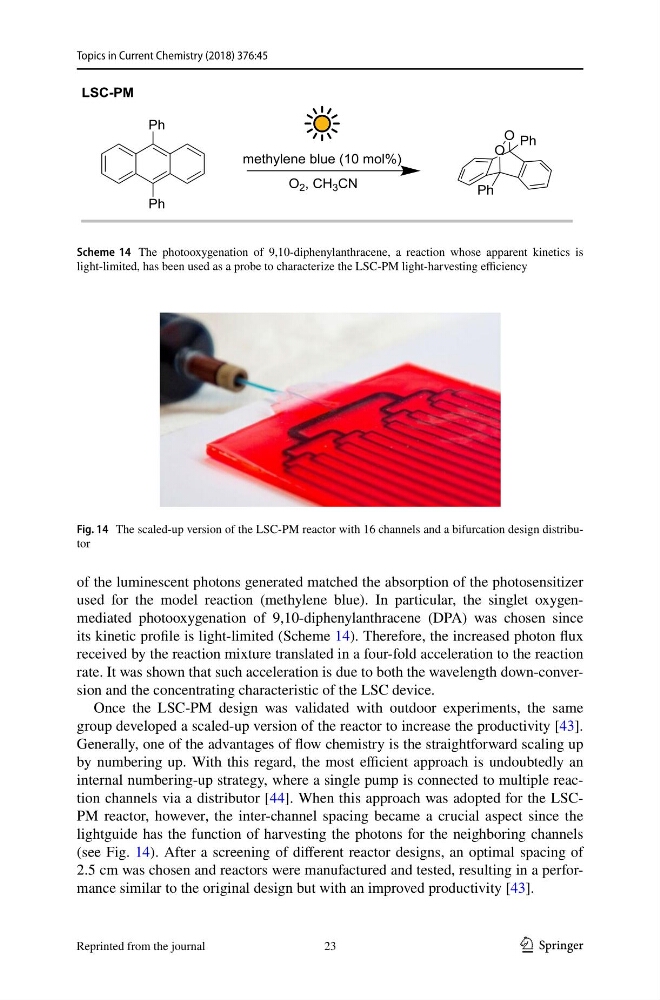
internal numbering-up strategy, where a single pump is connected to multiple reaction channels via a distributor [44]. When this approach was adopted for the LSCPM reactor, however, the inter-channel spacing became a crucial aspect since the
lightguide has the function of harvesting the photons for the neighboring channels
(see Fig. 14). After a screening of different reactor designs, an optimal spacing of
2.5 cm was chosen and reactors were manufactured and tested, resulting in a performance similar to the original design but with an improved productivity [43].
Scheme 14 The photooxygenation of 9,10-diphenylanthracene, a reaction whose apparent kinetics is
light-limited, has been used as a probe to characterize the LSC-PM light-harvesting efficiency
Fig. 14 The scaled-up version of the LSC-PM reactor with 16 channels and a bifurcation design distributor
23
Reprinted from the journal
Topics in Current Chemistry (2018) 376:45
of the luminescent photons generated matched the absorption of the photosensitizer
used for the model reaction (methylene blue). In particular, the singlet oxygenmediated photooxygenation of 9,10-diphenylanthracene (DPA) was chosen since
its kinetic profile is light-limited (Scheme 14). Therefore, the increased photon flux
received by the reaction mixture translated in a four-fold acceleration to the reaction
rate. It was shown that such acceleration is due to both the wavelength down-conversion and the concentrating characteristic of the LSC device.
Once the LSC-PM design was validated with outdoor experiments, the same
group developed a scaled-up version of the reactor to increase the productivity [43].
Generally, one of the advantages of flow chemistry is the straightforward scaling up
by numbering up. With this regard, the most efficient approach is undoubtedly an
internal numbering-up strategy, where a single pump is connected to multiple reaction channels via a distributor [44]. When this approach was adopted for the LSCPM reactor, however, the inter-channel spacing became a crucial aspect since the
lightguide has the function of harvesting the photons for the neighboring channels
(see Fig. 14). After a screening of different reactor designs, an optimal spacing of
2.5 cm was chosen and reactors were manufactured and tested, resulting in a performance similar to the original design but with an improved productivity [43].
Scheme 14 The photooxygenation of 9,10-diphenylanthracene, a reaction whose apparent kinetics is
light-limited, has been used as a probe to characterize the LSC-PM light-harvesting efficiency
Fig. 14 The scaled-up version of the LSC-PM reactor with 16 channels and a bifurcation design distributor
23
Reprinted from the journal