

Topics in Current Chemistry (2018) 376:45
1 3
designed is based on an existing solar concentration technology, the luminescent
solar concentrator (LSC) concept, embedded with a continuous-flow microreactor
(see Fig. 12).
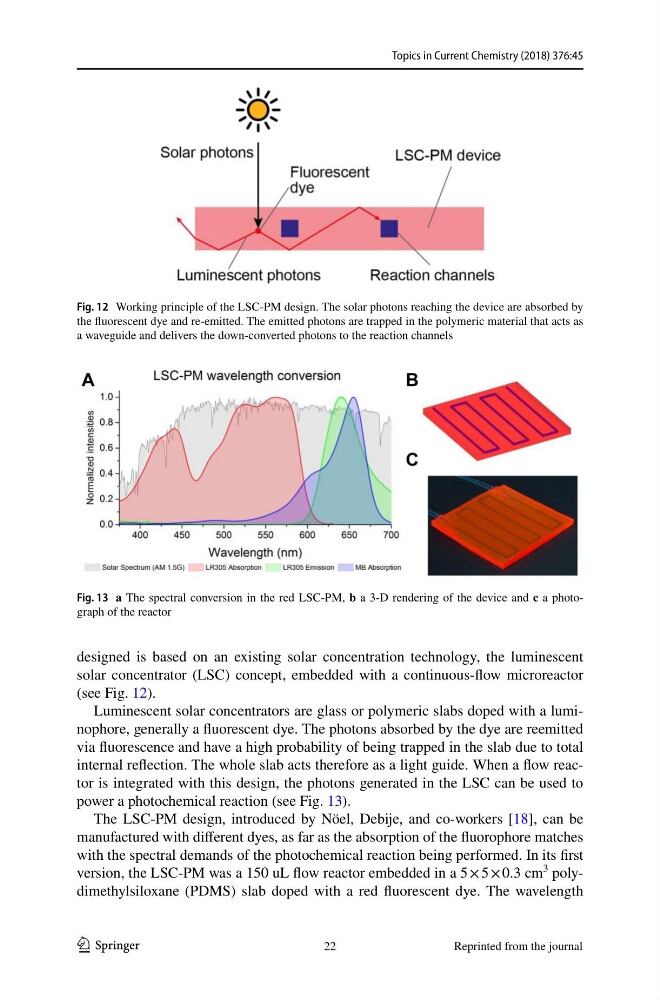
Luminescent solar concentrators are glass or polymeric slabs doped with a luminophore, generally a fluorescent dye. The photons absorbed by the dye are reemitted
via fluorescence and have a high probability of being trapped in the slab due to total
internal reflection. The whole slab acts therefore as a light guide. When a flow reactor is integrated with this design, the photons generated in the LSC can be used to
power a photochemical reaction (see Fig. 13).
The LSC-PM design, introduced by Nöel, Debije, and co-workers [18], can be
manufactured with different dyes, as far as the absorption of the fluorophore matches
with the spectral demands of the photochemical reaction being performed. In its first
version, the LSC-PM was a 150 uL flow reactor embedded in a 5 × 5 × 0.3 cm
3
polydimethylsiloxane (PDMS) slab doped with a red fluorescent dye. The wavelength
Fig. 12 Working principle of the LSC-PM design. The solar photons reaching the device are absorbed by
the fluorescent dye and re-emitted. The emitted photons are trapped in the polymeric material that acts as
a waveguide and delivers the down-converted photons to the reaction channels
Fig. 13 a The spectral conversion in the red LSC-PM, b a 3-D rendering of the device and c a photograph of the reactor
22
Reprinted from the journal
1 3
designed is based on an existing solar concentration technology, the luminescent
solar concentrator (LSC) concept, embedded with a continuous-flow microreactor
(see Fig. 12).
Luminescent solar concentrators are glass or polymeric slabs doped with a luminophore, generally a fluorescent dye. The photons absorbed by the dye are reemitted
via fluorescence and have a high probability of being trapped in the slab due to total
internal reflection. The whole slab acts therefore as a light guide. When a flow reactor is integrated with this design, the photons generated in the LSC can be used to
power a photochemical reaction (see Fig. 13).
The LSC-PM design, introduced by Nöel, Debije, and co-workers [18], can be
manufactured with different dyes, as far as the absorption of the fluorophore matches
with the spectral demands of the photochemical reaction being performed. In its first
version, the LSC-PM was a 150 uL flow reactor embedded in a 5 × 5 × 0.3 cm
3
polydimethylsiloxane (PDMS) slab doped with a red fluorescent dye. The wavelength
Fig. 12 Working principle of the LSC-PM design. The solar photons reaching the device are absorbed by
the fluorescent dye and re-emitted. The emitted photons are trapped in the polymeric material that acts as
a waveguide and delivers the down-converted photons to the reaction channels
Fig. 13 a The spectral conversion in the red LSC-PM, b a 3-D rendering of the device and c a photograph of the reactor
22
Reprinted from the journal