

1 3
Topics in Current Chemistry (2018) 376:45
than the photooxygenation of citronellol performed in the PROPHIS reported in the
same article, partly due to the lower reactivity of the substrate with singlet oxygen
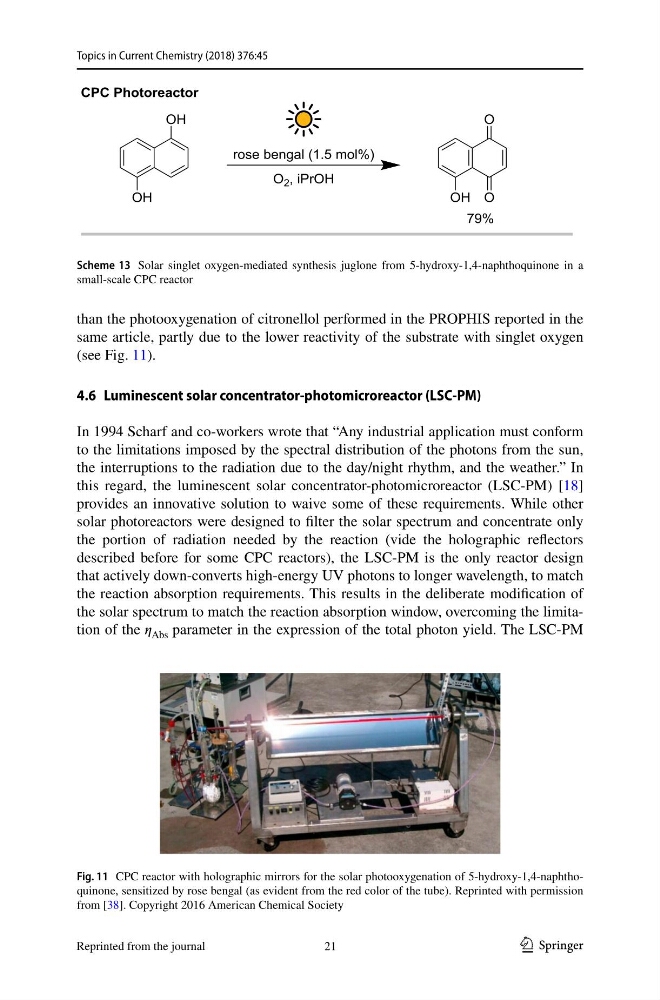
(see Fig. 11).
4.6 Luminescent solar concentrator‑photomicroreactor (LSC‑PM)
In 1994 Scharf and co-workers wrote that “Any industrial application must conform
to the limitations imposed by the spectral distribution of the photons from the sun,
the interruptions to the radiation due to the day/night rhythm, and the weather.” In
this regard, the luminescent solar concentrator-photomicroreactor (LSC-PM) [18]
provides an innovative solution to waive some of these requirements. While other
solar photoreactors were designed to filter the solar spectrum and concentrate only
the portion of radiation needed by the reaction (vide the holographic reflectors
described before for some CPC reactors), the LSC-PM is the only reactor design
that actively down-converts high-energy UV photons to longer wavelength, to match
the reaction absorption requirements. This results in the deliberate modification of
the solar spectrum to match the reaction absorption window, overcoming the limitation of the Abs parameter in the expression of the total photon yield. The LSC-PM
Scheme 13 Solar singlet oxygen-mediated synthesis juglone from 5-hydroxy-1,4-naphthoquinone in a
small-scale CPC reactor
Fig. 11 CPC reactor with holographic mirrors for the solar photooxygenation of 5-hydroxy-1,4-naphthoquinone, sensitized by rose bengal (as evident from the red color of the tube). Reprinted with permission
from [38]. Copyright 2016 American Chemical Society
21
Reprinted from the journal
Topics in Current Chemistry (2018) 376:45
than the photooxygenation of citronellol performed in the PROPHIS reported in the
same article, partly due to the lower reactivity of the substrate with singlet oxygen
(see Fig. 11).
4.6 Luminescent solar concentrator‑photomicroreactor (LSC‑PM)
In 1994 Scharf and co-workers wrote that “Any industrial application must conform
to the limitations imposed by the spectral distribution of the photons from the sun,
the interruptions to the radiation due to the day/night rhythm, and the weather.” In
this regard, the luminescent solar concentrator-photomicroreactor (LSC-PM) [18]
provides an innovative solution to waive some of these requirements. While other
solar photoreactors were designed to filter the solar spectrum and concentrate only
the portion of radiation needed by the reaction (vide the holographic reflectors
described before for some CPC reactors), the LSC-PM is the only reactor design
that actively down-converts high-energy UV photons to longer wavelength, to match
the reaction absorption requirements. This results in the deliberate modification of
the solar spectrum to match the reaction absorption window, overcoming the limitation of the Abs parameter in the expression of the total photon yield. The LSC-PM
Scheme 13 Solar singlet oxygen-mediated synthesis juglone from 5-hydroxy-1,4-naphthoquinone in a
small-scale CPC reactor
Fig. 11 CPC reactor with holographic mirrors for the solar photooxygenation of 5-hydroxy-1,4-naphthoquinone, sensitized by rose bengal (as evident from the red color of the tube). Reprinted with permission
from [38]. Copyright 2016 American Chemical Society
21
Reprinted from the journal