

Topics in Current Chemistry (2018) 376:45
1 3
The sunflow reactor has also been applied by the same authors to the arylation of
isonitriles and heteroaromatic substrates via photolysis of azosulfones [39].
A similar approach to flow solar photochemistry was reported by Kim et al. for
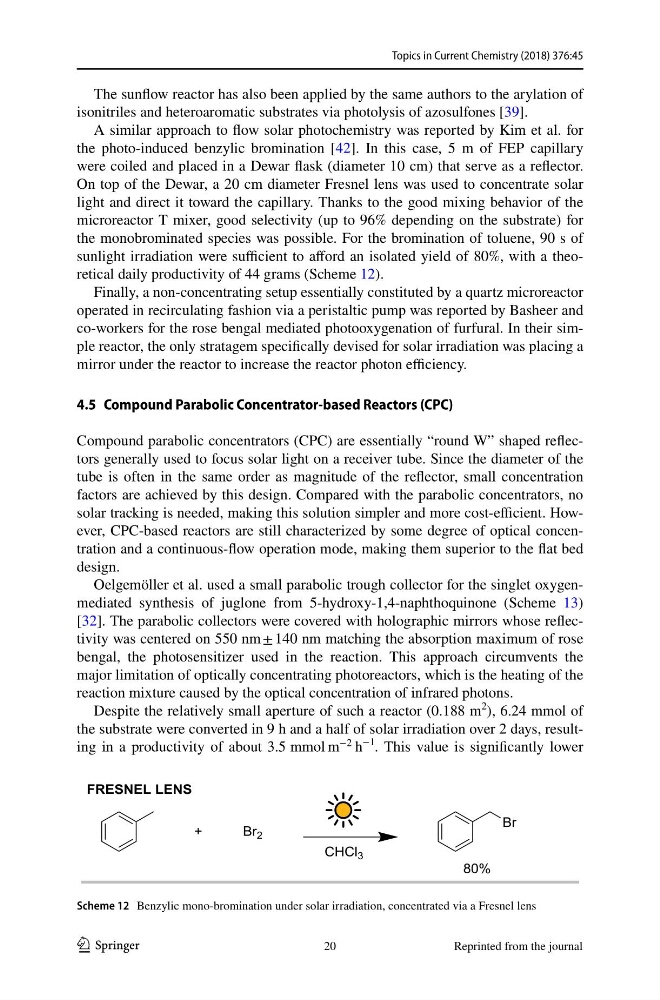
the photo-induced benzylic bromination [42]. In this case, 5 m of FEP capillary
were coiled and placed in a Dewar flask (diameter 10 cm) that serve as a reflector.
On top of the Dewar, a 20 cm diameter Fresnel lens was used to concentrate solar
light and direct it toward the capillary. Thanks to the good mixing behavior of the
microreactor T mixer, good selectivity (up to 96% depending on the substrate) for
the monobrominated species was possible. For the bromination of toluene, 90 s of
sunlight irradiation were sufficient to afford an isolated yield of 80%, with a theoretical daily productivity of 44 grams (Scheme 12).
Finally, a non-concentrating setup essentially constituted by a quartz microreactor
operated in recirculating fashion via a peristaltic pump was reported by Basheer and
co-workers for the rose bengal mediated photooxygenation of furfural. In their simple reactor, the only stratagem specifically devised for solar irradiation was placing a
mirror under the reactor to increase the reactor photon efficiency.
4.5 Compound Parabolic Concentrator‑based Reactors (CPC)
Compound parabolic concentrators (CPC) are essentially “round W” shaped reflectors generally used to focus solar light on a receiver tube. Since the diameter of the
tube is often in the same order as magnitude of the reflector, small concentration
factors are achieved by this design. Compared with the parabolic concentrators, no
solar tracking is needed, making this solution simpler and more cost-efficient. However, CPC-based reactors are still characterized by some degree of optical concentration and a continuous-flow operation mode, making them superior to the flat bed
design.
Oelgemöller et al. used a small parabolic trough collector for the singlet oxygenmediated synthesis of juglone from 5-hydroxy-1,4-naphthoquinone (Scheme 13)
[32]. The parabolic collectors were covered with holographic mirrors whose reflectivity was centered on 550 nm ± 140 nm matching the absorption maximum of rose
bengal, the photosensitizer used in the reaction. This approach circumvents the
major limitation of optically concentrating photoreactors, which is the heating of the
reaction mixture caused by the optical concentration of infrared photons.
Despite the relatively small aperture of such a reactor (0.188 m
2
), 6.24 mmol of
the substrate were converted in 9 h and a half of solar irradiation over 2 days, resulting in a productivity of about 3.5 mmol m
−2 h
−1
. This value is significantly lower
Scheme 12 Benzylic mono-bromination under solar irradiation, concentrated via a Fresnel lens
20
Reprinted from the journal
1 3
The sunflow reactor has also been applied by the same authors to the arylation of
isonitriles and heteroaromatic substrates via photolysis of azosulfones [39].
A similar approach to flow solar photochemistry was reported by Kim et al. for
the photo-induced benzylic bromination [42]. In this case, 5 m of FEP capillary
were coiled and placed in a Dewar flask (diameter 10 cm) that serve as a reflector.
On top of the Dewar, a 20 cm diameter Fresnel lens was used to concentrate solar
light and direct it toward the capillary. Thanks to the good mixing behavior of the
microreactor T mixer, good selectivity (up to 96% depending on the substrate) for
the monobrominated species was possible. For the bromination of toluene, 90 s of
sunlight irradiation were sufficient to afford an isolated yield of 80%, with a theoretical daily productivity of 44 grams (Scheme 12).
Finally, a non-concentrating setup essentially constituted by a quartz microreactor
operated in recirculating fashion via a peristaltic pump was reported by Basheer and
co-workers for the rose bengal mediated photooxygenation of furfural. In their simple reactor, the only stratagem specifically devised for solar irradiation was placing a
mirror under the reactor to increase the reactor photon efficiency.
4.5 Compound Parabolic Concentrator‑based Reactors (CPC)
Compound parabolic concentrators (CPC) are essentially “round W” shaped reflectors generally used to focus solar light on a receiver tube. Since the diameter of the
tube is often in the same order as magnitude of the reflector, small concentration
factors are achieved by this design. Compared with the parabolic concentrators, no
solar tracking is needed, making this solution simpler and more cost-efficient. However, CPC-based reactors are still characterized by some degree of optical concentration and a continuous-flow operation mode, making them superior to the flat bed
design.
Oelgemöller et al. used a small parabolic trough collector for the singlet oxygenmediated synthesis of juglone from 5-hydroxy-1,4-naphthoquinone (Scheme 13)
[32]. The parabolic collectors were covered with holographic mirrors whose reflectivity was centered on 550 nm ± 140 nm matching the absorption maximum of rose
bengal, the photosensitizer used in the reaction. This approach circumvents the
major limitation of optically concentrating photoreactors, which is the heating of the
reaction mixture caused by the optical concentration of infrared photons.
Despite the relatively small aperture of such a reactor (0.188 m
2
), 6.24 mmol of
the substrate were converted in 9 h and a half of solar irradiation over 2 days, resulting in a productivity of about 3.5 mmol m
−2 h
−1
. This value is significantly lower
Scheme 12 Benzylic mono-bromination under solar irradiation, concentrated via a Fresnel lens
20
Reprinted from the journal