

1 3
Topics in Current Chemistry (2018) 376:45
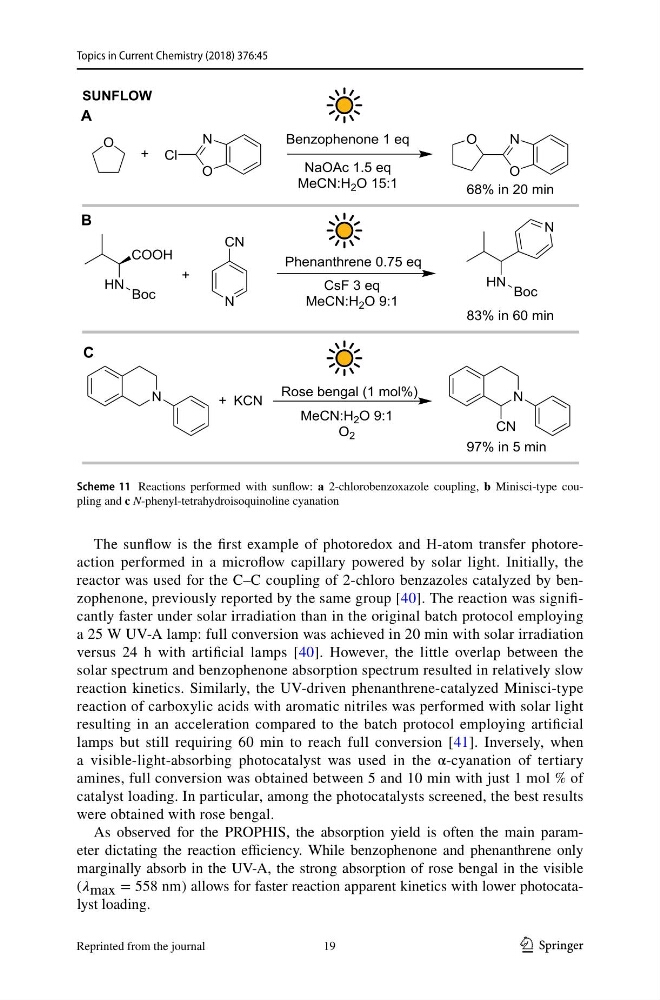
The sunflow is the first example of photoredox and H-atom transfer photoreaction performed in a microflow capillary powered by solar light. Initially, the
reactor was used for the C–C coupling of 2-chloro benzazoles catalyzed by benzophenone, previously reported by the same group [40]. The reaction was significantly faster under solar irradiation than in the original batch protocol employing
a 25 W UV-A lamp: full conversion was achieved in 20 min with solar irradiation
versus 24 h with artificial lamps [40]. However, the little overlap between the
solar spectrum and benzophenone absorption spectrum resulted in relatively slow
reaction kinetics. Similarly, the UV-driven phenanthrene-catalyzed Minisci-type
reaction of carboxylic acids with aromatic nitriles was performed with solar light
resulting in an acceleration compared to the batch protocol employing artificial
lamps but still requiring 60 min to reach full conversion [41]. Inversely, when
a visible-light-absorbing photocatalyst was used in the α-cyanation of tertiary
amines, full conversion was obtained between 5 and 10 min with just 1 mol % of
catalyst loading. In particular, among the photocatalysts screened, the best results
were obtained with rose bengal.
As observed for the PROPHIS, the absorption yield is often the main parameter dictating the reaction efficiency. While benzophenone and phenanthrene only
marginally absorb in the UV-A, the strong absorption of rose bengal in the visible
( max = 558 nm ) allows for faster reaction apparent kinetics with lower photocatalyst loading.
A
B
C
Scheme 11 Reactions performed with sunflow: a 2-chlorobenzoxazole coupling, b Minisci-type coupling and c N-phenyl-tetrahydroisoquinoline cyanation
19
Reprinted from the journal
Topics in Current Chemistry (2018) 376:45
The sunflow is the first example of photoredox and H-atom transfer photoreaction performed in a microflow capillary powered by solar light. Initially, the
reactor was used for the C–C coupling of 2-chloro benzazoles catalyzed by benzophenone, previously reported by the same group [40]. The reaction was significantly faster under solar irradiation than in the original batch protocol employing
a 25 W UV-A lamp: full conversion was achieved in 20 min with solar irradiation
versus 24 h with artificial lamps [40]. However, the little overlap between the
solar spectrum and benzophenone absorption spectrum resulted in relatively slow
reaction kinetics. Similarly, the UV-driven phenanthrene-catalyzed Minisci-type
reaction of carboxylic acids with aromatic nitriles was performed with solar light
resulting in an acceleration compared to the batch protocol employing artificial
lamps but still requiring 60 min to reach full conversion [41]. Inversely, when
a visible-light-absorbing photocatalyst was used in the α-cyanation of tertiary
amines, full conversion was obtained between 5 and 10 min with just 1 mol % of
catalyst loading. In particular, among the photocatalysts screened, the best results
were obtained with rose bengal.
As observed for the PROPHIS, the absorption yield is often the main parameter dictating the reaction efficiency. While benzophenone and phenanthrene only
marginally absorb in the UV-A, the strong absorption of rose bengal in the visible
( max = 558 nm ) allows for faster reaction apparent kinetics with lower photocatalyst loading.
A
B
C
Scheme 11 Reactions performed with sunflow: a 2-chlorobenzoxazole coupling, b Minisci-type coupling and c N-phenyl-tetrahydroisoquinoline cyanation
19
Reprinted from the journal