

Topics in Current Chemistry (2018) 376:45
1 3
to their ability to efficiently collect the diffuse component of solar irradiance [36,
37].
4.4 Sunflow and Similar Design
Recently, Opatz and co-workers reported a novel reactor for solar photoredox and
H-atom transfer chemistry named “sunflow” [20]. Compared to the reactors previously described, the sunflow is simpler as it does not include any type of solar concentration. Furthermore, realizing the importance of a narrow residence time distribution to optimize the reaction time and prevent over-irradiation, the recirculating
closed-loop design was replaced with a more efficient single-pass. The reactor is
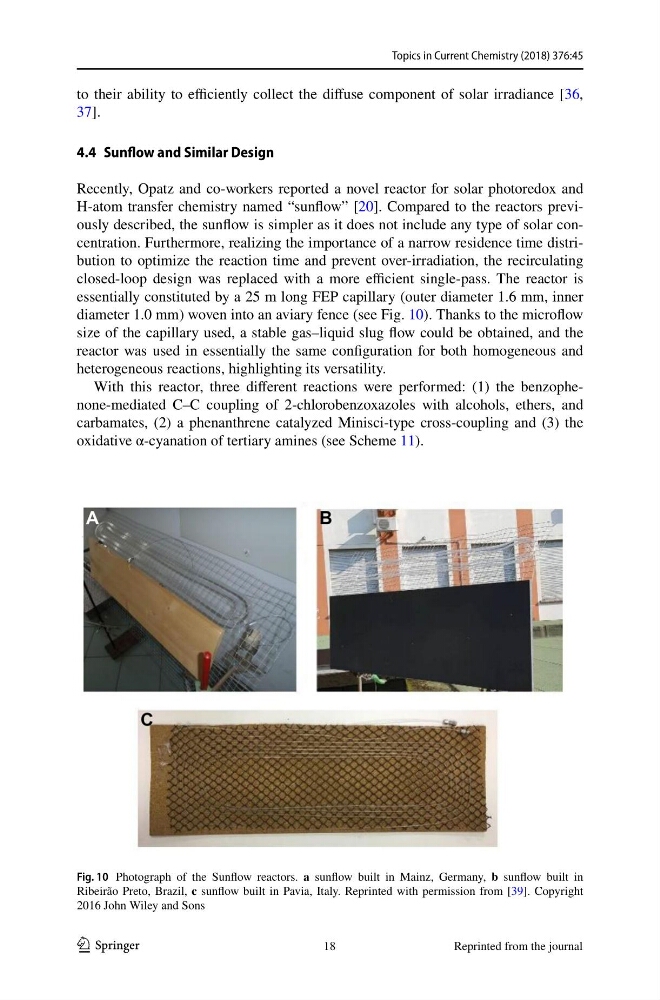
essentially constituted by a 25 m long FEP capillary (outer diameter 1.6 mm, inner
diameter 1.0 mm) woven into an aviary fence (see Fig. 10). Thanks to the microflow
size of the capillary used, a stable gas–liquid slug flow could be obtained, and the
reactor was used in essentially the same configuration for both homogeneous and
heterogeneous reactions, highlighting its versatility.
With this reactor, three different reactions were performed: (1) the benzophenone-mediated C–C coupling of 2-chlorobenzoxazoles with alcohols, ethers, and
carbamates, (2) a phenanthrene catalyzed Minisci-type cross-coupling and (3) the
oxidative α-cyanation of tertiary amines (see Scheme 11).
Fig. 10 Photograph of the Sunflow reactors. a sunflow built in Mainz, Germany, b sunflow built in
Ribeirão Preto, Brazil, c sunflow built in Pavia, Italy. Reprinted with permission from [39]. Copyright
2016 John Wiley and Sons
18
Reprinted from the journal
1 3
to their ability to efficiently collect the diffuse component of solar irradiance [36,
37].
4.4 Sunflow and Similar Design
Recently, Opatz and co-workers reported a novel reactor for solar photoredox and
H-atom transfer chemistry named “sunflow” [20]. Compared to the reactors previously described, the sunflow is simpler as it does not include any type of solar concentration. Furthermore, realizing the importance of a narrow residence time distribution to optimize the reaction time and prevent over-irradiation, the recirculating
closed-loop design was replaced with a more efficient single-pass. The reactor is
essentially constituted by a 25 m long FEP capillary (outer diameter 1.6 mm, inner
diameter 1.0 mm) woven into an aviary fence (see Fig. 10). Thanks to the microflow
size of the capillary used, a stable gas–liquid slug flow could be obtained, and the
reactor was used in essentially the same configuration for both homogeneous and
heterogeneous reactions, highlighting its versatility.
With this reactor, three different reactions were performed: (1) the benzophenone-mediated C–C coupling of 2-chlorobenzoxazoles with alcohols, ethers, and
carbamates, (2) a phenanthrene catalyzed Minisci-type cross-coupling and (3) the
oxidative α-cyanation of tertiary amines (see Scheme 11).
Fig. 10 Photograph of the Sunflow reactors. a sunflow built in Mainz, Germany, b sunflow built in
Ribeirão Preto, Brazil, c sunflow built in Pavia, Italy. Reprinted with permission from [39]. Copyright
2016 John Wiley and Sons
18
Reprinted from the journal