

1 3
Topics in Current Chemistry (2018) 376:45
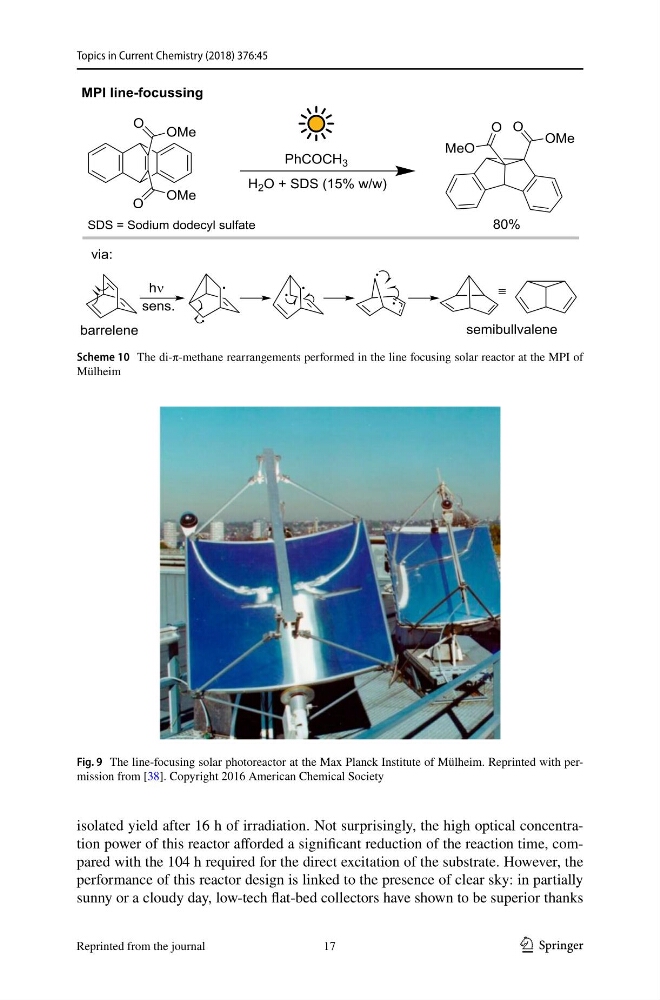
isolated yield after 16 h of irradiation. Not surprisingly, the high optical concentration power of this reactor afforded a significant reduction of the reaction time, compared with the 104 h required for the direct excitation of the substrate. However, the
performance of this reactor design is linked to the presence of clear sky: in partially
sunny or a cloudy day, low-tech flat-bed collectors have shown to be superior thanks
Scheme 10 The di-π-methane rearrangements performed in the line focusing solar reactor at the MPI of
Mülheim
Fig. 9 The line-focusing solar photoreactor at the Max Planck Institute of Mülheim. Reprinted with permission from [38]. Copyright 2016 American Chemical Society
17
Reprinted from the journal
Topics in Current Chemistry (2018) 376:45
isolated yield after 16 h of irradiation. Not surprisingly, the high optical concentration power of this reactor afforded a significant reduction of the reaction time, compared with the 104 h required for the direct excitation of the substrate. However, the
performance of this reactor design is linked to the presence of clear sky: in partially
sunny or a cloudy day, low-tech flat-bed collectors have shown to be superior thanks
Scheme 10 The di-π-methane rearrangements performed in the line focusing solar reactor at the MPI of
Mülheim
Fig. 9 The line-focusing solar photoreactor at the Max Planck Institute of Mülheim. Reprinted with permission from [38]. Copyright 2016 American Chemical Society
17
Reprinted from the journal