

Topics in Current Chemistry (2018) 376:45
1 3
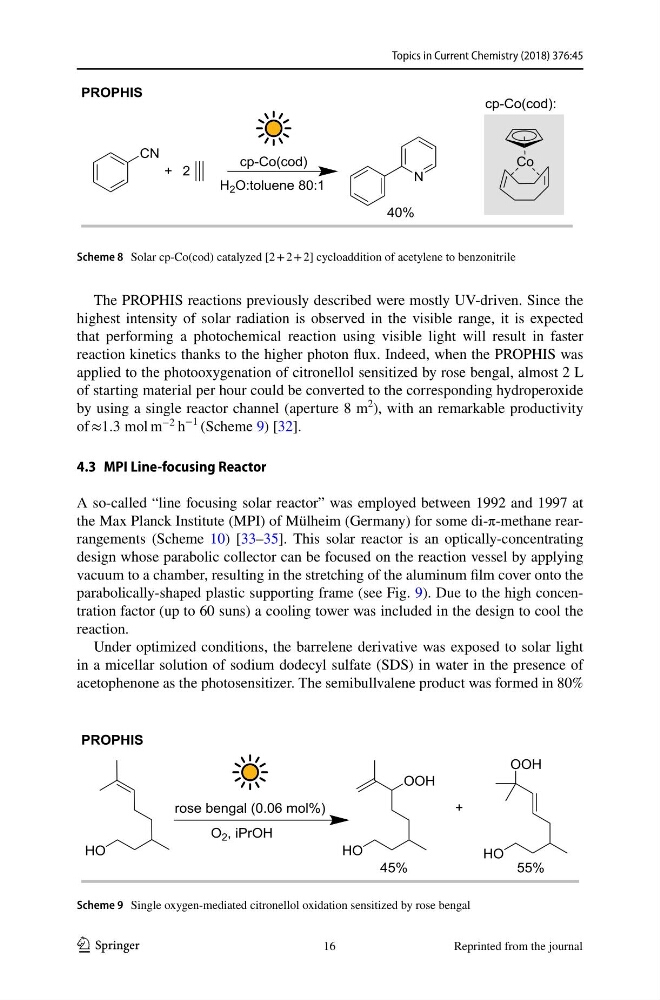
The PROPHIS reactions previously described were mostly UV-driven. Since the
highest intensity of solar radiation is observed in the visible range, it is expected
that performing a photochemical reaction using visible light will result in faster
reaction kinetics thanks to the higher photon flux. Indeed, when the PROPHIS was
applied to the photooxygenation of citronellol sensitized by rose bengal, almost 2 L
of starting material per hour could be converted to the corresponding hydroperoxide
by using a single reactor channel (aperture 8 m
2
), with an remarkable productivity
of ≈ 1.3 mol m
−2 h
−1
(Scheme 9) [32].
4.3 MPI Line‑focusing Reactor
A so-called “line focusing solar reactor” was employed between 1992 and 1997 at
the Max Planck Institute (MPI) of Mülheim (Germany) for some di-π-methane rearrangements (Scheme 10) [33–35]. This solar reactor is an optically-concentrating
design whose parabolic collector can be focused on the reaction vessel by applying
vacuum to a chamber, resulting in the stretching of the aluminum film cover onto the
parabolically-shaped plastic supporting frame (see Fig. 9). Due to the high concentration factor (up to 60 suns) a cooling tower was included in the design to cool the
reaction.
Under optimized conditions, the barrelene derivative was exposed to solar light
in a micellar solution of sodium dodecyl sulfate (SDS) in water in the presence of
acetophenone as the photosensitizer. The semibullvalene product was formed in 80%
Scheme 8 Solar cp-Co(cod) catalyzed [2 + 2 + 2] cycloaddition of acetylene to benzonitrile
Scheme 9 Single oxygen-mediated citronellol oxidation sensitized by rose bengal
16
Reprinted from the journal
1 3
The PROPHIS reactions previously described were mostly UV-driven. Since the
highest intensity of solar radiation is observed in the visible range, it is expected
that performing a photochemical reaction using visible light will result in faster
reaction kinetics thanks to the higher photon flux. Indeed, when the PROPHIS was
applied to the photooxygenation of citronellol sensitized by rose bengal, almost 2 L
of starting material per hour could be converted to the corresponding hydroperoxide
by using a single reactor channel (aperture 8 m
2
), with an remarkable productivity
of ≈ 1.3 mol m
−2 h
−1
(Scheme 9) [32].
4.3 MPI Line‑focusing Reactor
A so-called “line focusing solar reactor” was employed between 1992 and 1997 at
the Max Planck Institute (MPI) of Mülheim (Germany) for some di-π-methane rearrangements (Scheme 10) [33–35]. This solar reactor is an optically-concentrating
design whose parabolic collector can be focused on the reaction vessel by applying
vacuum to a chamber, resulting in the stretching of the aluminum film cover onto the
parabolically-shaped plastic supporting frame (see Fig. 9). Due to the high concentration factor (up to 60 suns) a cooling tower was included in the design to cool the
reaction.
Under optimized conditions, the barrelene derivative was exposed to solar light
in a micellar solution of sodium dodecyl sulfate (SDS) in water in the presence of
acetophenone as the photosensitizer. The semibullvalene product was formed in 80%
Scheme 8 Solar cp-Co(cod) catalyzed [2 + 2 + 2] cycloaddition of acetylene to benzonitrile
Scheme 9 Single oxygen-mediated citronellol oxidation sensitized by rose bengal
16
Reprinted from the journal