

1 3
Topics in Current Chemistry (2018) 376:45
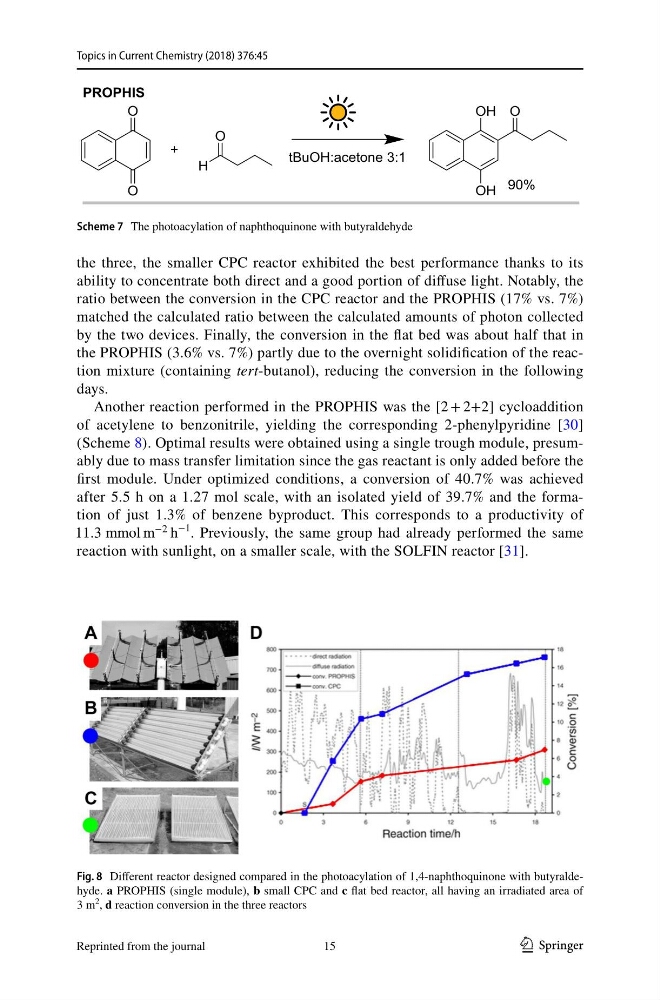
the three, the smaller CPC reactor exhibited the best performance thanks to its
ability to concentrate both direct and a good portion of diffuse light. Notably, the
ratio between the conversion in the CPC reactor and the PROPHIS (17% vs. 7%)
matched the calculated ratio between the calculated amounts of photon collected
by the two devices. Finally, the conversion in the flat bed was about half that in
the PROPHIS (3.6% vs. 7%) partly due to the overnight solidification of the reaction mixture (containing tert-butanol), reducing the conversion in the following
days.
Another reaction performed in the PROPHIS was the [2 + 2+2] cycloaddition
of acetylene to benzonitrile, yielding the corresponding 2-phenylpyridine [30]
(Scheme 8). Optimal results were obtained using a single trough module, presumably due to mass transfer limitation since the gas reactant is only added before the
first module. Under optimized conditions, a conversion of 40.7% was achieved
after 5.5 h on a 1.27 mol scale, with an isolated yield of 39.7% and the formation of just 1.3% of benzene byproduct. This corresponds to a productivity of
11.3 mmol m
−2 h
−1
. Previously, the same group had already performed the same
reaction with sunlight, on a smaller scale, with the SOLFIN reactor [31].
Scheme 7 The photoacylation of naphthoquinone with butyraldehyde
Fig. 8 Different reactor designed compared in the photoacylation of 1,4-naphthoquinone with butyraldehyde. a PROPHIS (single module), b small CPC and c flat bed reactor, all having an irradiated area of
3 m
2
, d reaction conversion in the three reactors
15
Reprinted from the journal
Topics in Current Chemistry (2018) 376:45
the three, the smaller CPC reactor exhibited the best performance thanks to its
ability to concentrate both direct and a good portion of diffuse light. Notably, the
ratio between the conversion in the CPC reactor and the PROPHIS (17% vs. 7%)
matched the calculated ratio between the calculated amounts of photon collected
by the two devices. Finally, the conversion in the flat bed was about half that in
the PROPHIS (3.6% vs. 7%) partly due to the overnight solidification of the reaction mixture (containing tert-butanol), reducing the conversion in the following
days.
Another reaction performed in the PROPHIS was the [2 + 2+2] cycloaddition
of acetylene to benzonitrile, yielding the corresponding 2-phenylpyridine [30]
(Scheme 8). Optimal results were obtained using a single trough module, presumably due to mass transfer limitation since the gas reactant is only added before the
first module. Under optimized conditions, a conversion of 40.7% was achieved
after 5.5 h on a 1.27 mol scale, with an isolated yield of 39.7% and the formation of just 1.3% of benzene byproduct. This corresponds to a productivity of
11.3 mmol m
−2 h
−1
. Previously, the same group had already performed the same
reaction with sunlight, on a smaller scale, with the SOLFIN reactor [31].
Scheme 7 The photoacylation of naphthoquinone with butyraldehyde
Fig. 8 Different reactor designed compared in the photoacylation of 1,4-naphthoquinone with butyraldehyde. a PROPHIS (single module), b small CPC and c flat bed reactor, all having an irradiated area of
3 m
2
, d reaction conversion in the three reactors
15
Reprinted from the journal