

Topics in Current Chemistry (2018) 376:45
1 3
to the photostationary equilibrium (Scheme 6). The productivity, in this case, was
about 70 mmol m
−2 h
−1
.
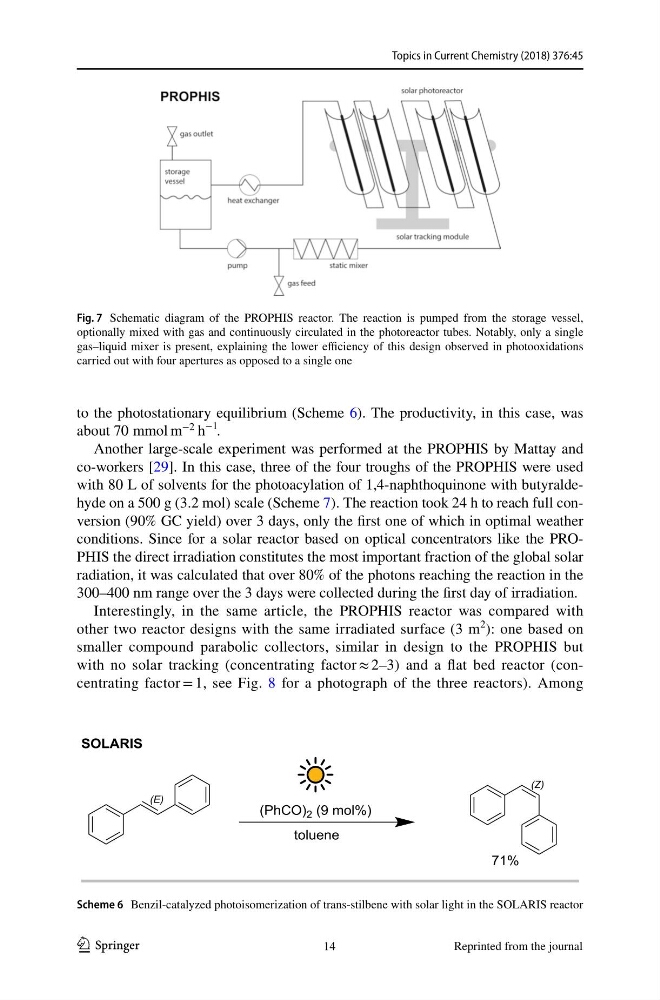
Another large-scale experiment was performed at the PROPHIS by Mattay and
co-workers [29]. In this case, three of the four troughs of the PROPHIS were used
with 80 L of solvents for the photoacylation of 1,4-naphthoquinone with butyraldehyde on a 500 g (3.2 mol) scale (Scheme 7). The reaction took 24 h to reach full conversion (90% GC yield) over 3 days, only the first one of which in optimal weather
conditions. Since for a solar reactor based on optical concentrators like the PROPHIS the direct irradiation constitutes the most important fraction of the global solar
radiation, it was calculated that over 80% of the photons reaching the reaction in the
300–400 nm range over the 3 days were collected during the first day of irradiation.
Interestingly, in the same article, the PROPHIS reactor was compared with
other two reactor designs with the same irradiated surface (3 m
2
): one based on
smaller compound parabolic collectors, similar in design to the PROPHIS but
with no solar tracking (concentrating factor ≈ 2–3) and a flat bed reactor (concentrating factor = 1, see Fig. 8 for a photograph of the three reactors). Among
Fig. 7 Schematic diagram of the PROPHIS reactor. The reaction is pumped from the storage vessel,
optionally mixed with gas and continuously circulated in the photoreactor tubes. Notably, only a single
gas–liquid mixer is present, explaining the lower efficiency of this design observed in photooxidations
carried out with four apertures as opposed to a single one
Scheme 6 Benzil-catalyzed photoisomerization of trans-stilbene with solar light in the SOLARIS reactor
14
Reprinted from the journal
1 3
to the photostationary equilibrium (Scheme 6). The productivity, in this case, was
about 70 mmol m
−2 h
−1
.
Another large-scale experiment was performed at the PROPHIS by Mattay and
co-workers [29]. In this case, three of the four troughs of the PROPHIS were used
with 80 L of solvents for the photoacylation of 1,4-naphthoquinone with butyraldehyde on a 500 g (3.2 mol) scale (Scheme 7). The reaction took 24 h to reach full conversion (90% GC yield) over 3 days, only the first one of which in optimal weather
conditions. Since for a solar reactor based on optical concentrators like the PROPHIS the direct irradiation constitutes the most important fraction of the global solar
radiation, it was calculated that over 80% of the photons reaching the reaction in the
300–400 nm range over the 3 days were collected during the first day of irradiation.
Interestingly, in the same article, the PROPHIS reactor was compared with
other two reactor designs with the same irradiated surface (3 m
2
): one based on
smaller compound parabolic collectors, similar in design to the PROPHIS but
with no solar tracking (concentrating factor ≈ 2–3) and a flat bed reactor (concentrating factor = 1, see Fig. 8 for a photograph of the three reactors). Among
Fig. 7 Schematic diagram of the PROPHIS reactor. The reaction is pumped from the storage vessel,
optionally mixed with gas and continuously circulated in the photoreactor tubes. Notably, only a single
gas–liquid mixer is present, explaining the lower efficiency of this design observed in photooxidations
carried out with four apertures as opposed to a single one
Scheme 6 Benzil-catalyzed photoisomerization of trans-stilbene with solar light in the SOLARIS reactor
14
Reprinted from the journal