

1 3
Topics in Current Chemistry (2018) 376:45
4.2 SOLARIS and PROPHIS
A convincing example of how solar light can be exploited for the photochemical
synthesis of fine chemicals on a large scale is constituted by the SOLARIS (solar
photochemical synthesis of fine chemicals) reactor and its successor PROPHIS (parabolic trough-facility for organic photochemical syntheses), which are essentially
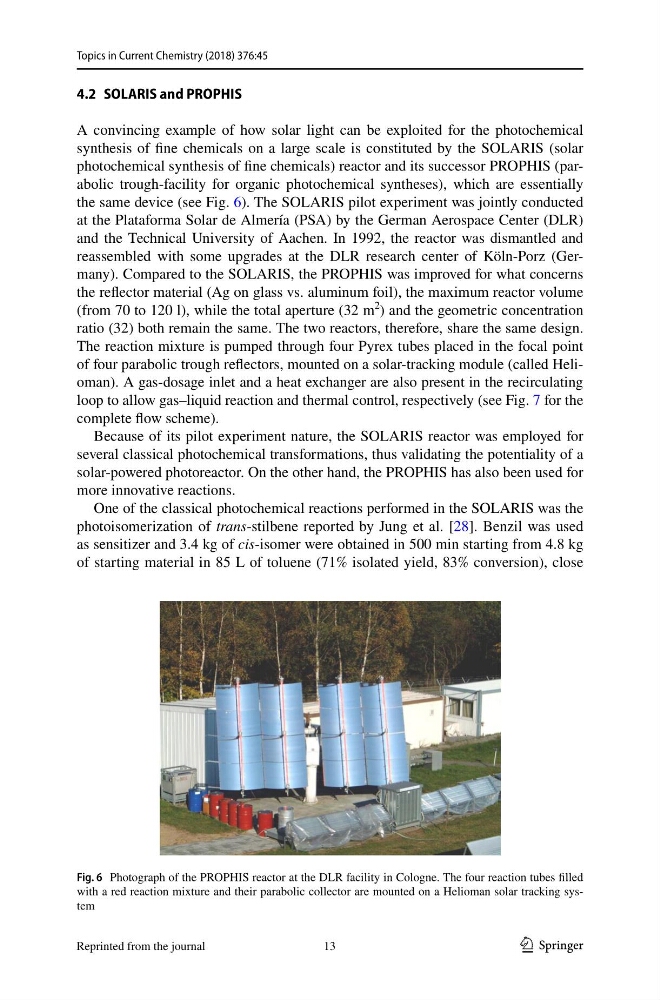
the same device (see Fig. 6). The SOLARIS pilot experiment was jointly conducted
at the Plataforma Solar de Almería (PSA) by the German Aerospace Center (DLR)
and the Technical University of Aachen. In 1992, the reactor was dismantled and
reassembled with some upgrades at the DLR research center of Köln-Porz (Germany). Compared to the SOLARIS, the PROPHIS was improved for what concerns
the reflector material (Ag on glass vs. aluminum foil), the maximum reactor volume
(from 70 to 120 l), while the total aperture (32 m
2
) and the geometric concentration
ratio (32) both remain the same. The two reactors, therefore, share the same design.
The reaction mixture is pumped through four Pyrex tubes placed in the focal point
of four parabolic trough reflectors, mounted on a solar-tracking module (called Helioman). A gas-dosage inlet and a heat exchanger are also present in the recirculating
loop to allow gas–liquid reaction and thermal control, respectively (see Fig. 7 for the
complete flow scheme).
Because of its pilot experiment nature, the SOLARIS reactor was employed for
several classical photochemical transformations, thus validating the potentiality of a
solar-powered photoreactor. On the other hand, the PROPHIS has also been used for
more innovative reactions.
One of the classical photochemical reactions performed in the SOLARIS was the
photoisomerization of trans-stilbene reported by Jung et al. [28]. Benzil was used
as sensitizer and 3.4 kg of cis-isomer were obtained in 500 min starting from 4.8 kg
of starting material in 85 L of toluene (71% isolated yield, 83% conversion), close
Fig. 6 Photograph of the PROPHIS reactor at the DLR facility in Cologne. The four reaction tubes filled
with a red reaction mixture and their parabolic collector are mounted on a Helioman solar tracking system
13
Reprinted from the journal
Topics in Current Chemistry (2018) 376:45
4.2 SOLARIS and PROPHIS
A convincing example of how solar light can be exploited for the photochemical
synthesis of fine chemicals on a large scale is constituted by the SOLARIS (solar
photochemical synthesis of fine chemicals) reactor and its successor PROPHIS (parabolic trough-facility for organic photochemical syntheses), which are essentially
the same device (see Fig. 6). The SOLARIS pilot experiment was jointly conducted
at the Plataforma Solar de Almería (PSA) by the German Aerospace Center (DLR)
and the Technical University of Aachen. In 1992, the reactor was dismantled and
reassembled with some upgrades at the DLR research center of Köln-Porz (Germany). Compared to the SOLARIS, the PROPHIS was improved for what concerns
the reflector material (Ag on glass vs. aluminum foil), the maximum reactor volume
(from 70 to 120 l), while the total aperture (32 m
2
) and the geometric concentration
ratio (32) both remain the same. The two reactors, therefore, share the same design.
The reaction mixture is pumped through four Pyrex tubes placed in the focal point
of four parabolic trough reflectors, mounted on a solar-tracking module (called Helioman). A gas-dosage inlet and a heat exchanger are also present in the recirculating
loop to allow gas–liquid reaction and thermal control, respectively (see Fig. 7 for the
complete flow scheme).
Because of its pilot experiment nature, the SOLARIS reactor was employed for
several classical photochemical transformations, thus validating the potentiality of a
solar-powered photoreactor. On the other hand, the PROPHIS has also been used for
more innovative reactions.
One of the classical photochemical reactions performed in the SOLARIS was the
photoisomerization of trans-stilbene reported by Jung et al. [28]. Benzil was used
as sensitizer and 3.4 kg of cis-isomer were obtained in 500 min starting from 4.8 kg
of starting material in 85 L of toluene (71% isolated yield, 83% conversion), close
Fig. 6 Photograph of the PROPHIS reactor at the DLR facility in Cologne. The four reaction tubes filled
with a red reaction mixture and their parabolic collector are mounted on a Helioman solar tracking system
13
Reprinted from the journal